
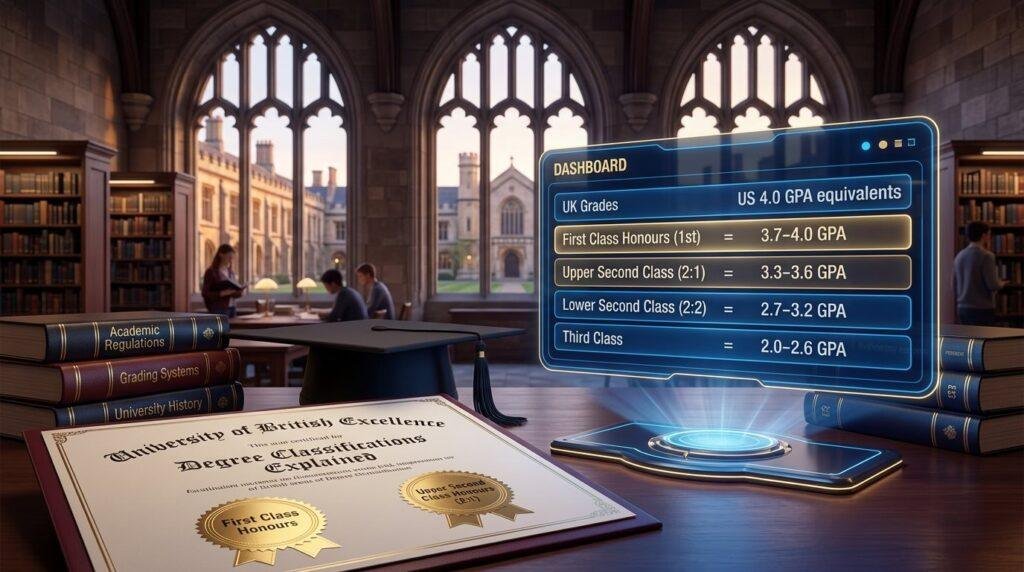
UK Degree Classifications First 21 and 22 Explained: Best 2026 Guide
The uk degree classifications first 21 and 22 explained in this comprehensive guide form the foundation of the British university undergraduate honours grading system. Unlike international universities that evaluate academic performance using a cumulative 4.0 Grade Point Average (GPA), higher education institutions across England, Scotland, Wales, and Northern Ireland categorize undergraduate achievements into distinct honours tiers.
Try it yourself: Use our free Bavarian Formula Grade Converter to run your own numbers in seconds. No sign-up needed.
Understanding every nuance of the uk degree classifications first 21 and 22 explained framework is vital for international applicants, current undergraduates, and prospective job seekers. Your final classification dictates eligibility for elite graduate employment schemes, postgraduate master’s admissions, and international academic credential conversions. This definitive 2026 analysis breaks down historical boundaries, mathematical weighting, international GPA equivalencies, and modern employer expectations.
Table of Contents
1. What Are the UK Degree Classifications First 21 and 22 Explained in Detail?
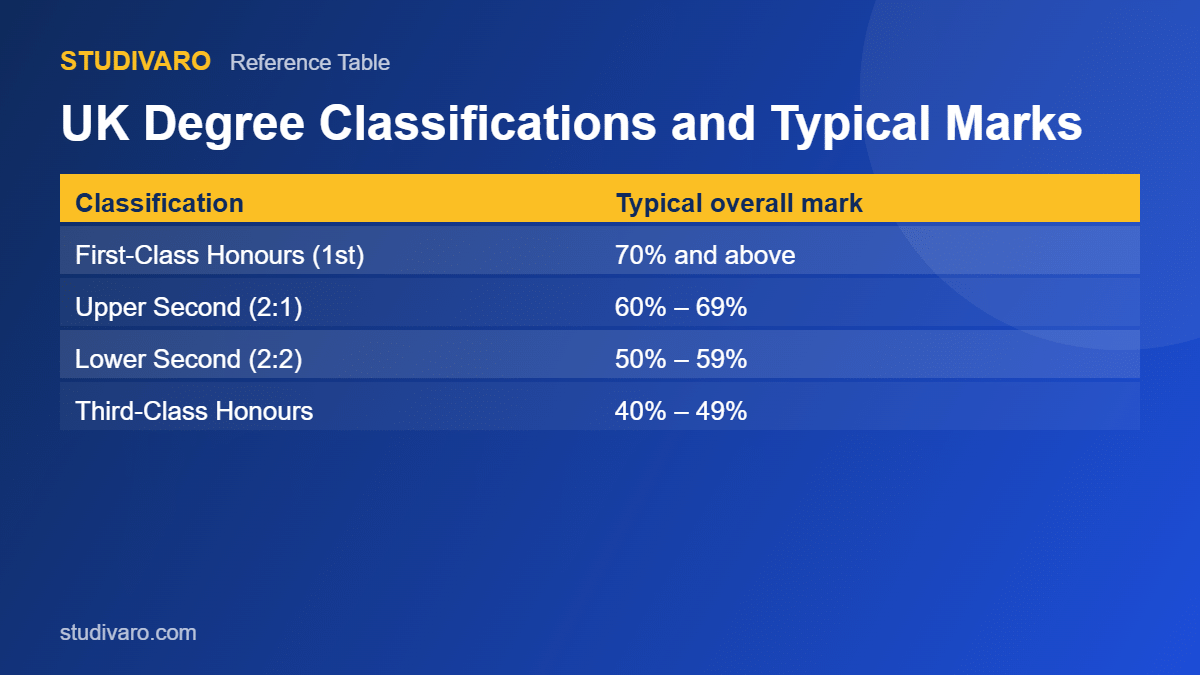
British undergraduate degrees awarded with honours (designated as BA Hons, BSc Hons, or BEng Hons) are evaluated on a strict percentage scale ranging from 0% to 100%. However, individual module percentages are aggregated to produce one of four primary honours classifications.
The four standard classifications are:
- First-Class Honours (1st): Representing the pinnacle of British undergraduate achievement (70% and above).
- Upper Second-Class Honours (2:1): The standard benchmark for top-tier graduate schemes and postgraduate entry (60% to 69%).
- Lower Second-Class Honours (2:2): A respectable degree classification demonstrating solid subject competence (50% to 59%).
- Third-Class Honours (3rd): The minimum standard required to graduate with an honours degree (40% to 49%).
Our complete uk degree classifications first 21 and 22 explained breakdown highlights that UK university marking criteria are deliberately conservative compared to North American curves. Scoring 70% in a British university is exceptionally demanding and reflects academic excellence equivalent to an American 4.0 GPA.
2. First-Class Honours (1st): Criteria, Prestige, and Percentage Boundaries
A First-Class degree—commonly referred to in academic circles as a “First”—is the highest undergraduate accolade awarded by UK higher education providers. Historically awarded to fewer than 15% of graduates, recent higher education expansions see approximately 30% of UK undergraduates achieving this standard.
Core Academic Characteristics of a First (70%+)
Achieving a First requires demonstrating comprehensive independent critical analysis, deep engagement with academic literature, and original synthesis of complex concepts. Examiners look beyond standard lecture syllabus materials.
In STEM fields, a First signifies near-flawless mathematical derivations, rigorous methodology, and comprehensive experimental accuracy. In humanities and social sciences, it reflects sophisticated argumentative structure and scholarly nuance.
Reviewing this uk degree classifications first 21 and 22 explained tier reveals that graduates holding a First receive priority consideration for competitive doctoral (PhD) studentships funded by UK Research and Innovation (UKRI), prestigious civil service fast streams, and leading investment banks.
3. Upper Second-Class Honours (2:1): The Universal Gold Standard
The Upper Second-Class degree—universally spoken as a “Two-One”—is the standard grade achieved by roughly 45% to 50% of British university graduates. It serves as the primary gateway for professional careers in the UK and worldwide.
Why the 2:1 Threshold Matters
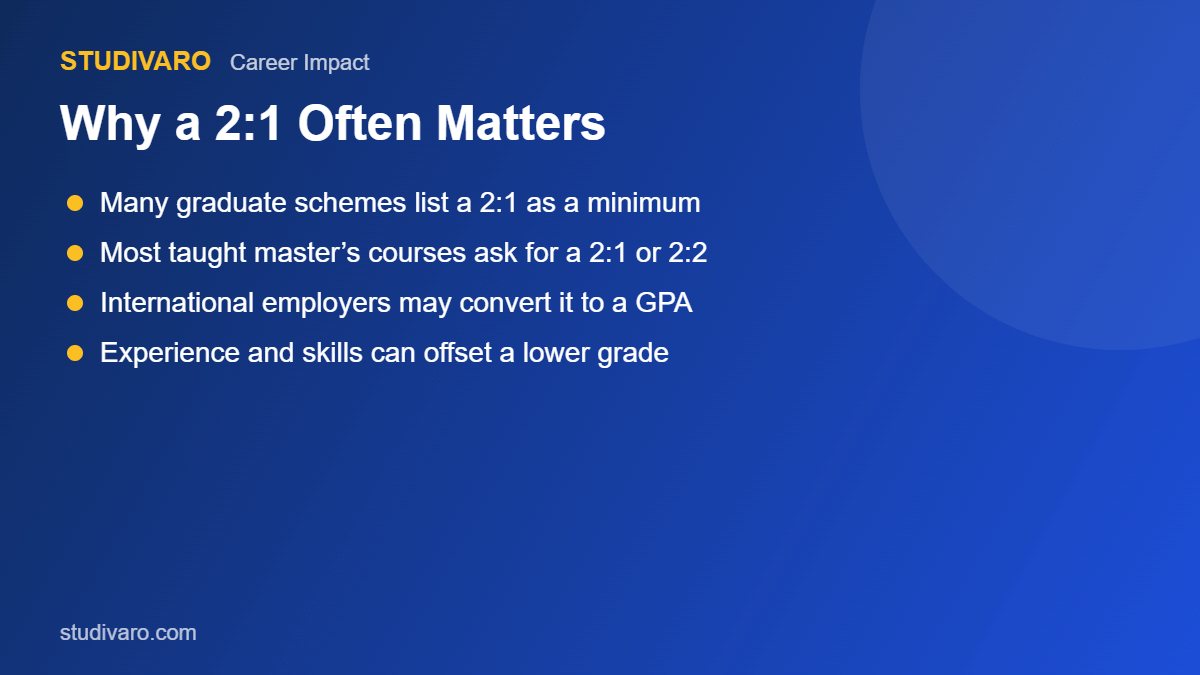
For decades, major multinational corporations, magic circle law firms, and management consultancies have enforced a strict 2:1 minimum screening threshold for their competitive graduate training programs. If an applicant’s degree profile shows a 2:2, automated recruitment software historically eliminated their resume before human review.
Achieving a 2:1 (60% to 69%) proves that you have mastered your discipline, demonstrated consistent analytical competence, and can articulate coherent academic arguments under strict time constraints.
Applying an analytical uk degree classifications first 21 and 22 explained perspective confirms that securing a strong 2:1 (such as 66% to 68%) provides virtually identical commercial employment opportunities as a First in most corporate sectors.
4. Lower Second-Class Honours (2:2): Opportunities and Overcoming Career Barriers
The Lower Second-Class degree—colloquially termed a “Two-Two” or a “Desmond” (rhyming slang for Archbishop Desmond Tutu)—spans the 50% to 59% mark range. It represents roughly 15% to 20% of undergraduate cohorts.
Navigating the Graduate Job Market with a 2:2
While graduating with a 2:2 excludes candidates from select high-finance or commercial law corporate pipelines, the modern employment landscape is shifting rapidly. Leading employers—including accounting giants like PwC, EY, and several UK civil service departments—have abandoned the arbitrary 2:1 degree filter in favor of contextual recruitment, online behavioral assessments, and cognitive evaluations.
Candidates with a 2:2 can readily compensate by highlighting relevant commercial internships, specialized technical certifications, and quantifiable leadership achievements.
Referencing our uk degree classifications first 21 and 22 explained guidance, students holding a 2:2 can also secure admission to respected UK master’s programs by demonstrating relevant professional work experience or exceptional dissertation performance.
5. Third-Class Honours (3rd), Ordinary Passes, and Academic Failures
Undergraduate performance below 50% falls into secondary categories that carry specific academic implications.
- Third-Class Honours (40% to 49%): Commonly called a “Third”, this is the lowest classification that still confers an honours degree. It indicates that the student met foundational learning outcomes but struggled with advanced analytical synthesis.
- Ordinary Degree (Pass without Honours): If a student achieves passing marks in individual modules but fails to accumulate sufficient credits for an honours designation, an Ordinary Degree is awarded.
- Fail (Below 40%): Marks below 40% represent a failure to satisfy course requirements. Students are generally offered an opportunity to resit examinations capped at 40%.
Understanding this comprehensive uk degree classifications first 21 and 22 explained hierarchy prevents undergraduates from underestimating the consequences of failed modular coursework.
6. Master Comparison Table: UK Degree Classifications, GPAs, and Percentages
The following reference matrix outlines the relationship between British degree tiers, international GPA scales, European ECTS credits, and typical cohort distributions:
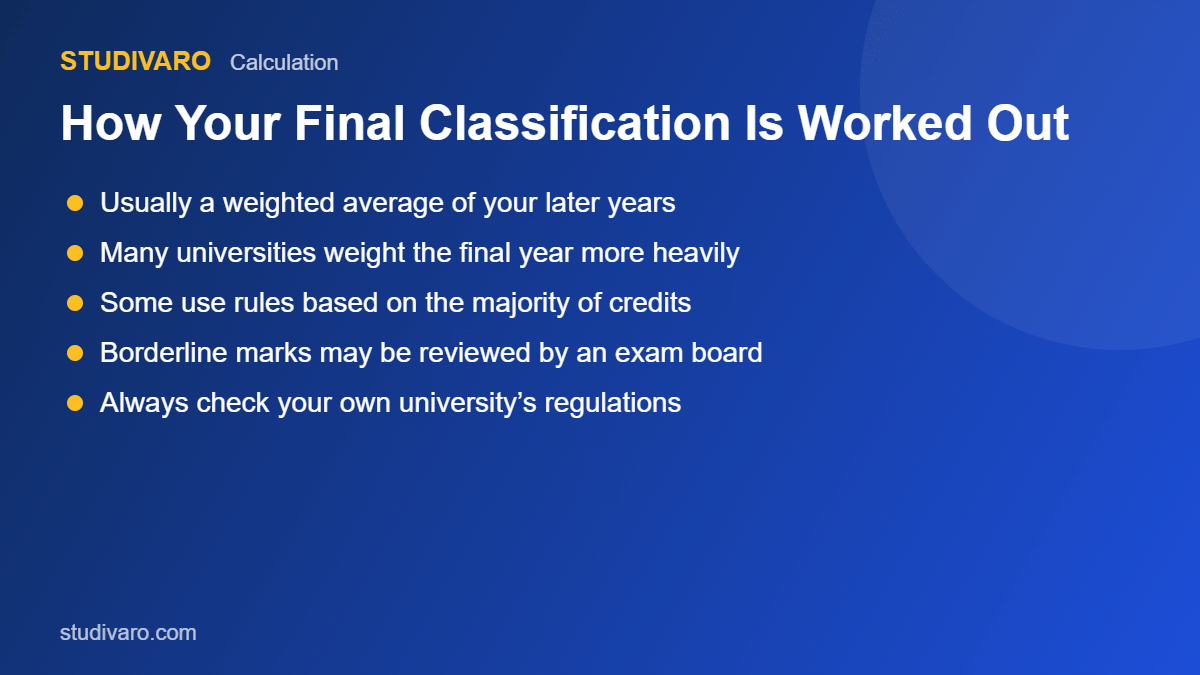
| Classification | Abbreviation | Mark Boundary | US 4.0 GPA Equivalent | Latin Honours Equivalent | ECTS Grade | Typical UK Cohort % |
|---|---|---|---|---|---|---|
| First-Class Honours | 1st | 70% – 100% | 3.70 – 4.00 | Summa / Magna Cum Laude | A | ~30% – 35% |
| Upper Second-Class | 2:1 | 60% – 69% | 3.30 – 3.69 | Cum Laude | B | ~45% – 50% |
| Lower Second-Class | 2:2 | 50% – 59% | 2.70 – 3.29 | Honorable Mention | C | ~15% – 18% |
| Third-Class Honours | 3rd | 40% – 49% | 2.00 – 2.69 | Satisfactory | D / E | ~3% – 5% |
| Ordinary Degree | Pass | 35% – 39% | 1.50 – 1.99 | Unclassified Pass | E | ~1% – 2% |
| Fail | Fail | 0% – 39% | 0.00 – 1.49 | Academic Failure | F | ~1% |
Following this authoritative uk degree classifications first 21 and 22 explained table prevents misunderstandings when converting academic credentials for international corporate recruiters or postgraduate admissions committees.
UK Degree Classifications First 21 and 22 Explained Calculator
Interactive tool for uk degree classifications first 21 and 22 explained to convert percentage marks to US GPA.
7. How UK Universities Calculate Your Final Classification (Degree Weighting)
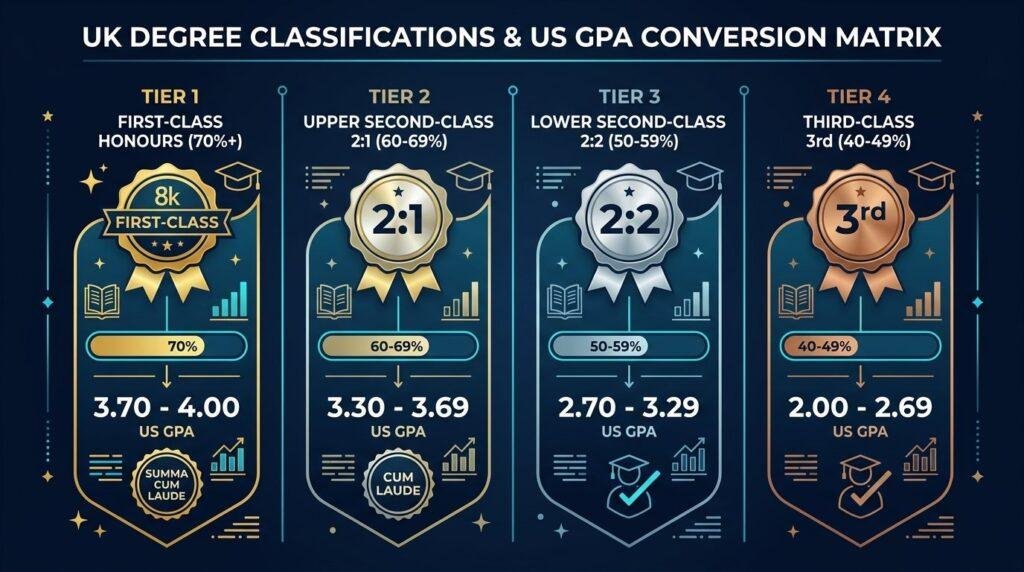
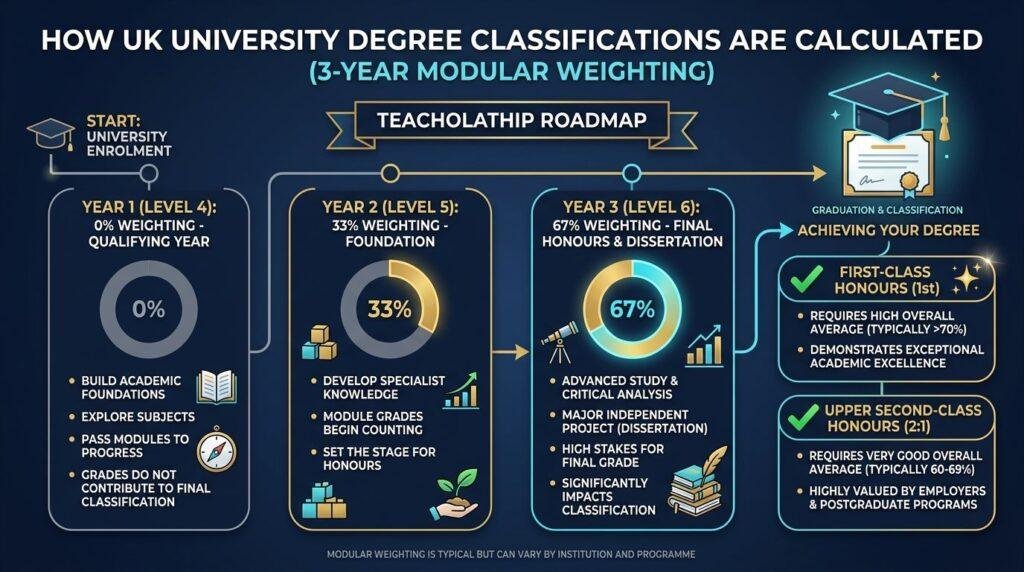
One of the most notable features of the British university degree algorithm is that first-year undergraduate marks generally do not count toward your final degree classification.
In a standard three-year English or Welsh bachelor’s degree:
- Year 1 (Certificate Level / Level 4): Requires achieving passing marks (40%+) to progress, but carries a 0% weight in the final degree calculation.
- Year 2 (Diploma Level / Level 5): Typically weighted between 25% and 33%.
- Year 3 (Honours Level / Level 6): Typically weighted between 67% and 75%, including your independent dissertation or final capstone project.
In four-year Scottish honours degrees, weighting is distributed across Years 3 and 4 (Levels 9 and 10).
Consulting this structured uk degree classifications first 21 and 22 explained methodology reassures first-year students who stumbled during early adjustments that their final honours classification remains entirely unblemished.
8. International Conversions: UK Honours vs. US GPA and Professional Schools
Converting a British degree classification to foreign grading structures requires careful contextual analysis. While a 70% mark sounds mediocre in the United States—where 70% equates to a C-minus—it denotes the absolute highest honors in the United Kingdom.
For British students applying to American law schools or medical institutions, credential evaluators like LSAC and WES perform rigorous credential recalculations. As outlined in our detailed analysis on LSAC 4.33 GPA Recalculation Explained, international transcripts are translated based on institutional prestige and class distribution curves.
Evaluating future earnings and degree debt is equally crucial when funding international education. Prospective students should benchmark their graduate repayment obligations using our Student Loan Monthly Payment Calculator.
Furthermore, you can project your post-graduation earnings against overall debt using our College Major Salary to Debt Ratio Calculator. Finally, maintaining attendance directly protects your degree classification; review our guide on How Much Does a Missed College Lecture Cost to avoid sacrificing valuable percentage marks.
Reviewing a calibrated uk degree classifications first 21 and 22 explained conversion table ensures international admissions committees recognize the full weight of your British degree.
9. Borderline Profiles and the “Exit Velocity” Rules
What happens if your cumulative weighted average sits at 59.4% or 69.2%? UK universities employ specific mathematical mechanisms to resolve borderline classifications.
1. The 1% to 2% Discretionary Zone
Most university senate regulations establish a 2% borderline band (such as 58.0% to 59.9% for a 2:1, or 68.0% to 69.9% for a First).
2. The Dominant Quality Rule
If your overall average falls within the borderline band, institutions assess the percentage of credits achieved in the higher class. If at least 50% (or 60 credits out of 120) of your final-year modules fall into the higher category, you are automatically upgraded.
3. Dissertation Weighting (Exit Velocity)
Many prestigious institutions elevate borderline candidates if their final independent dissertation or senior research project earned a higher classification mark.
Mastering these institutional uk degree classifications first 21 and 22 explained parameters gives students the precise tactical focus needed during final examination preparation.
10. Step-by-Step Strategy to Upgrade from a 2:2 to a 2:1 or First
To maximize your undergraduate trajectory and secure an elite degree outcome, implement this 5-point academic strategy:
- Deconstruct Module Marking Rubrics: Study the grade descriptor matrices published in your department handbooks to understand exactly what differentiates a 65% essay from a 75% critique.
- Prioritize Final-Year Modular Credits: Concentrate disproportionate study hours on Year 3 modules that carry two-thirds of your cumulative degree weighting.
- Target High-Yield Dissertation Credits: Because dissertations often account for 30 to 40 credits, scoring 72%+ on your research thesis can lift a borderline 58% average into a clean 2:1.
- Engage in Formative Assessment Feedback: Schedule one-on-one office hour consultations with lecturers following preliminary submissions to correct analytical blind spots.
- Protect Exam Buffer Margins: Avoid coasting on strong coursework grades; calculate your required examination mark early to eliminate test-day stress.
Applying this proactive uk degree classifications first 21 and 22 explained plan transforms academic potential into verified undergraduate distinction.
Estimate Your Own UK Degree Classification
Most UK universities calculate your final result from a weighted average of your later years. The exact weighting varies, so check your course handbook, but the method below works for most three-year bachelor’s degrees.
- Find your year averages. Use your credit-weighted module average for Year 2 and Year 3 (first-year marks usually do not count toward UK degree classifications).
- Apply your university’s weighting. Common splits include 40/60, 33/67, and 25/75 between Year 2 and Year 3.
- Calculate the weighted average. Example: Year 2 at 62% and Year 3 at 68% with a 40/60 split gives (0.4 × 62) + (0.6 × 68) = 65.6%.
- Match it to the bands. 65.6% falls in the 60–69% range, which is an Upper Second (2:1).
- Check borderline rules. If you are within about 1–2% of a boundary, your university may consider the majority of credits or your final-year performance.
11. Frequently Asked Questions (FAQ)
What is the difference between a 2:1 and a First in the UK job market?
Both a First and a 2:1 fulfill the academic criteria for over 90% of graduate recruitment programs. While a First provides a competitive edge in research academia, top-tier strategy consulting, and quantitative trading, commercial employers prioritize interpersonal skills, leadership, and internship experience once the 2:1 baseline is satisfied.
Can I get into a UK master’s program with a 2:2 degree?
Yes. Many leading UK universities accept applicants holding a 2:2 for specialized master’s programs, particularly if the candidate possesses relevant professional experience, strong academic references, or exceptional marks in quantitative prerequisite modules.
Does a 68% count as a 2:1 or a First in the UK?
A 68% is officially categorized as an Upper Second-Class degree (2:1). To achieve a First, a student must reach the 70% threshold or satisfy their university’s specific borderline upgrade criteria.
Why is 70% considered a First-Class degree in the UK?
British university marking standards use the full 0% to 100% scale philosophically. A mark above 70% signifies outstanding scholarly command and publication-grade analysis. Marks above 80% are exceptionally rare, and marks above 85% are virtually unprecedented in humanities disciplines according to standard uk degree classifications first 21 and 22 explained conventions.
Do employers verify degree classifications with universities?
Yes. Major corporate employers and background check agencies verify degree titles, graduation dates, and verified honours classifications directly through official platforms like the Higher Education Degree Datacheck (HEDD). Falsifying a degree classification on an application constitutes employment fraud.
UK Degree Classifications: Key Takeaways
A quick recap of what matters most:
- UK degree classifications are First (70%+), 2:1 (60–69%), 2:2 (50–59%), and Third (40–49%).
- Your final result is usually based on a weighted average of your later years, with the final year often counting most.
- Many graduate employers and master’s programs use UK degree classifications as an entry filter, with a 2:1 being the most common requirement.
- Borderline and discretion rules differ between universities, so read your own regulations early.
- International applicants can explain UK degree classifications with an approximate GPA conversion, but always label it as an estimate.
Knowing exactly how UK degree classifications are worked out at your university lets you focus effort on the modules and years that carry the most weight.
12. Verified Higher Education Resources and Regulatory Citations
For official guidance on British university degree frameworks and institutional quality standards, consult these verified agencies: