

German Sperrkonto Monthly Cost by City: Best 2026 Guide
The german sperrkonto monthly cost by city is one of the most critical financial factors international students must evaluate before applying for a German student visa. While the federal government mandates a single national statutory deposit amount, the actual cost of living varies dramatically between German federal states and university towns.
Try it yourself: Use our free Bavarian Formula Grade Converter to run your own numbers in seconds. No sign-up needed.
Understanding the real-world german sperrkonto monthly cost by city prevents students from experiencing unexpected financial distress after arrival. Under Section 16b of the German Residence Act (Aufenthaltsgesetz), prospective students must prove sufficient financial resources (Finanzierungsnachweis) to sustain their studies. This comprehensive guide breaks down the official statutory requirements, real living costs across major student hubs, provider fee structures, and proven budgeting strategies for 2026.
Table of Contents
1. What Is the German Sperrkonto Monthly Cost by City Baseline in 2026?
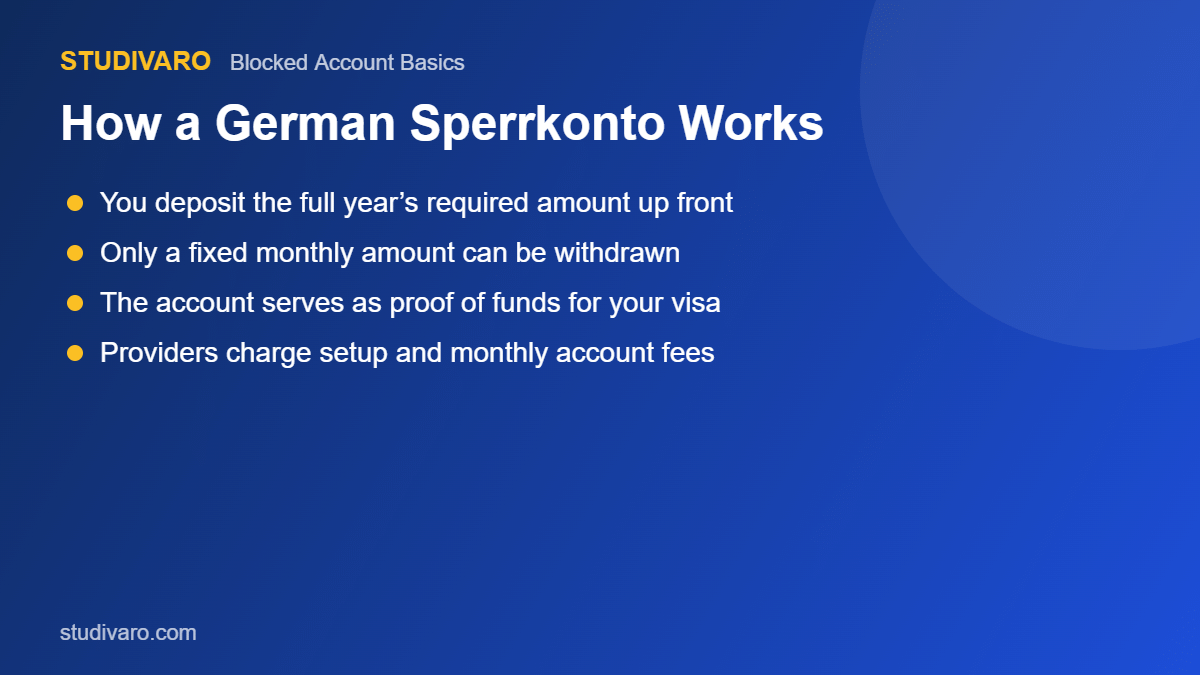
A Sperrkonto (Blocked Account) is a specialized German bank account designed to guarantee that foreign students possess sufficient funds for their living expenses during their initial academic year. Once deposited, the total sum is locked and automatically disbursed in equal monthly installments to your German current account (Girokonto).
The statutory minimum deposit required by the German Federal Foreign Office (Auswärtiges Amt) is tied directly to the federal student financial aid rate (BAföG). For 2026, the official statutory blocked amount stands at €992 per month, which totals €11,904 per year.
However, relying solely on this statutory baseline without analyzing the german sperrkonto monthly cost by city can be misleading. While €992 per month is more than enough to live comfortably in affordable cities like Leipzig or Chemnitz, it falls significantly short of covering basic living costs in competitive metropolises such as Munich or Frankfurt.
2. High-Cost Metropolises: Munich, Frankfurt, Berlin, and Hamburg
Germany’s premier metropolitan centers offer world-renowned universities, extensive industry networks, and vibrant cultural ecosystems. However, they also impose the steepest financial burden on international student budgets.
Munich (München)
Munich consistently ranks as Germany’s most expensive student city. The private rental market is notoriously competitive, with student rooms in shared flats (Wohngemeinschaft or WG) frequently exceeding €650 to €850 per month. Total monthly student expenditures routinely range between €1,250 and €1,450. A standard german sperrkonto monthly cost by city assessment shows a monthly deficit of €250 to €450 against the statutory €992 payout.
Frankfurt am Main
As continental Europe’s financial capital, Frankfurt commands premium rental prices. WG rooms average €550 to €750 per month, pushing average student monthly living budgets to approximately €1,150 to €1,300. Students must secure secondary funding sources or minijobs to bridge the gap.
Berlin and Hamburg
Berlin was historically an affordable bohemian capital, but rapid population influx has driven rental costs upward. A typical student in Berlin or Hamburg now requires €1,100 to €1,250 per month. Calculating your projected german sperrkonto monthly cost by city early enables prospective residents to apply for subsidized student dormitories (Studentenwohnheim) through the local Studierendenwerk well before departure.
3. Moderate-Cost Educational Hubs: Cologne, Stuttgart, Heidelberg, and Bonn
Medium-sized university cities and industrial heartlands provide an outstanding balance between academic prestige, strong regional job markets, and manageable living costs.
Cologne (Köln) and Düsseldorf
Located in North Rhine-Westphalia, these Rhine-Ruhr hubs host massive student populations. Monthly living expenses average between €1,000 and €1,150. The statutory Sperrkonto payout of €992 covers nearly all core necessities if you secure housing through university dormitories or shared accommodations outside prime city centers.
Heidelberg, Tübingen, and Freiburg
These historic university towns in Baden-Württemberg offer world-class research institutes and exceptional student life. Because student populations constitute a large percentage of total residents, rental demand is high. Average monthly budgets hover around €1,050 to €1,180.
Reviewing this german sperrkonto monthly cost by city tier indicates that students residing in these regions can balance their budgets with minor supplemental savings or modest part-time work.
4. Affordable Student Cities: Leipzig, Dresden, Chemnitz, and Magdeburg
Eastern federal states (the Neue Bundesländer) and select northern university towns offer the highest quality-of-life-to-cost ratio for international students in Western Europe.
Leipzig and Dresden
Saxony’s premier cultural and technology hubs feature affordable housing, modern campus infrastructure, and vibrant international communities. A private WG room in Leipzig or Dresden typically costs between €300 and €420 per month. Total monthly living costs rarely exceed €800 to €920.
Chemnitz, Halle, and Magdeburg
In these highly accessible university towns, room rents often start as low as €230 to €320 per month. Living costs remain comfortably between €720 and €850 per month.
Under our comparative german sperrkonto monthly cost by city model, students in these locations actually generate a monthly surplus of €100 to €270 from their €992 monthly blocked account payout, allowing them to accumulate emergency savings without financial stress.
5. Master Comparison Table: German Sperrkonto Monthly Cost by City
The following comparative table illustrates realistic monthly student expenditures compared against the statutory monthly Sperrkonto payout of €992 across primary German university destinations:
| City | Tier / Region | Avg. Rent (Warmmiete) | Health Insurance & Fees | Food & Living Costs | Total Monthly Budget | Sperrkonto Surplus / Deficit |
|---|---|---|---|---|---|---|
| Munich | Tier 1 (Very High) | €720 | €145 | €420 | €1,285 | -€293 (Deficit) |
| Frankfurt | Tier 1 (Very High) | €650 | €145 | €400 | €1,195 | -€203 (Deficit) |
| Berlin | Tier 1 (High) | €590 | €145 | €390 | €1,125 | -€133 (Deficit) |
| Hamburg | Tier 1 (High) | €610 | €145 | €400 | €1,155 | -€163 (Deficit) |
| Stuttgart | Tier 2 (Moderate-High) | €550 | €145 | €380 | €1,075 | -€83 (Deficit) |
| Cologne | Tier 2 (Moderate) | €520 | €145 | €370 | €1,035 | -€43 (Deficit) |
| Heidelberg | Tier 2 (Moderate) | €540 | €145 | €370 | €1,055 | -€63 (Deficit) |
| Aachen | Tier 2 (Moderate) | €460 | €145 | €360 | €965 | +€27 (Surplus) |
| Bremen | Tier 3 (Affordable) | €420 | €145 | €350 | €915 | +€77 (Surplus) |
| Leipzig | Tier 3 (Affordable) | €370 | €145 | €340 | €855 | +€137 (Surplus) |
| Dresden | Tier 3 (Affordable) | €360 | €145 | €330 | €835 | +€157 (Surplus) |
| Chemnitz | Tier 3 (Very Affordable) | €280 | €145 | €320 | €745 | +€247 (Surplus) |
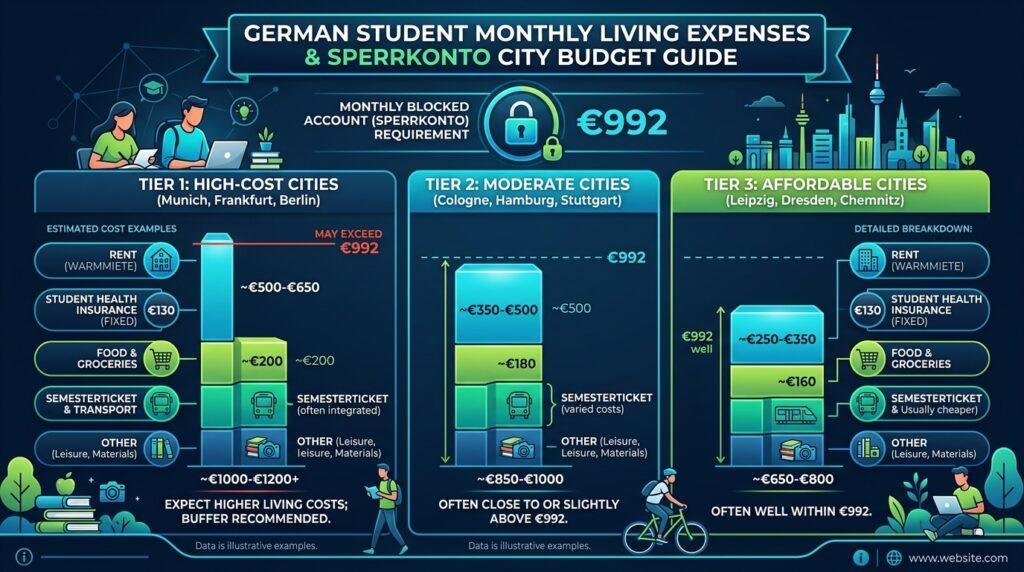
This authoritative german sperrkonto monthly cost by city matrix demonstrates that housing costs constitute over 50% of the variance between expensive and economical educational destinations.
6. Mandatory Non-Negotiable Monthly Expenses Across Germany
Regardless of which city you select, specific statutory and institutional costs remain identical across all federal states.
Statutory Public Health Insurance (Gesetzliche Krankenversicherung)
All international students under the age of 30 enrolled in degree programs must maintain comprehensive health insurance. Public healthcare providers (such as Techniker Krankenkasse, AOK, or Barmer) charge a standardized student tariff of approximately €125 to €135 per month, including statutory nursing care coverage (Pflegeversicherung).
Broadcasting Contribution (Rundfunkbeitrag / GEZ)
Every residential apartment in Germany is legally obligated to pay the public broadcasting contribution of €18.36 per month. In a shared flat (WG), this fee is split equally among all flatmates, reducing individual contributions to roughly €4 to €6 per month.
Semester Contribution (Semesterbeitrag)
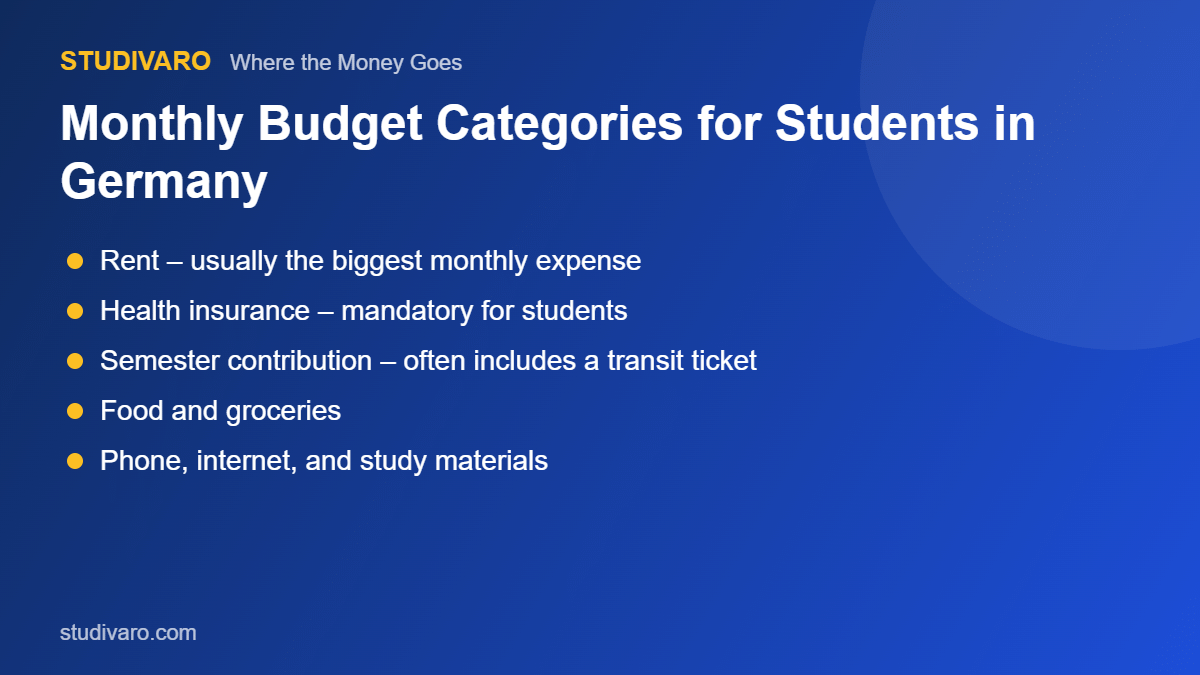
German public universities do not charge general tuition fees for most consecutive degree programs, but they require a mandatory semester contribution of €150 to €380 per semester. This fee covers student union administration, university sports access, and the regional student transit ticket (Semesterticket).
Budgeting for these recurring commitments within your german sperrkonto monthly cost by city schedule ensures you avoid administrative penalties or sudden financial shortfalls.
7. Official Blocked Account Providers: Comparison and Fees
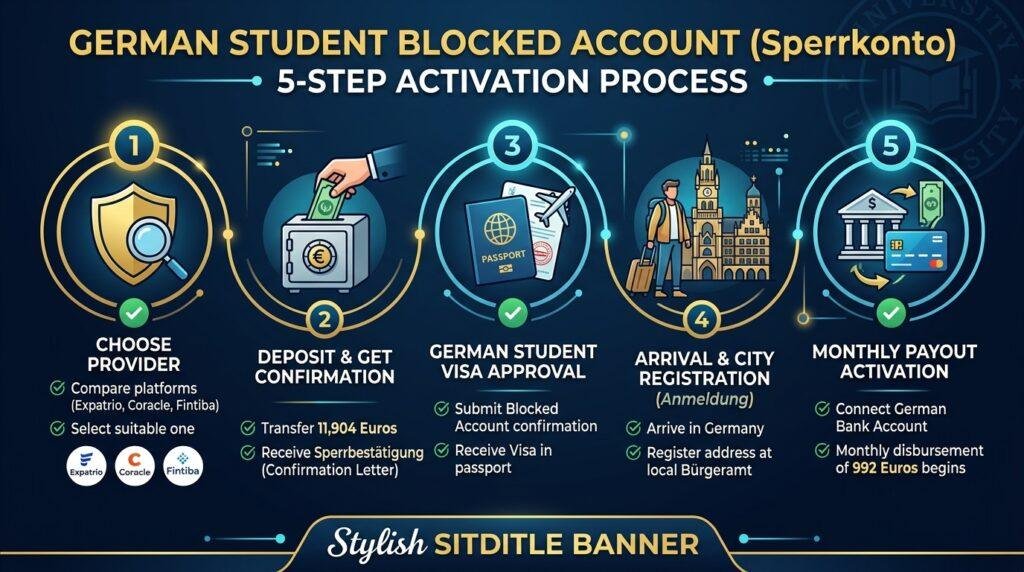
To establish your Sperrkonto, you must utilize a provider officially recognized by the German Federal Foreign Office. The three primary digital providers are:
- Expatrio: Renowned for rapid digital processing, English-language customer support, and seamless integration with Techniker Krankenkasse (TK) health insurance. Initial setup fee is typically €49 with a monthly service fee of €5.
- Coracle: Popular for transparent, competitive pricing and zero monthly maintenance charges on select packages. Setup fee is generally €59.
- Fintiba: One of the earliest digital blocked account platforms with global recognition and an intuitive mobile application. Initial setup fee is €89 with a monthly maintenance charge of €4.90.
Incorporating provider setup fees and mandatory buffer deposits into your german sperrkonto monthly cost by city capital projections guarantees complete visa compliance without administrative delays.
8. Bridging the Deficit: Working Student (Werkstudent) and Minijob Regulations
If you enroll in high-cost cities like Munich or Frankfurt, supplementing your monthly Sperrkonto payout through lawful student employment is standard practice.
Under updated German labor and immigration laws:
- International students from non-EU/EEA countries are permitted to work up to 140 full days or 280 half days per calendar year (increased from the previous 120 full days / 240 half days limit).
- Students can take on a Minijob earning up to €538 per month tax-free without compromising their student health insurance status.
- Working as an academic research assistant or teaching assistant (HiWi) inside your university does not count against your 140-day annual allocation.
Just as U.S. scholars must obey strict federal employment limits—as detailed in our guide on the F-1 Student Visa 20 Hour Work Rule Explained—international students in Germany must carefully monitor their workdays to preserve their residency permits.
9. Long-Term Financial Planning and Educational Return on Investment
Pursuing higher education in Germany remains one of the highest-yield global educational investments due to tuition-free public universities. However, managing your international relocation costs requires disciplined financial benchmarking.
Students financing their initial blocked account through personal savings or family assistance should calculate realistic loan timelines. You can forecast your financing obligations using our Student Loan Monthly Payment Calculator.
Furthermore, evaluating future graduate salaries against relocation costs ensures sustainable career planning. We encourage students to assess long-term compensation prospects using our College Major Salary to Debt Ratio Calculator. Finally, maintaining rigorous class attendance is vital for academic success; review our analysis on How Much Does a Missed College Lecture Cost to protect your educational capital.
Reviewing a precise german sperrkonto monthly cost by city schedule guarantees that your German academic adventure remains financially secure from matriculation to graduation.
10. Step-by-Step Student Budgeting Checklist for Germany
To maintain financial stability throughout your academic program, execute this 5-point operational checklist:
- Apply for Studierendenwerk Dormitories Immediately: Submit housing applications the day you receive your university admission letter to secure rooms priced under €350 per month.
- Buffer Your Initial Deposit: Deposit an extra €500 to €1,000 into your current account to cover initial rental security deposits (Kaution), which equal two to three months of cold rent.
- Verify Health Insurance Tariffs: Choose student public healthcare rather than private travel insurance to ensure permanent residency compliance.
- Register Your Residence Promptly (Anmeldung): Complete your city registration within 14 days of moving into your apartment to unblock your Sperrkonto funds.
- Track Weekly Grocery and Living Expenses: Shop at discount supermarket chains (Aldi, Lidl, Penny) to keep weekly food expenses under €60.
Applying these practical german sperrkonto monthly cost by city principles ensures seamless transition and sustained financial wellness.
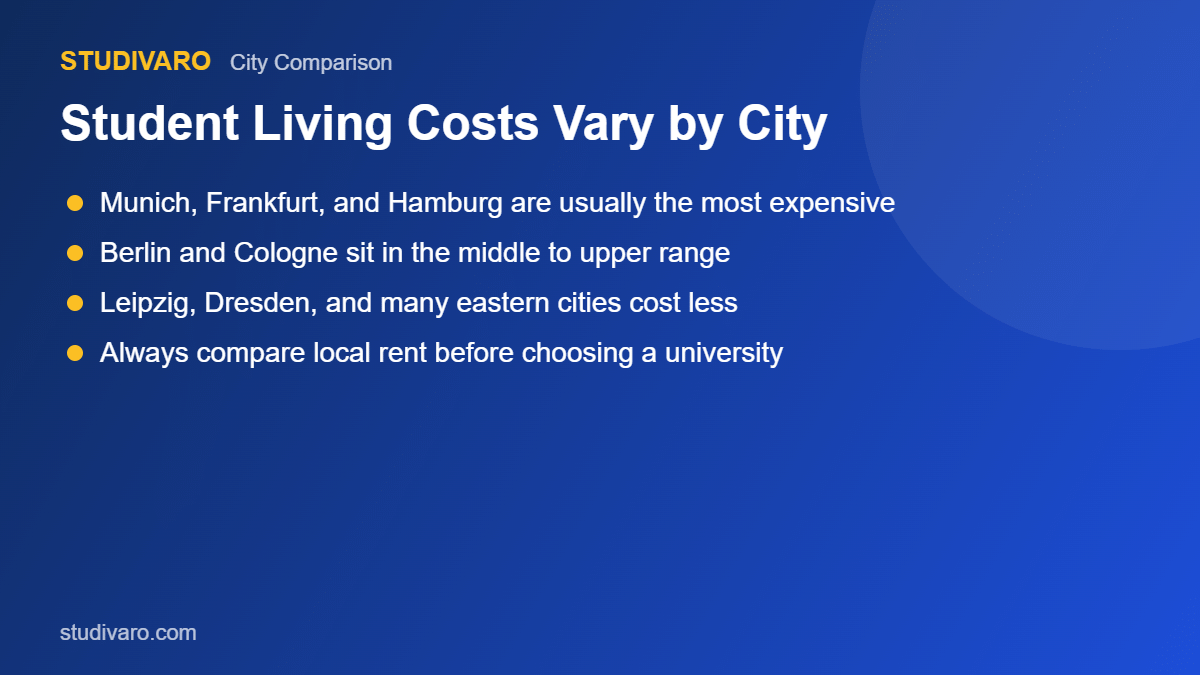
11. Frequently Asked Questions (FAQ)
Is the statutory €992 Sperrkonto amount enough to live in Germany in 2026?
Yes, €992 per month is sufficient in most small-to-medium university cities such as Leipzig, Dresden, Bremen, and Aachen. However, in major economic hubs like Munich, Frankfurt, and Hamburg, you will likely need an additional €150 to €350 per month to cover market-rate private rents.
Can I withdraw more than €992 per month from my German Sperrkonto?
No. Under standard federal regulations, the blocked account strictly limits withdrawals to the authorized monthly maximum (currently €992). The only exception occurs if you deposited additional voluntary buffer funds designated as accessible capital by your provider.
What happens to my Sperrkonto money if my German student visa is rejected?
If your visa application is denied by the German embassy or consulate, your blocked account provider will refund your entire deposited balance upon presentation of the official visa rejection letter (Ablehnungsbescheid), minus minor bank processing fees.
How does the german sperrkonto monthly cost by city affect student visa approval?
German embassies evaluate visa applications based on the national statutory requirement (€11,904 total or €992 per month). However, individual immigration offices (Ausländerbehörde) in high-cost cities like Munich can request proof of additional financial resources during visa extensions if local rental contracts exceed standard thresholds.
Do I need to open a separate German current account (Girokonto) to receive Sperrkonto payouts?
Yes. A Sperrkonto cannot be used for daily transactions, card payments, or ATM withdrawals. Upon arrival in Germany, you must open a standard current account (Girokonto) with a retail bank (such as N26, Sparkasse, or Deutsche Bank) and link it to your blocked account provider for automatic monthly transfers.
German Sperrkonto: Key Takeaways
Use this summary as a final checklist before you open your blocked account and apply for your student visa:
- A German Sperrkonto (blocked account) is the most common way to prove you can cover your living costs as an international student.
- You deposit the required yearly amount up front, then withdraw only a fixed monthly sum once you arrive in Germany.
- The required amount is set by the German government and can change, so confirm the current figure with the German embassy or Federal Foreign Office before transferring money.
- Your real monthly cost depends heavily on your city: rent in Munich or Frankfurt can take a much larger share of your Sperrkonto withdrawal than rent in Leipzig or Dresden.
- Compare Sperrkonto providers on setup fees, monthly fees, and processing times, not just on the headline price.
- Build a small extra buffer beyond the minimum for deposits, furniture, and your first weeks before the first monthly payout arrives.
Planning your German Sperrkonto budget city by city helps you choose a university that fits both your academic goals and your wallet, and it makes the transition to life in Germany far less stressful. Once your German Sperrkonto is funded and confirmed, you can focus on housing, enrollment, and settling in.
12. Verified Institutional Resources and Legal Citations
For official federal guidelines, visa regulations, and student support services, consult these verified resources:
- German Federal Foreign Office (Auswärtiges Amt): Information on the Blocked Account (Sperrkonto)
- German Academic Exchange Service (DAAD): Costs of Education and Living in Germany
German Sperrkonto City Living Cost Calculator
Calculate your real living expenses vs. the €992 monthly blocked account payout.