
College Major Salary to Debt Ratio Calculator: Best 2026 Tool
Use this college major salary to debt ratio calculator to compare your estimated starting salary against your projected student loan debt before making major enrollment decisions. Entering your projected numbers into this calculator helps you determine whether your chosen field of study will provide enough initial cash flow to comfortably pay down your education loans.
Try it yourself: Use our free Tuition Cost Per Lecture Calculator to run your own numbers in seconds. No sign-up needed.
Executive Summary: The 1:1 Golden Rule of College Borrowing
A reliable college major salary to debt ratio calculator serves as an essential reality check for high school seniors, college undergraduates, and returning adult learners.
The universal financial planning guideline states: Never borrow more for an undergraduate degree than you e
Table of Contents
College Major Salary to Debt Ratio Calculator
Calculate your salary-to-debt ratio, borrowing risk tier, and estimated monthly loan payment burden.
What Is a College Major Salary to Debt Ratio?
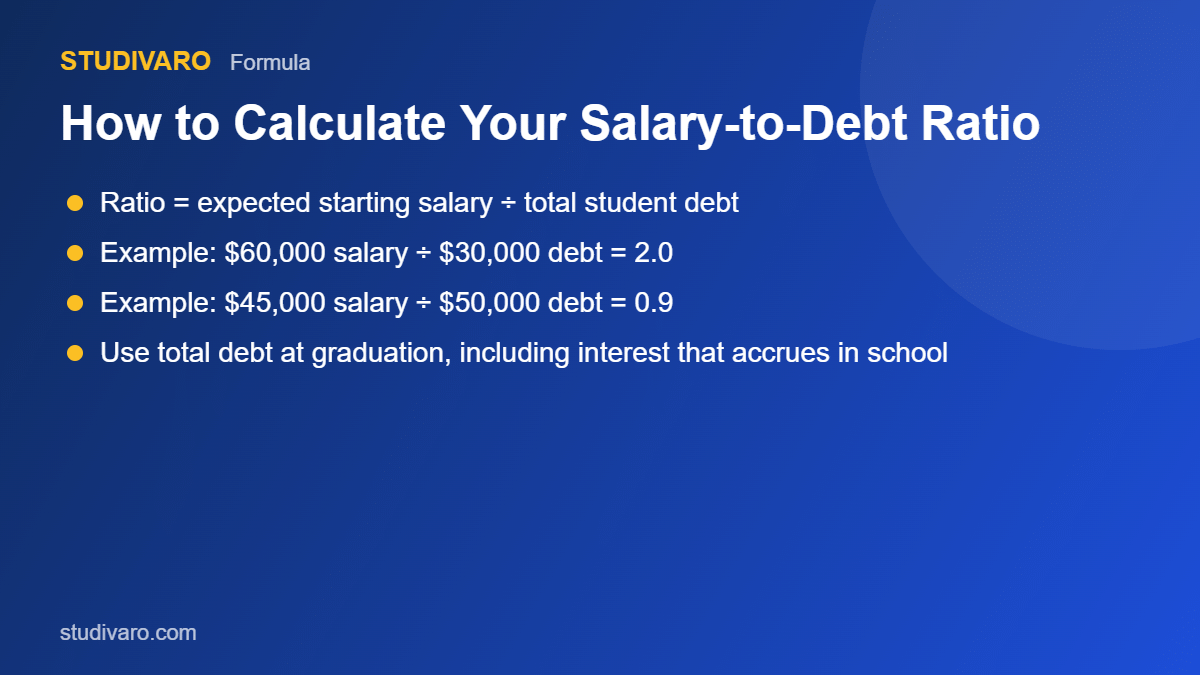
The salary-to-debt ratio is a mathematical comparison between your anticipated annual gross starting salary and the total student loan balance you must repay after graduation.
Instead of focusing solely on university tuition or campus reputation, this metric measures your return on educational investment (ROI). It directly answers the question: For every dollar borrowed to earn this credential, how many dollars of annual salary will you generate in your first entry-level position?
1. The Salary-to-Debt Ratio Formula
Salary-to-Debt Ratio = Annual Starting Gross Salary ÷ Total Student Debt Borrowed
For example, if you graduate with a starting salary of $60,000 and accumulated $30,000 in student loans:
- $60,000 ÷ $30,000 = 2.00 : 1
- A higher number reflects greater financial freedom and lower relative debt burden.
2. The Debt-to-Salary Percentage Formula
Debt-to-Salary Percentage = (Total Student Debt ÷ Annual Starting Gross Salary) × 100
Using the same scenario:
- ($30,000 ÷ $60,000) × 100 = 50.0%
- A lower percentage indicates that a smaller fraction of your annual earnings is tied to education debt.
Using an objective college major salary to debt ratio calculator ensures that you evaluate both perspectives simultaneously.
What Does a Good Salary-to-Debt Ratio Look Like?
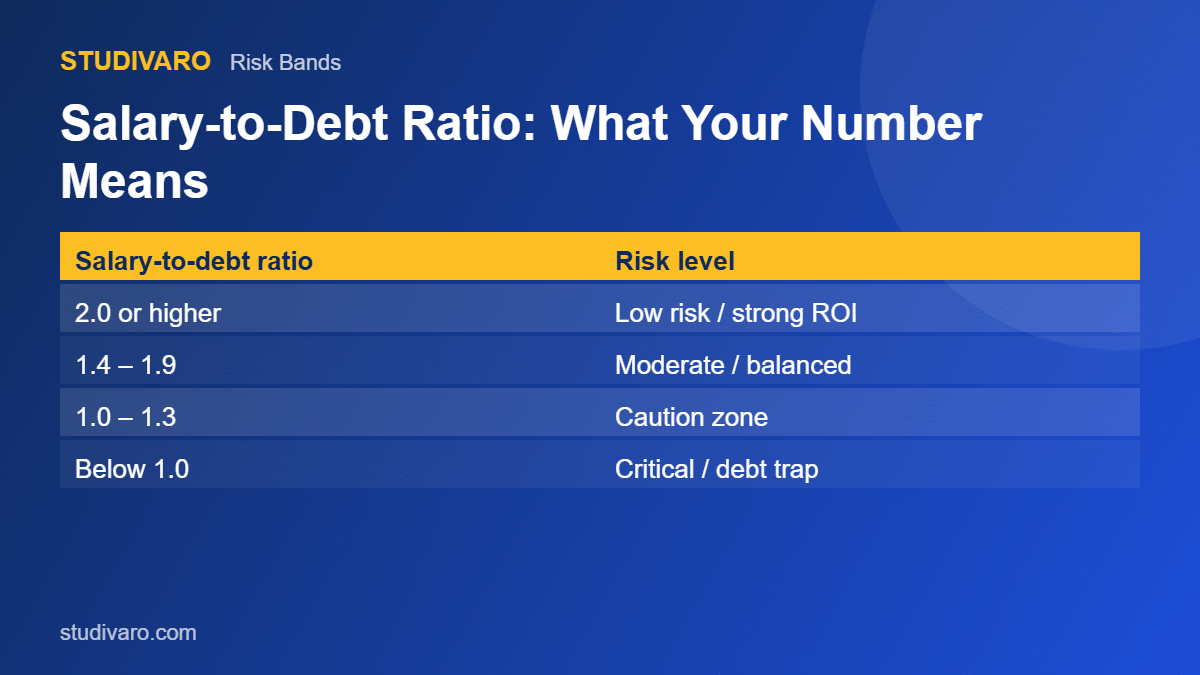
Financial advisors, loan servicers, and higher education researchers evaluate salary-to-debt ratios across four clear financial risk tiers:
1. Ratio of 2.0 or Higher (Low Risk / Strong ROI)
Your starting annual salary is at least double your total student debt. Under a standard 10-year repayment plan, your monthly student loan bill will typically consume only 5% to 7% of your gross pay. You will have plenty of financial flexibility for emergency savings, independent rent, and retirement investing.
2. Ratio of 1.4 to 1.9 (Moderate Risk / Balanced)
Your starting income comfortably exceeds your debt. Monthly loan installments remain manageable (approximately 8% to 11% of monthly gross income), provided you maintain moderate living expenses and avoid high-interest credit card balances.
3. Ratio of 1.0 to 1.3 (Caution Zone)
Your debt is nearly equal to your first-year salary. Under standard repayment, loan bills will consume 12% to 15% of your gross income (and up to 20% of your take-home pay). You will need to budget strictly and may have to postpone major life milestones like buying a home or purchasing a new vehicle.
4. Ratio Below 1.0 (Critical Risk / Debt Trap)
Your student debt exceeds your first-year starting salary. For example, borrowing $55,000 for a degree that pays $40,000 produces a ratio of 0.72. Paying off this balance within 10 years will require severe financial sacrifices or enrollment in 20-to-25-year federal Income-Driven Repayment (IDR) plans.
College Major Starting Salary vs. Debt Benchmarks
To help you benchmark your degree path inside our college major salary to debt ratio calculator, the table below outlines national average starting salaries, typical undergraduate debt levels, and resulting ratios across 10 popular majors:
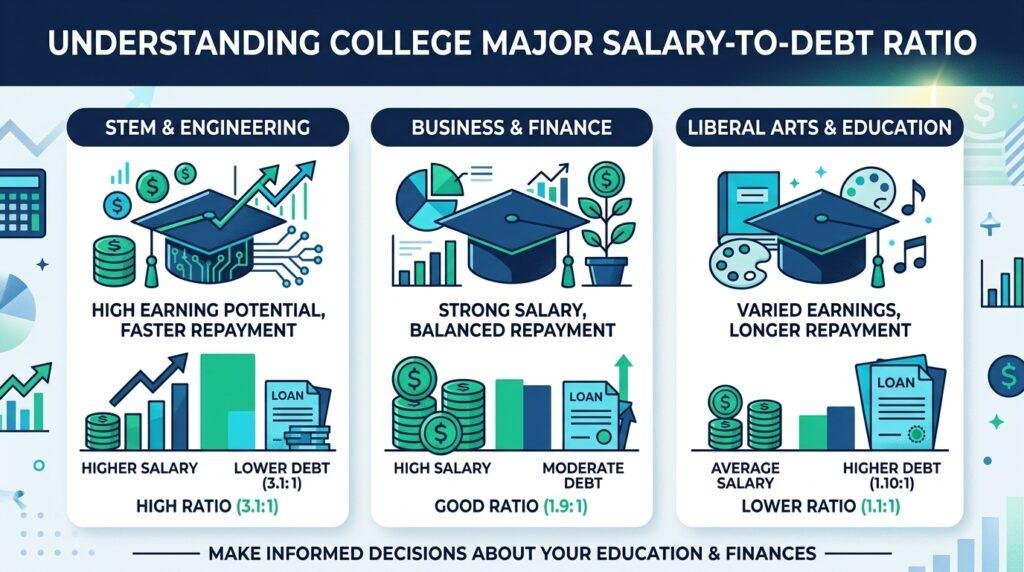
You can use this college major salary to debt ratio calculator to see which academic fields justify higher borrowing amounts.
| Undergraduate Major | Avg. Starting Salary | Avg. Student Debt | Salary-to-Debt Ratio | Financial Risk Tier |
|---|---|---|---|---|
| Computer Science | $75,000 | $28,000 | 2.68 : 1 | Low Risk (Exceptional ROI) |
| Mechanical Engineering | $72,000 | $30,000 | 2.40 : 1 | Low Risk (Strong ROI) |
| Registered Nursing (BSN) | $68,000 | $32,000 | 2.13 : 1 | Low Risk (High Job Security) |
| Finance / Accounting | $65,000 | $31,000 | 2.10 : 1 | Low Risk (Strong Career Growth) |
| Business Administration | $52,000 | $33,000 | 1.58 : 1 | Moderate / Balanced |
| Communications & Media | $44,000 | $34,000 | 1.29 : 1 | Caution Zone (Tight Budget) |
| Psychology | $42,000 | $35,000 | 1.20 : 1 | Caution Zone (Often Needs Grad School) |
| English / Literature | $41,000 | $36,000 | 1.14 : 1 | High Risk (Extended Payoff) |
| Social Work | $40,000 | $38,000 | 1.05 : 1 | High Risk (Requires PSLF Forgiveness) |
| Fine Arts / Studio Arts | $38,000 | $42,000 | 0.90 : 1 | Critical Risk (Debt Exceeds Salary) |
(Benchmark figures compiled from the National Center for Education Statistics, Bureau of Labor Statistics, and U.S. Department of Education median graduate debt data).
Real-World Case Studies: Comparing Two Degree Paths
To understand why using a college major salary to debt ratio calculator is vital before accepting financial aid packages, consider two real-world student scenarios:
Student A: High Ratio (Computer Science Graduate)
- Degree: B.S. in Computer Science at an in-state public university
- Total Borrowed Debt: $28,000
- Starting Gross Salary: $75,000 ($6,250 / month)
- Salary-to-Debt Ratio: 2.68 : 1
- Monthly Loan Payment (10-Yr at 6.5%): ~$318 / month
- Impact: Loan payments consume just 5.1% of monthly gross income. Student A can easily afford rent in a major city, build a 6-month emergency cushion, and invest in a 401(k) from month one.
Student B: Inverted Ratio (Private University Liberal Arts Graduate)
- Degree: B.A. in Communications at an out-of-state private college
- Total Borrowed Debt: $62,000
- Starting Gross Salary: $44,000 ($3,666 / month)
- Salary-to-Debt Ratio: 0.71 : 1
- Monthly Loan Payment (10-Yr at 6.5%): ~$704 / month
- Impact: Loan payments consume 19.2% of gross earnings and over 25% of actual net take-home pay. Student B faces intense cash-flow pressure, cannot afford independent living, and may be forced into an extended 25-year repayment plan where total interest doubles the original loan balance.
Gross Salary vs. Take-Home Reality: The Hidden Trap
A major mistake students make when evaluating their numbers in a college major salary to debt ratio calculator is confusing gross annual salary with actual take-home cash.
When an employer offers you an entry-level salary of $50,000 per year ($4,166 / month), you do not take home $4,166:
- Federal and State Income Taxes: Deduct roughly 14% to 18%.
- FICA Taxes (Social Security & Medicare): Deduct 7.65%.
- Health Insurance Premiums & Retirement: Deduct another $150 to $250 monthly.
- Actual Net Take-Home Pay: Approximately $3,100 to $3,250 per month.
If you borrowed $45,000 in student loans (a monthly bill of ~$510), that student loan payment is not 10% of your money—it is over 16% of your actual spendable cash. Factor this net pay reduction into your calculations before accepting maximum student loan awards.
5 Critical Mistakes When Evaluating Major Salary-to-Debt Ratios
- Using Mid-Career Pay Instead of Starting Pay: Online job boards often list median compensation for workers with 8–10 years of experience. When using a college major salary to debt ratio calculator, always input realistic entry-level (0–2 years) starting wages.
- Ignoring Capitalized Loan Interest: Unsubsidized federal loans and private student loans accrue interest while you attend classes. A $30,000 loan balance frequently balloons to $34,000 or more by graduation day due to interest capitalization.
- Overlooking Regional Cost of Living: A $65,000 starting salary in expensive metropolitan centers (New York, San Francisco, Boston) provides significantly less discretionary income than $48,000 in lower-cost states.
- Assuming Every Major Guarantees a Direct Job: STEM and licensed healthcare degrees offer structured career pipelines. Majors in liberal arts, psychology, or general business require active internships and networking to secure competitive starting salaries.
- Treating Calculator Estimates as Official Guarantees: A college major salary to debt ratio calculator provides a directional mathematical estimate for financial planning. It does not replace detailed institutional financial aid award letters or personalized loan counseling.
How to Use a Salary to Debt Ratio Before You Choose a Major
A salary to debt ratio is most useful before you sign your first loan, not after graduation. Treat it as a planning tool: you are testing whether a specific major, at a specific school, at a specific price, is likely to leave you with manageable payments.
Follow these steps to run a realistic check with our college major salary to debt ratio calculator:
- Estimate your total debt at graduation. Add up every year of expected borrowing, not just freshman year. Include interest that builds while you are in school on unsubsidized loans.
- Find a realistic starting salary. Use early-career salary data for your exact major, not mid-career figures. Median starting pay is a safer input than the top earners you see online.
- Divide salary by debt. A result of 2.0 means you expect to earn twice what you owe in your first year. A result below 1.0 means your debt is larger than a full year of gross pay.
- Run a pessimistic scenario. Lower the salary by 10 to 15 percent and add one extra semester of borrowing. If your salary to debt ratio still stays above 1.0, your plan has a safety margin.
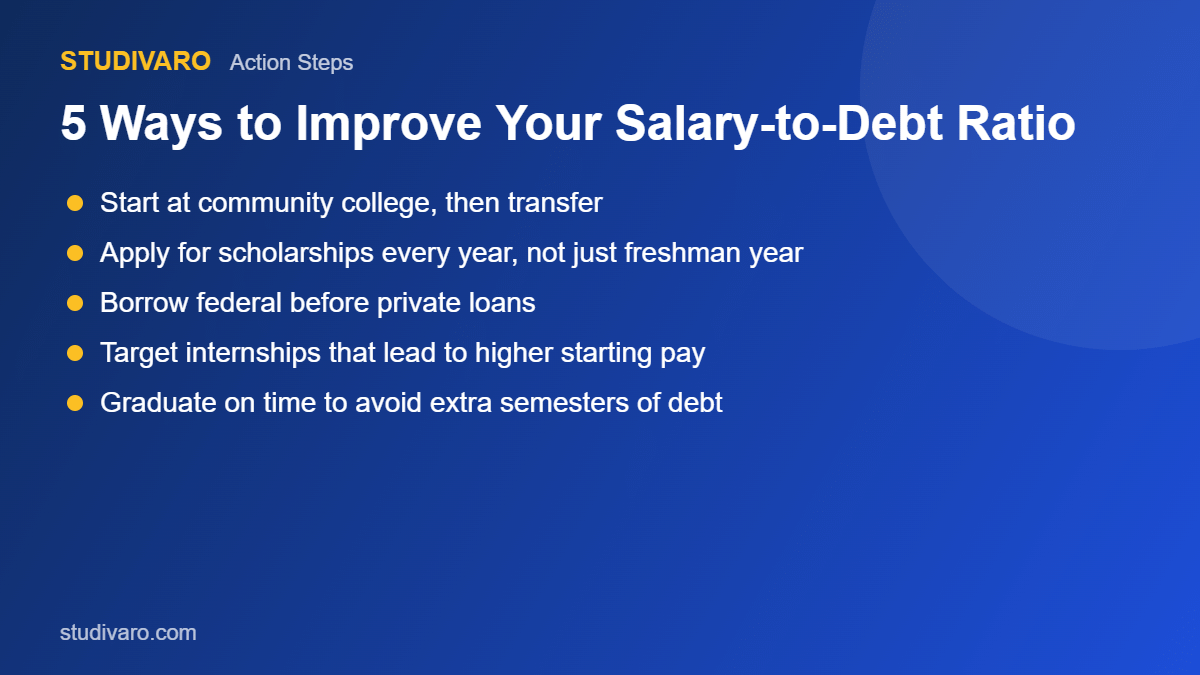
- Compare two or three schools. The same major can produce a very different salary to debt ratio depending on tuition, aid, and how many years you need to finish.
If the numbers look tight, that does not automatically mean you should change your major. It often means you should change the cost of the degree: a cheaper school, more scholarships, a community college start, or living at home for part of your program can lift your salary to debt ratio more than switching fields.
What to Do If Your Salary to Debt Ratio Is Below 1.0
A salary to debt ratio under 1.0 means you are on track to owe more than you will earn in your first year of work. That is a signal to act early, while you still have the most options. You do not need to abandon your goals, but you should reduce risk before borrowing more.
- Cut the cost first. Appeal your financial aid offer, apply for department scholarships, or consider transferring to a lower-cost public university for your final years.
- Borrow federal before private. Federal loans offer income-driven repayment and deferment options that most private loans do not.
- Build a higher-paying path within your field. Add a minor, certification, or internship that leads to better-paid entry roles in the same industry.
- Finish on time. Every extra semester adds debt and delays your first paycheck, which lowers your salary to debt ratio from both sides.
- Plan your repayment now. Estimate your monthly payment and compare it with your expected take-home pay, not your gross salary.
Recalculate after each change. Small moves, like a $3,000 scholarship or one fewer semester, can push your salary to debt ratio from the danger zone into a manageable range. Keep a simple record of each scenario so you can see which decision made the biggest difference.
Frequently Asked Questions
What is a good college major salary-to-debt ratio?
A healthy salary-to-debt ratio is 1.0 or higher. Financial advisors recommend striving for a ratio of 1.4 to 2.0+ whenever possible. This ensures that standard 10-year monthly loan repayments do not exceed 10% of your gross monthly paycheck.
What should I do if my projected student debt is higher than my salary?
If your expected ratio is below 1.0, take immediate steps to reduce borrowing before graduation: attend a local community college for general education prerequisites, choose an in-state public university, apply for departmental scholarships, work part-time as a resident assistant (RA), or look into federal Public Service Loan Forgiveness (PSLF) career paths.
How does this calculator differ from a monthly student loan calculator?
A college major salary to debt ratio calculator assesses high-level return on investment (ROI) and overall borrowing safety before you take out loans. A monthly payment calculator determines exact amortization schedules, interest totals, and monthly billing statements.
Does this ratio apply to graduate school degrees (Law, Medicine, MBA)?
Yes, but graduate programs often require temporary inversions. Medical and dental students frequently graduate with debt exceeding starting resident salaries (ratios of 0.4 to 0.7), but their earnings accelerate dramatically 3 to 5 years into their specialized careers.
Can income-driven repayment plans fix a bad ratio?
Federal Income-Driven Repayment (IDR) plans cap monthly bills at a percentage of your discretionary income, providing immediate relief for low ratios. However, extended 20-to-25-year repayment schedules significantly increase the total cumulative interest paid over the life of the loan.
Salary to Debt Ratio: Key Takeaways
Here is a quick summary you can come back to before every financial aid decision:
- Your salary to debt ratio compares expected first-year salary with total student debt at graduation.
- A ratio of 2.0 or higher is generally low risk; below 1.0 is a warning sign that payments may squeeze your budget.
- Use conservative, early-career salary data and include every year of borrowing.
- Lowering the cost of your degree usually improves your salary to debt ratio faster than chasing a higher salary.
- Recheck your numbers each year as tuition, aid, and your career plans change.
- Pair this result with a monthly payment estimate so you can see how the debt will feel in your real budget.
Used together, these checks turn a vague worry about student loans into a clear, numbers-based decision you can explain to parents, advisors, or yourself.
Next Steps: Plan Your Long-Term Loan Repayment
Once you have calculated your major ratio and finalized your borrowing limits, model your exact monthly installments and lifetime interest costs using our companion Student Loan Monthly Payment Calculator.
Reviewing both your salary-to-debt ratio and monthly amortization schedule ensures you graduate with a clear, stress-free repayment plan.
Verified Higher Education & Salary Data Sources
For verified, government-backed data on university costs, median borrowing levels, and national starting salaries, consult these official databases:
- Search institution-specific graduate debt and earnings reports: U.S. Department of Education College Scorecard
- Review national occupational outlook and entry-level career wages: Bureau of Labor Statistics (BLS) Occupational Outlook Handbook
Disclaimer: This educational college major salary to debt ratio calculator provides general mathematical estimations for college planning purposes. It does not constitute certified financial, tax, or legal advice. Always confirm specific degree costs and loan terms with your college financial aid office and loan servicer.