

Dorm vs Off-Campus Living Student Cost Comparison: 2026 Complete Guide
Choosing where to live during your university years is one of the most consequential financial decisions of your academic journey. Every year, millions of undergraduates and graduate students grapple with the central housing dilemma: should you stay in a university residence hall or rent an apartment in the surrounding community? Conducting a rigorous dorm vs off-campus living student cost comparison is essential because housing and food often account for over 50% of your total college expenses—frequently exceeding the cost of tuition itself.
Try it yourself: Use our free Tuition Cost Per Lecture Calculator to run your own numbers in seconds. No sign-up needed.
At first glance, calculating a dorm vs off-campus living student cost comparison seems simple. You compare the university’s published room and board rate with twelve months of local apartment rent. However, this superficial evaluation overlooks critical variables, such as 9-month versus 12-month lease commitments, mandatory campus meal plans, utility setup fees, commuting costs, and financial aid disbursement rules.
Without a detailed dorm vs off-campus living student cost comparison, students regularly underestimate hidden expenses by thousands of dollars per semester. This definitive guide provides an exhaustive, line-by-line financial breakdown, real-world expense models, regional benchmarks, and practical strategies to help you make the most cost-effective housing choice.
Table of Contents
National Cost Benchmarks: Dorm vs Off-Campus Living Student Cost Comparison
According to empirical data from the College Board and the National Center for Education Statistics, the average cost of room and board across American higher education institutions now exceeds $12,000 to $15,000 per academic year. Understanding where your money actually goes requires an evidence-based dorm vs off-campus living student cost comparison.
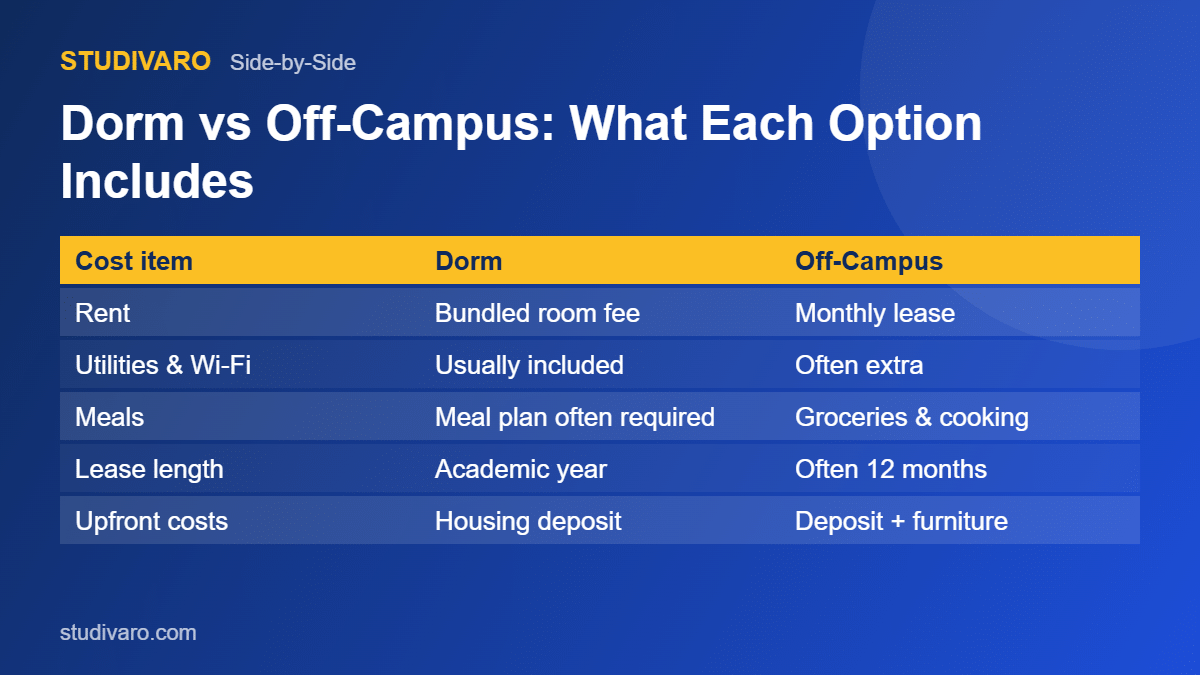
The table below illustrates a standard, nine-month academic year baseline comparing an on-campus double-occupancy residence hall with an off-campus two-bedroom apartment shared with one roommate:
| Expense Category | On-Campus Dorm (9 Months) | Off-Campus Apartment (9-Month Share) | Off-Campus Apartment (12-Month Lease) |
|---|---|---|---|
| Base Rent / Housing Fee | $7,800 (Double Room) | $6,300 ($700/month split) | $8,400 ($700/month split) |
| Meal Plan vs Groceries | $5,200 (Unlimited Plan) | $3,150 ($350/month food) | $4,200 ($350/month food) |
| Utilities (Electricity, Water, Gas) | $0 (Included in fee) | $720 ($80/month split) | $960 ($80/month split) |
| High-Speed Internet | $0 (Campus Wi-Fi) | $360 ($40/month split) | $480 ($40/month split) |
| Transportation & Parking | $150 (Walking / Shuttle) | $900 (Gas, Bus Pass, Parking) | $1,200 (Annual Transit) |
| Renter’s Insurance | $0 (Covered by Campus) | $135 ($15/month) | $180 ($15/month) |
| Laundry & Incidental Supplies | $180 (Dorm Washers/Dryers) | $90 (In-Unit or Laundromat) | $120 (Annual Laundry) |
| Total Estimated Expense | $13,330 | $11,655 | $15,540 |
As this preliminary cost comparison demonstrates, an off-campus apartment is significantly cheaper if you only pay for nine months. However, when tied to a standard 12-month lease without summer subletting, off-campus housing can actually cost more overall.
The Core Economics: Analyzing the 9-Month vs 12-Month Lease Trap
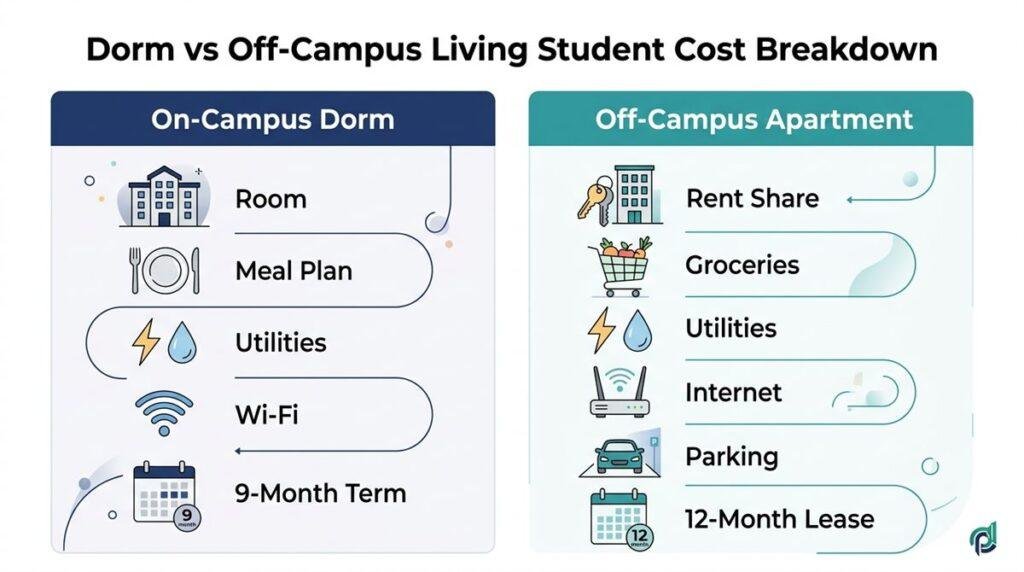
The single biggest source of financial error in any dorm vs off-campus living student cost comparison is the duration of the housing contract. Universities structure residence hall agreements around the academic calendar—typically August through May (approximately 36 to 38 weeks).
In contrast, private property management companies almost universally require a 12-month legally binding lease. When you conduct a dorm vs off-campus living student cost comparison, you must account for the “summer rent trap”:
- On-Campus Calendar: You move in mid-August and vacate in mid-May. You do not pay for June or July unless you enroll in summer classes and contract for separate summer housing.
- Off-Campus Lease: Even if you return to your hometown from June through August, your lease obligation remains active. Unless you secure a qualified subletter, you must pay three months of rent, electric bills, and internet fees for an empty apartment.
Factoring summer vacancy into your overall student housing budget is vital. If your monthly rent share is $800, paying for three vacant summer months adds $2,400 to your annual expenditure, which can completely erase the monthly savings of living off-campus.
Detailed On-Campus Housing Costs: Beyond Room and Board
When students evaluate an on-campus dorm vs off-campus living student cost comparison, they often appreciate the simplicity of a single semester billing statement. However, university housing carries specific cost structures that demand careful scrutiny.
1. Mandatory Meal Plans
At most four-year institutions, first-year and second-year students residing in dormitories are legally or administratively required to purchase an unlimited or high-tier dining hall plan. Campus meal plans regularly cost between $4,800 and $6,500 per academic year. When broken down per meal, dining hall contracts often equal $12 to $16 per swipe, which is far higher than preparing meals at home. In any realistic dorm vs off-campus living student cost comparison, meal plans represent the single largest inflation factor for on-campus living.
2. Move-Out and Break Storage Penalties
Many residence halls close entirely during Thanksgiving break, Winter intersession (typically 3 to 4 weeks in January), and Spring break. Students who cannot travel home must pay auxiliary nightly fees or arrange temporary hotel stays. Furthermore, mandatory dorm move-out in May frequently forces out-of-state students to rent commercial summer storage units, adding $300 to $600 to your annual housing expenses.
3. Limited Cost Control
In a residence hall, you cannot economize by lowering the thermostat, using less hot water, or cooking bulk meals in an expansive kitchen. Your fee is locked in by university board trustees twelve months in advance.
Detailed Off-Campus Housing Costs: The Realities of Independent Renting
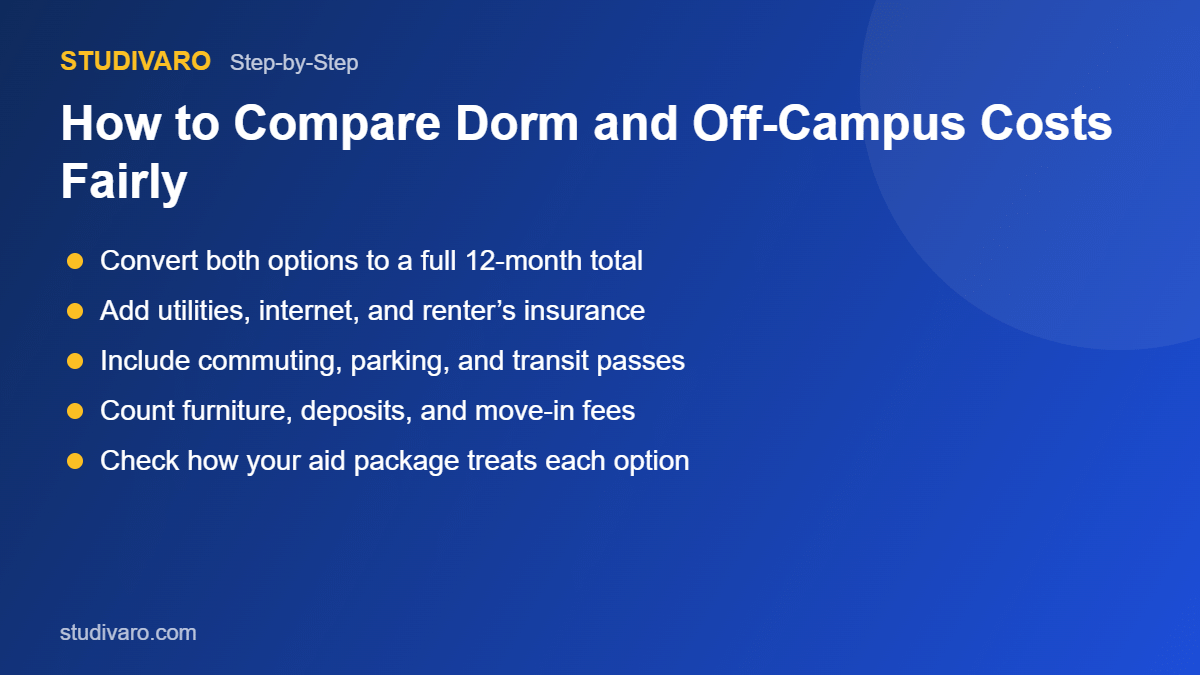
Moving off campus offers autonomy, privacy, and personal space, but it introduces decentralized operational expenses. A rigorous dorm vs off-campus living student cost comparison must calculate several often-neglected line items:
1. Upfront Move-In Liquidity Requirements
Securing an off-campus lease requires substantial upfront cash reserves. Landlords typically demand:
- Application and screening fees:
$50to$100per applicant. - Security deposit: Equal to one full month’s rent (e.g.,
$700to$1,200). - First and last month’s rent: Payable prior to key handover.
- Utility activation deposits: Electricity and municipal water companies frequently require
$100to$250deposits for students without established credit history.
In your dorm vs off-campus living student cost comparison, ensure you possess at least $2,000 to $3,500 in liquid capital before move-in day.
2. Furnishings and Household Infrastructure
Unless you rent an explicitly furnished student-housing suite, off-campus apartments are completely empty. Purchasing a mattress, bed frame, desk, couch, dining table, cookware, cleaning appliances, and shower curtains can easily cost $800 to $1,500. Even when sourcing used furniture, these initial setup expenses influence your overall collegiate living costs.
3. Transportation and Campus Commute Realities
Living two or three miles from campus introduces recurring transportation overhead. If you operate an automobile, budget for fuel, vehicle depreciation, auto insurance, and most importantly, university campus commuter parking permits, which regularly cost $400 to $900 per year. If you rely on public transit or cycling, verify weather constraints and bus pass subsidies. Neglecting daily commuting costs is a frequent pitfall in a casual dorm vs off-campus living student cost comparison.
How Financial Aid and Scholarships Impact Your Decision
A critical dimension of the dorm vs off-campus living student cost comparison is how your financial aid package adapts to your housing status. Under federal regulations governing Title IV aid (such as Pell Grants, Direct Federal Student Loans, and FAFSA), every university calculates an official Cost of Attendance (COA) budget.
According to financial aid guidelines published by the Federal Student Aid Information Center, your university COA includes an explicit room and board allowance whether you live on or off campus. When evaluating your dorm vs off-campus living student cost comparison, observe these crucial aid dynamics:
- Direct University Invoicing: For on-campus students, scholarships, grants, and student loans apply directly to your university account, covering tuition and dorm fees simultaneously.
- Refund Check Disbursement: For off-campus students, aid funds in excess of tuition and institutional fees are disbursed directly to your personal checking account as a financial aid refund check. You are personally responsible for using this lump sum to pay private landlords and utility bills monthly.
- Institutional Scholarship Restrictions: Some university-specific institutional awards or housing stipends are strictly contingent upon residing in on-campus housing. If you move off-campus, you may forfeit these dedicated housing grants, drastically altering your net financial calculation.
Always consult your university financial aid counselor before signing a commercial lease agreement.
Roommate Dynamics and Financial Risk Mitigation
In an on-campus residence hall, your financial liability is entirely individual. If your roommate drops out of college, transfers mid-semester, or is dismissed for disciplinary reasons, the university housing department absorbs the loss; your fee remains unchanged.
Conversely, off-campus housing involves joint and several liability contracts. In an objective dorm vs off-campus living student cost comparison, you must evaluate roommate financial risk:
- Joint and Several Leases: On standard private leases, all signatories are 100% collectively liable for the total monthly rent. If your roommate abruptly vacates or fails to pay their
$700share, the landlord can legally demand the full rent from you or report your credit to reporting bureaus. - Individual By-the-Bed Leases: Purpose-built student housing complexes frequently offer individual leases where you are only responsible for your specific bedroom and an equal share of common areas. While slightly more expensive, by-the-bed leases reduce risk and simplify off-campus budgeting.
If interpersonal conflicts arise during group academic or living environments, understanding conflict resolution strategies is vital; our comprehensive guide on handling group project free rider problems provides proven communication frameworks that apply equally well to difficult roommate situations.
Quality of Life and Academic Productivity Trade-Offs
A comprehensive dorm vs off-campus living student cost comparison extends beyond pure monetary calculations. Non-monetary quality-of-life factors exert a substantial impact on your academic performance, social engagement, and physical well-being.
As research published by the National Center for Education Statistics (NCES) highlights, first-year students who reside on campus generally exhibit higher retention rates and greater academic persistence. Integrating these qualitative factors into your dorm vs off-campus living student cost comparison ensures balanced decision-making:
Advantages of On-Campus Dorm Living:
- Academic Convenience: You can wake up fifteen minutes before a lecture and walk to class, dramatically reducing absenteeism; calculating how much a missed college lecture costs illustrates the tangible value of punctuality.
- Campus Integration: Immediate proximity to university libraries, research laboratories, tutoring centers, and campus extracurricular organizations.
- All-Inclusive Simplicity: One semester payment covers rent, unlimited heating and air conditioning, water, trash disposal, campus Wi-Fi, and security.
Advantages of Off-Campus Apartment Living:
- Privacy and Mental Health: Having a private bedroom and dedicated living space significantly reduces social burnout and sleep disruptions.
- Dietary Freedom: Cooking your own healthy meals provides superior nutrition at a fraction of university dining hall costs.
- Year-Round Stability: You never experience the stress of packing your entire life into cardboard boxes during Thanksgiving, winter breaks, or spring vacations.
Dorm vs Off-Campus Living Student Cost Comparison Calculator
Calculate your real 9-month residence hall fees vs 12-month private apartment expenses with this interactive dorm vs off-campus living student cost comparison tool.
Step-by-Step Worksheet: Conducting Your Personal Cost Evaluation
To conduct an accurate, personalized dorm vs off-campus living student cost comparison for your specific college town, execute the following four-step calculation process:
Step 1: Calculate Total 9-Month On-Campus Costs[Published Dorm Fee] + [Mandatory Meal Plan] + [Campus Laundry/Parking] = Base On-Campus CostStep 2: Calculate True 12-Month Off-Campus Costs([Monthly Rent Share] x 12) + ([Monthly Utilities & Wi-Fi] x 12) + ([Monthly Groceries] x 12) = Base Rent & FoodStep 3: Add Off-Campus Incidental & Commuter Expenses[Upfront Deposits & Moving Costs] + [Annual Commuter Transit/Parking] + [Renter's Insurance] = Additional CostsStep 4: Factor Summer Sublease ProbabilitySubtract realistic summer sublet income (typically 50% to 70% of summer rent) if you plan to leave campus.
By completing this structured worksheet, your customized student housing worksheet will yield an exact dollar figure tailored to your institution.
Long-Term Financial Planning and Student Debt Management
Every thousand dollars saved on undergraduate housing reduces your future borrowing needs. When utilizing federal or private student loans to finance living costs, the compound interest accrues over ten to twenty-five years.
Incorporating long-term repayment estimates into your dorm vs off-campus living student cost comparison is essential for responsible borrowing. Utilizing our interactive student loan monthly payment calculator and our college major salary to debt ratio calculator will illustrate how saving $3,000 annually on off-campus rent can reduce your ultimate loan repayment obligations by over $5,000 after graduation.
If you are planning to study abroad in European university systems, understanding different credit frameworks and living stipends is equally vital; review our detailed ECTS to US semester credits conversion guide to structure your academic mobility smoothly.
Frequently Asked Questions (FAQs)
Is it genuinely cheaper to live off campus than in a college dorm?
In most university cities, living off campus is 15% to 30% cheaper on a monthly basis, primarily because grocery shopping is substantially less expensive than mandatory dining hall meal plans. However, your dorm vs off-campus living student cost comparison must account for the summer months; if you sign a 12-month lease and cannot sublease for the summer, the cost advantage diminishes significantly.
Does federal financial aid cover off-campus rent and utilities?
Yes. Federal financial aid, including Pell Grants and Direct Subsidized and Unsubsidized student loans, can be used to pay for off-campus living expenses. Your university financial aid office will deduct tuition and direct fees first, and then disburse the remaining funds as a refund check to pay your rent, utilities, and groceries.
How much should an off-campus student budget for monthly groceries?
A realistic monthly grocery budget for a college student ranges from $275 to $400, depending on location, dietary needs, and cooking habits. This equals roughly $3,300 per year, compared to campus meal plans that regularly exceed $5,000 to $6,000 annually.
What are the biggest hidden costs of living off campus?
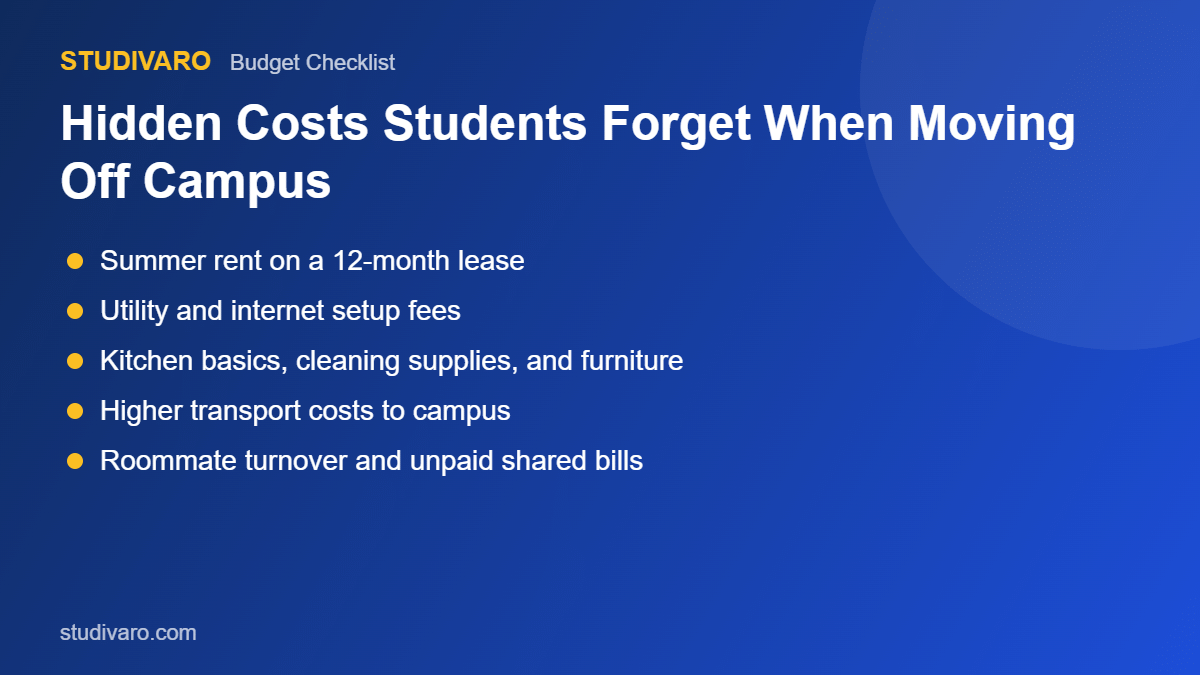
The most overlooked expenses in any dorm vs off-campus living student cost comparison include security deposits, utility activation fees, campus commuter parking permits, furniture acquisition, and utility bills during extreme summer and winter weather peaks.
Can first-year students live off campus?
Many universities enforce a mandatory on-campus housing policy for first-year undergraduates, requiring freshmen to live in residence halls unless they commute directly from a permanent parent or guardian residence within a specified mileage radius. Always check your university housing policy before performing an off-campus search.
Final Recommendation: Making Your Housing Decision
Determining the ideal housing arrangement requires aligning your financial resources, academic discipline, and personal lifestyle preferences. Conducting a thorough dorm vs off-campus living student cost comparison provides the mathematical clarity needed to avoid high-interest student debt traps.
If you prioritize convenience, social community, and simple consolidated billing, living on campus in a dorm is a worthwhile investment, especially for underclassmen. If you possess reliable roommates, basic budgeting skills, cooking capabilities, and desire personal privacy, living off campus offers significant financial savings and invaluable life experience. Use this dorm vs off-campus living student cost comparison framework to assess your local market and choose the living arrangement that empowers your academic success.