

How to Handle Group Project Free Rider Problems: Complete College Guide
Every semester, university students face severe group project free rider problems that threaten both their grades and their mental well-being. You are assigned to a four-person group project worth 30% or 40% of your final grade, and within seventy-two hours, one teammate completely vanishes. They miss scheduled check-in calls, ignore group messages, offer vague excuses about workload, or promise to finish their slides only to upload unformatted, unreferenced text at 2:00 AM on the day of submission.
Try it yourself: Use our free Late Submission Penalty Calculator to run your own numbers in seconds. No sign-up needed.
Learning how to handle group project free rider problems is an essential academic survival skill. Successfully managing group project free rider problems protects your cumulative grade point average (GPA) while preparing you for real-world workplace collaboration. In corporate project management, engineering teams, and academic research labs, unequal contribution and social loafing happen constantly.
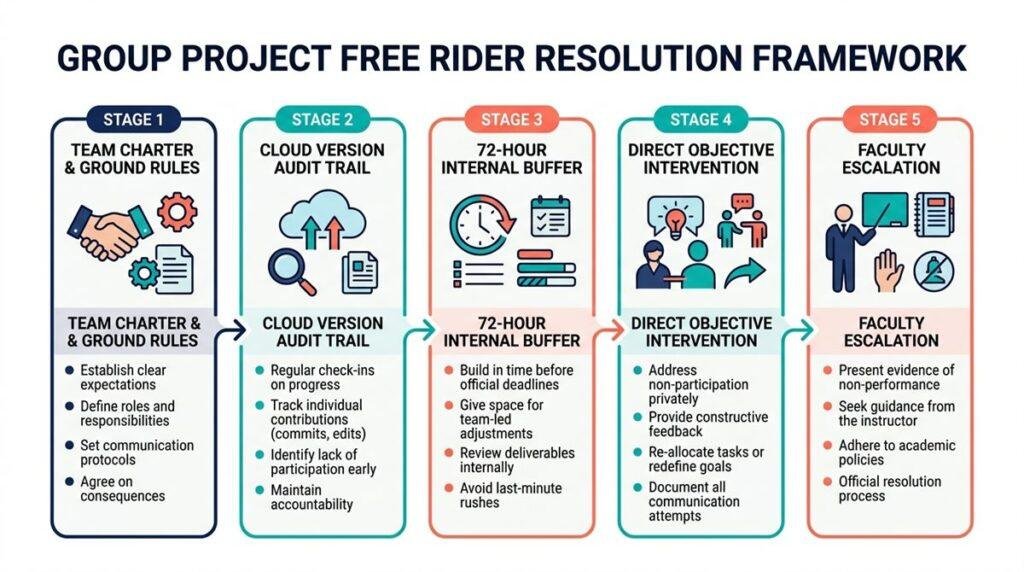
Students who struggle with non-contributing peers usually make one of two catastrophic mistakes: they either suffer in silence and do all the slacker’s work themselves, or they lash out in anger right before the final presentation without documentation. This comprehensive guide provides an actionable, five-phase framework to resolve group project free rider problems, build an indisputable digital paper trail, and professionally escalate issues to your course instructor.
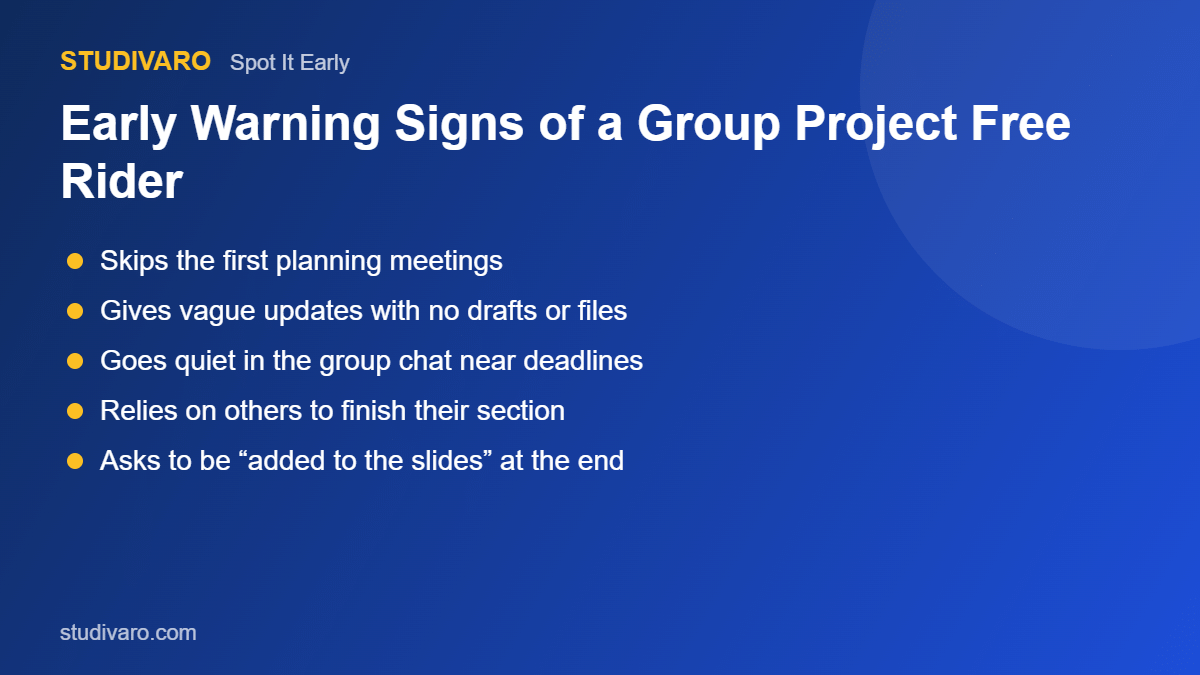
What Causes Group Project Free Rider Problems in Higher Education?
In organizational psychology, the underlying cause of group project free rider problems is known as social loafing. First identified by French agricultural engineer Max Ringelmann in 1913, the Ringelmann Effect demonstrates that as group size expands, individual team members exert progressively less effort because their personal contribution feels less visible.In organizational psychology, the underlying cause of group project free rider problems is known as social loafing research by Vanderbilt University. First identified by French agricultural engineer Max Ringelmann in 1913…
Understanding why group project free rider problems occur helps you address the root cause rather than reacting purely out of frustration:
- Diffusion of Responsibility: When four people share a collective deliverable, each individual feels only 25% responsible for failure. Without explicit, named sub-tasks, this diffusion of responsibility triggers recurring group project free rider problems.
- Asymmetric Grade Expectations: A student aiming for competitive graduate school admission needs a 4.0 GPA and an A grade. A graduating senior who already secured an employment offer may only require a 50% passing grade (C or D). This misalignment often sparks intense group project free rider problems.
- Absence of Intermediate Milestones: When professors assign a semester-long project with only a single final deadline at Week 14, unmotivated teammates defer work indefinitely. Without internal accountability gates, project momentum collapses.
- Uniform Group Grading Policies: When instructors assign identical grades to all group members regardless of contribution, rational slackers realize they can reap the academic reward without investing time or energy, fueling chronic group project free rider problems.
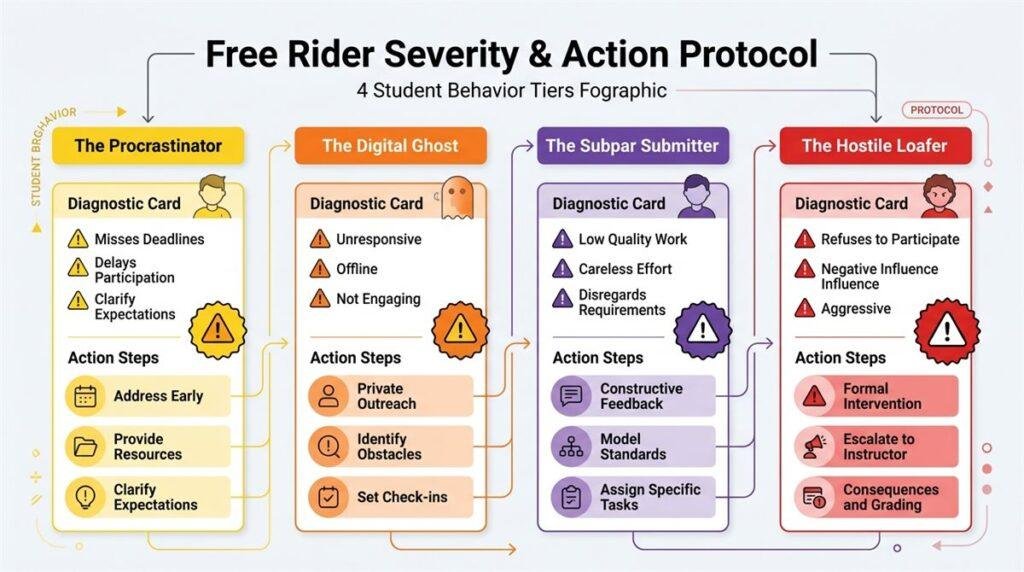
Diagnosing Group Project Free Rider Problems: The Severity Matrix
Not every non-responsive teammate has malicious intent. To resolve group project free rider problems before deadlines approach, diagnose the exact behavior pattern you are facing using this comparative framework:
| Free-Rider Category | Observable Behavioral Symptoms | Team Impact | Recommended Immediate Action |
|---|---|---|---|
| The Procrastinator | Attends group meetings, agrees enthusiastically to tasks, but misses internal drafts by several days. | Delays dependent workflow steps (e.g., data analysis or slide design). | Establish strict 48-hour pre-deadline buffers and require shared cloud document links. |
| The Digital Ghost | Leaves group chat messages on read, skips team check-ins without notice, and provides zero updates. | Creates panic and uncertainty regarding whether their assigned section exists. | Send a formal boundary email with a 24-hour response window and CC all active group members. |
| The Subpar Submitter | Submits low-effort, plagiarized, unreferenced, or hallucinated AI-generated text minutes before deadlines. | Threatens academic integrity and forces peers to perform emergency late-night rewrites. | Reject the submission explicitly in writing, cite assignment rubric requirements, and log the unedited text. |
| The Hostile Loafer | Becomes defensive when questioned, blames teammates, or claims personal emergencies while posting on social media. | Degrades team morale and poisons communication across the entire group. | Cease informal text chats immediately; transition all correspondence to institutional email and alert faculty. |
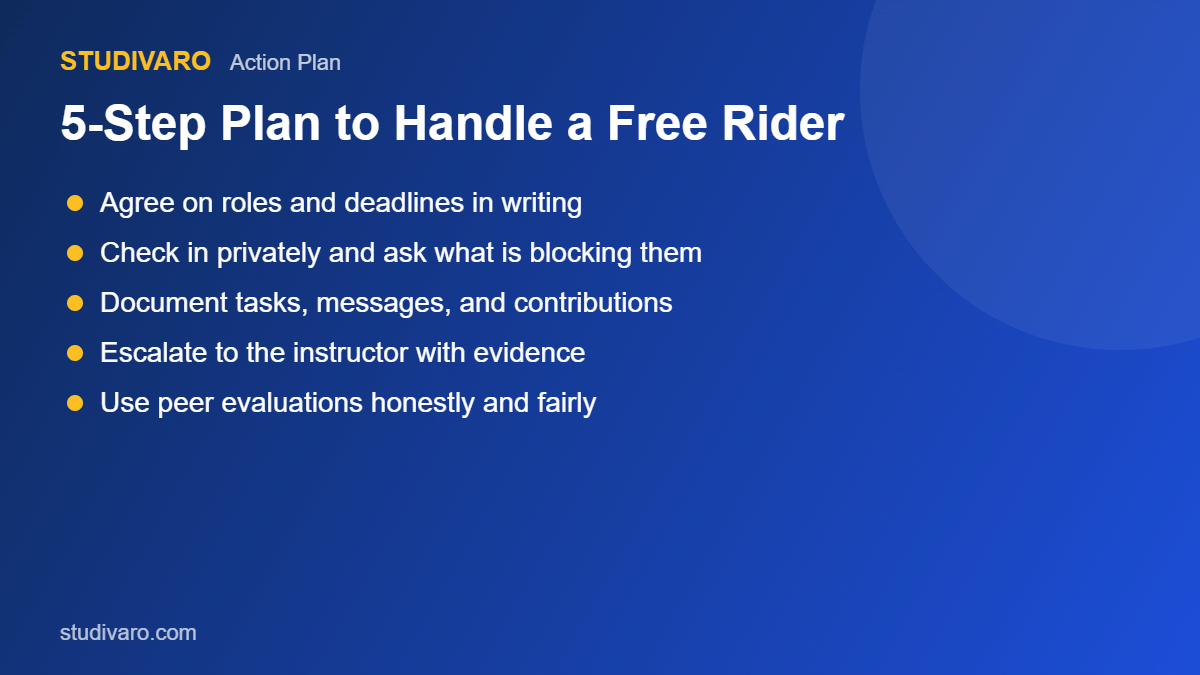
Phase 1: Preventing Group Project Free Rider Problems on Day 1
The most effective strategy for preventing group project free rider problems is establishing binding governance during the very first week of the assignment. When ground rules are explicit from Day 1, resolving group project free rider problems becomes an objective procedural check rather than an emotional confrontation.
1. Draft and Sign a Written Team Charter
During your first kickoff meeting, spend thirty minutes co-authoring a simple one-page Team Charter. Every member must explicitly sign or acknowledge it in writing. Include:
- Preferred official communication channel (e.g., Discord, Slack, WhatsApp, or Microsoft Teams).
- Mandatory response window for all messages (e.g., within 24 hours on weekdays).
- Concrete division of core responsibilities with named owners.
- Protocol for unforeseen illnesses or family emergencies.
2. Establish a Cloud-Based Digital Paper Trail
Never permit group members to work offline in isolated desktop files and send email attachments at the final hour. Using cloud logs stops group project free rider problems before they start:
- Google Docs or Office 365 Word: Provides real-time version history, per-character edit logs, and user-specific revision timestamps.
- Trello, Notion, or Asana: Visually tracks task progression across “To-Do,” “In Progress,” and “Completed” boards.
- GitHub or GitLab: Essential for coding, computer science, and data engineering projects to record exact commit histories and pull requests.
3. Implement the 72-Hour Internal Buffer Rule
If the professor’s formal submission deadline is Friday at 11:59 PM, set your internal group completion deadline for Tuesday at 11:59 PM. This 72-hour safety margin ensures that if an irresponsible teammate causes sudden group project free rider problems, the remaining members have adequate time to evaluate the situation, notify the professor, or reassign tasks without experiencing an all-night crisis.
Phase 2: Step-by-Step Intervention for Group Project Free Rider Problems
When confronting active group project free rider problems, follow this structured, progressive intervention process:
[Day 1: Private Empathetic Check-In] │ ▼ (No response within 24 hours)[Day 2: Formal Group Written Notice with Firm Re-assignment Deadline] │ ▼ (Failure to meet deadline or substandard work)[Day 3: Digital Evidence Compilation & Formal Faculty Escalation]
Step 1: The Private, Empathetic Inquiry
Begin by reaching out individually rather than calling out the student in front of the entire group. Public shaming triggers immediate defensiveness. Assume positive intent initially: students experience mental health crises, sudden family illnesses, and intense work shifts.
Ask directly whether everything is all right and verify whether they need clarification on their assigned sub-task. Reference the upcoming milestone clearly.
Step 2: The Formal Group Boundary Notice
If the teammate does not respond to private inquiries within 24 hours, escalate to a formal message inside the main group communication channel. Be polite, objective, and unambiguous:
- Specify the exact task that is overdue.
- Reference the agreed-upon project schedule.
- State a firm secondary deadline (e.g., 5:00 PM tomorrow).
- State clearly that if the milestone is not met, the remaining group members will redistribute the work and notify the professor that the scope has changed.
Step 3: Stop Doing Their Work in Secret
Doing extra work quietly worsens group project free rider problems across the academic community. When you quietly complete a slacker’s assigned tasks:
- The instructor assumes every group member contributed equally.
- The free rider receives an undeserved high grade at your expense.
- You exhaust yourself physically and mentally, damaging your performance in other courses.
- You deprive yourself of legitimate academic accommodations or grade adjustments from faculty.
Phase 3: Escalating Group Project Free Rider Problems to Faculty
University professors and teaching assistants dislike resolving interpersonal student disputes. If you approach an instructor with emotional complaints (“Alex is lazy and does nothing!”), the instructor will often reply: “Part of learning teamwork is working through personality differences.”
To get immediate, supportive intervention from faculty regarding group project free rider problems, follow the Evidence-First Escalation Rule. As documented by the Carnegie Mellon University Eberly Center, presenting factual contribution metrics is the most effective method for resolving team inequities.
To get immediate, supportive intervention from faculty regarding group project free rider problems, follow the Evidence-First Escalation Rule. Present your case as an objective project management update supported by empirical data. Understanding how professors evaluate group project free rider problems allows you to frame your request effectively.
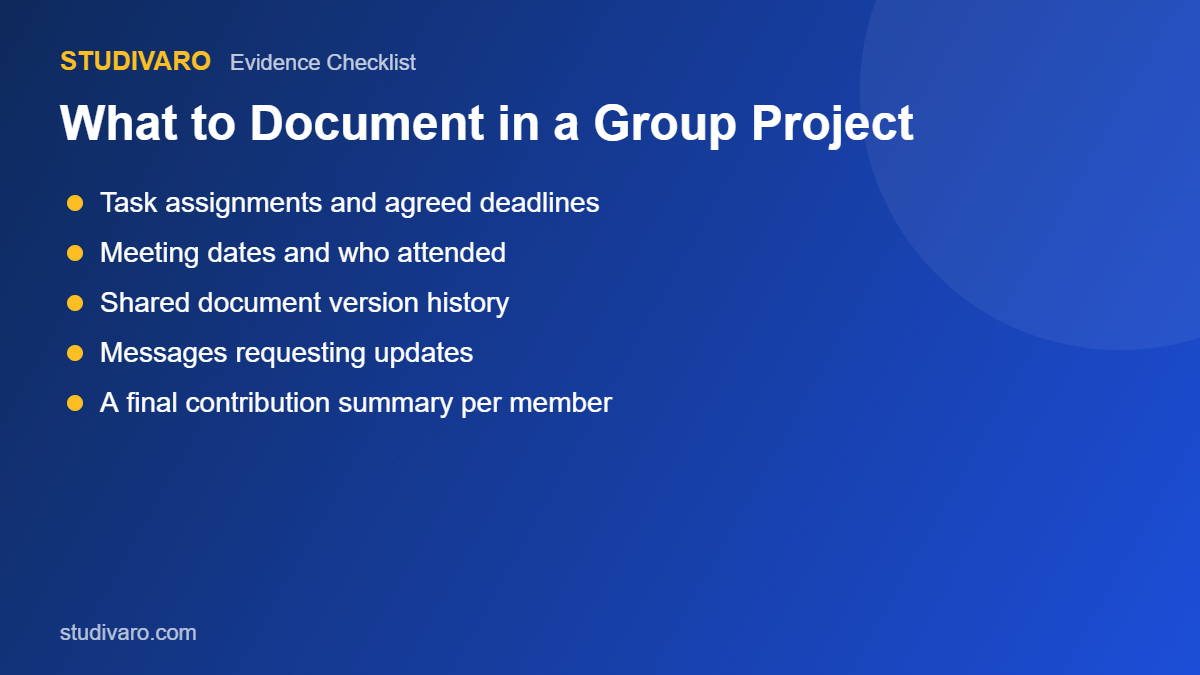
What Documentation Professors Require:
- Cloud Revision Histories: Export version histories demonstrating that 95% of document revisions and words were authored by the other three members.
- Communication Logs: Clean screenshots of unanswered check-ins, missed meeting dates, and ignored deadline reminders.
- The Original Team Charter: Demonstrates that the non-contributing student agreed to specific deliverables and deadlines weeks earlier.
- A Concrete Work Redistribution Proposal: Show the instructor how the active members plan to finalize the project without the missing component.
Actionable Communication Templates for Group Project Free Rider Problems
Use these copy-paste scripts to resolve group project free rider problems calmly and assertively:
Template 1: Gentle Private Check-In (Individual Message)
Subject/Message: Checking in on [Course Name] project milestone
“Hi [Name], I noticed we haven’t received your draft for Section 3, which was due yesterday for our internal review. Is everything okay on your end? We want to make sure you have what you need to complete your part. Please let us know when you can upload your draft so we can stay on track for Friday’s final submission. Thanks!”
Template 2: Formal Group Notice (Group Chat or Email)
Subject: [Course Name] Team 4: Urgent Update on [Deliverable Name]
“Hi [Name], we missed you at today’s check-in meeting. As outlined in our team schedule, the literature review draft was due on Tuesday at 6:00 PM. We have not received your section or an update regarding your progress.
To protect our team submission, we need your completed draft uploaded to our shared Google Doc by tomorrow (Thursday) at 12:00 PM.If you are unable to deliver the section by that time, the rest of the group will take over your topic and adjust the project structure accordingly. We will also need to inform Professor [Instructor Last Name] so they know how our responsibilities have been redistributed. Please let us know your status as soon as possible.”
Template 3: Professional Faculty Escalation (Official Course Email)
Subject: [Course Code] – Group [Number] Project Status & Contribution Update
“Dear Professor [Instructor Last Name],
We are writing to give you a brief, proactive update on our group project for [Course Name]. Our team ([Member 1], [Member 2], and [Member 3]) has completed approximately 75% of our final report and presentation slides.
Unfortunately, we have encountered significant contribution challenges regarding our teammate, [Student Name]. Despite multiple check-ins over the past two weeks and agreed-upon internal milestones, [Student Name] has not attended our last three group meetings and has not submitted their assigned section ([Topic/Section Name]).
We have documented our communication and document edit histories, which we are glad to share if needed.To ensure our project meets your high standards, the three of us have reorganized the remaining workload and are covering the essential elements.
We wanted to inform you of this adjustment ahead of Friday’s deadline and seek your guidance on how to reflect individual contributions appropriately in the final submission. Thank you for your time and advice.
Sincerely,
[Your Full Name]
[Teammate 2 Full Name]
[Teammate 3 Full Name]
[Course Section & Team Number]”
Peer Evaluation and Individual Grade Allocation
Many university departments now employ formal peer evaluation platforms such as CATME, Teammates, or Spark. When your course syllabus includes a peer assessment component, your ratings directly scale individual grades up or down based on a contribution multiplier.
How to Complete Peer Evaluations Fairly:
- Rate Behaviors, Not Likability: Do not penalize someone because they are introverted, and do not award a perfect score to a sociable student who contributed zero written work.
- Write Specific Rubric Justifications: When awarding a low score (e.g., 1 out of 5 for reliability), cite factual occurrences: “Missed 4 out of 5 scheduled check-ins; contributed 120 words to the final 6,000-word report according to Google Docs version history.”
- Provide Objective Self-Assessments: Accurately reflect your own contribution without hyperbole. Over-inflating your own score while giving everyone else bottom marks makes you look uncooperative.
What NOT to Do When Handling Group Project Free Rider Problems
When handling intense group project free rider problems, avoiding common pitfalls will safeguard your professional reputation and keep faculty on your side:
- Do Not Stage a Public Group Attack: Humiliating a teammate in a lecture hall or blowing up a group chat with insulting language violates student codes of conduct and shifts faculty sympathy to the slacker.
- Do Not Plagiarize to Fill Their Gap: If a free rider suddenly uploads copy-pasted Wikipedia paragraphs or unedited generative AI outputs at the last minute, delete it immediately. Submitting unvetted text exposes the entire team to academic disciplinary hearings.
- Do Not Wait Until Post-Submission to Speak Up: Approaching your professor after grades are published and demanding a grade change because a teammate did nothing is rarely successful. Instructors expect students to raise severe project bottlenecks before final grading.
- Do Not Remove Their Name Without Faculty Consultation: While tempting, deleting a student’s name from a cover page without the professor’s prior permission can lead to administrative complaints. Always notify the instructor in writing of authorship changes.
Academic and Professional Workload Planning Tools
Successfully resolving academic pressure requires balancing tight deadlines across multiple challenging courses. Use these trusted Studivaro resources and tools to optimize your semester:
- Thesis Writing Schedule Guide: Plan large-scale academic writing milestones, chapter distribution, and research buffers effectively.
- Missed College Lecture Cost Calculator: Understand the real financial investment of your college education and optimize attendance habits.
- ECTS to US Semester Credits Conversion Guide: Calculate credit transfers and academic course weights accurately for study-abroad programs.
- UK Degree Classifications Explained: Learn how First-Class and Upper Second-Class (2:1) honors are calculated across university modules.
Frequently Asked Questions (FAQs)
What should I do if a free rider refuses to respond to any messages?
If an assigned group member fails to respond to multiple inquiries within 48 hours, issue a formal written notice with a specific deadline. If that deadline passes without communication, inform your professor via official university email, summarize the missed deliverables objectively, and outline how the active group members are covering the core requirements.
Can a university professor fail one group member while passing the others?
Yes. Most university policies and academic honor codes allow instructors to assign differentiated grades based on documented non-participation, individual peer evaluations, and contribution logs. When presented with clear version histories, professors regularly award full credit to active contributors while failing the non-participating student.
Should I complete a free rider’s section the night before the deadline?
If the missing section is vital to the cohesion of the overall project, you may need to write an abbreviated version to ensure the assignment meets basic submission criteria. However, you must document that this emergency work was completed by the remaining team and notify your instructor before or at the time of submission so the free rider does not receive unearned credit.
How do I prove that a teammate did not contribute to a group project?
Use cloud platform history features. Google Docs, Word Online, and GitHub provide permanent, timestamped records of every edit, sentence, and line of code added by specific user accounts. Export these revision histories and retain screenshots of your group chat check-ins as verifiable digital evidence.
What if the non-contributing student has a genuine medical or personal emergency?
If a student discloses a legitimate personal or medical crisis, express empathy and advise them to contact the course professor and academic advising office directly for official accommodations. The remaining team members should work with the instructor to adjust project scope rather than taking on unsustainable workloads without institutional guidance.
How can I prevent group project free rider problems in future classes?
To prevent group project free rider problems, establish a written Team Charter detailing communication expectations, internal deadlines, and task ownership during week one. Adopting proven frameworks to eliminate group project free rider problems protects team morale. Set all internal completion dates at least 48 to 72 hours before the formal class deadline to create a buffer against unexpected delays.
Final Key Takeaway
Collaborative projects are designed to simulate real-world professional environments where team dynamics, accountability, and project management are just as important as technical subject knowledge. By establishing clear team agreements early, keeping timestamped digital records, maintaining calm communication, and escalating issues to instructors with objective evidence, you can successfully resolve group project free rider problems while protecting both your GPA and your peace of mind.
Group Project Fair Share & Peer Grade Calculator
Calculate individual peer contribution multipliers, detect free-rider discrepancies, and calculate fair differentiated individual grades using the standard CATME university algorithm.