

Thesis Writing Schedule How to Plan 80000 Words in 6 Months: Best Guide
Creating a structured thesis writing schedule how to plan 80000 words in 6 months is the single most vital operational strategy for doctoral candidates and master’s researchers completing a dissertation. Writing an 80,000-word book-length manuscript can feel overwhelming without a calibrated mathematical timeline.
Try it yourself: Use our free Thesis Planning Calculator to run your own numbers in seconds. No sign-up needed.
When researchers approach a doctoral thesis as a monolith, anxiety, procrastination, and imposter syndrome often paralyze academic output. However, breaking this monumental task down through a proven thesis writing schedule how to plan 80000 words in 6 months transforms an intimidating dissertation into manageable, predictable daily writing targets. This definitive 2026 academic productivity guide outlines chapter word distributions, 4-phase timelines, buffer management, and revision workflows verified across global research universities.
Table of Contents
1. Why a Thesis Writing Schedule How to Plan 80000 Words in 6 Months Matters
An 80,000-word PhD thesis is equivalent to an academic monograph of approximately 300 printed pages. In the UK, Australia, and North America, completing this manuscript is the defining prerequisite for doctoral degree conferral.
Without a rigorous schedule, doctoral researchers frequently fall into the “perpetual research trap”—spending endless months gathering secondary literature or tweaking experiments while drafting zero text. Executing our thesis writing schedule how to plan 80000 words in 6 months forces you to transition from consumer of knowledge to active producer of scholarly scholarship.
Furthermore, university enrollment deadlines, funding expiration dates, and visa validity caps create firm hard stops. Having an operational timeline provides institutional accountability and ensures your supervisor receives chapter drafts with sufficient lead time for rigorous feedback.
2. The Core Mathematical Breakdown: Daily Targets and Workload Reality
When candidates calculate the raw mathematics behind an 80,000-word target, the psychological burden dramatically evaporates.
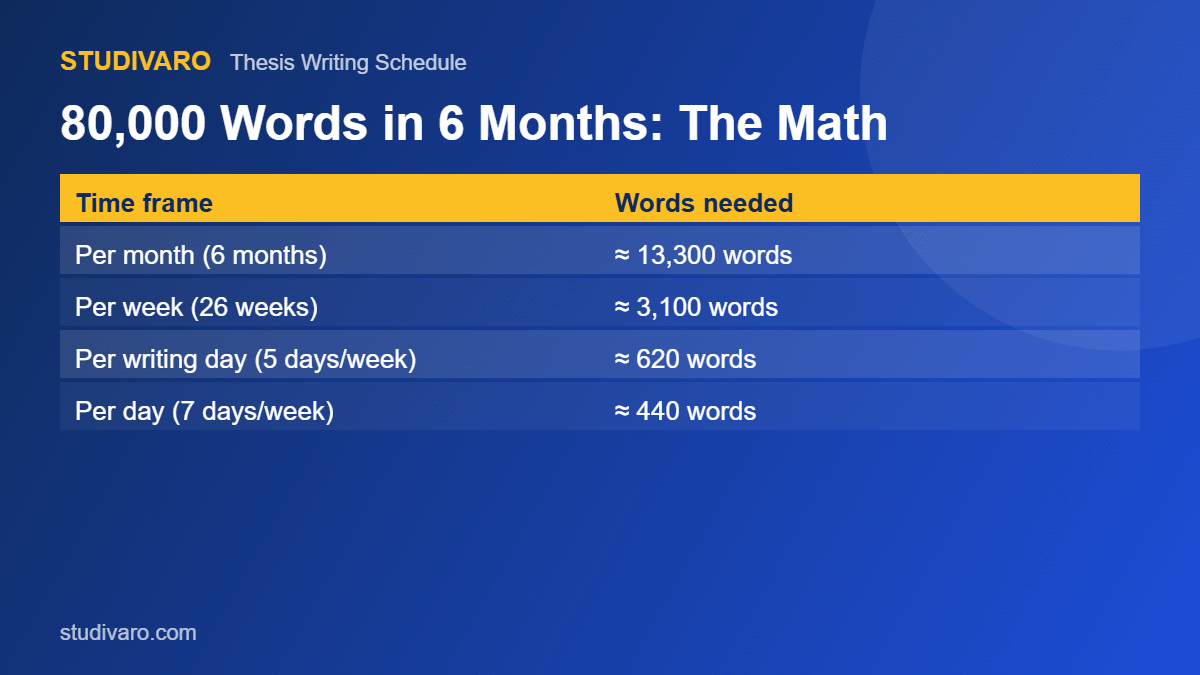
Over a 6-month period (precisely 26 weeks or 182 calendar days):
- Total Words Required: 80,000 words
- Calendar Days Available: 182 days
- Realistic Writing Days (5 Days per Week): 130 working days (reserving 2 days weekly for rest, illness, family, and unexpected research delays)
- Daily Word Count Target: 615 words per writing day (or ~3,075 words per week)
Writing 615 words per day equates to just two double-spaced academic pages. When guided by a calibrated thesis writing schedule how to plan 80000 words in 6 months, producing two coherent pages during a morning 90-minute deep work session is entirely attainable for any dedicated postgraduate scholar.
Adhering to our verified thesis writing schedule how to plan 80000 words in 6 months ensures you maintain consistent daily output without succumbing to academic burnout.
3. The 4-Phase Thesis Execution Architecture (Month-by-Month Roadmap)
A successful thesis is drafted modularly rather than chronologically. Writing the introduction first is a common rookie mistake; your introduction frames arguments that only crystalize after your empirical chapters are written.
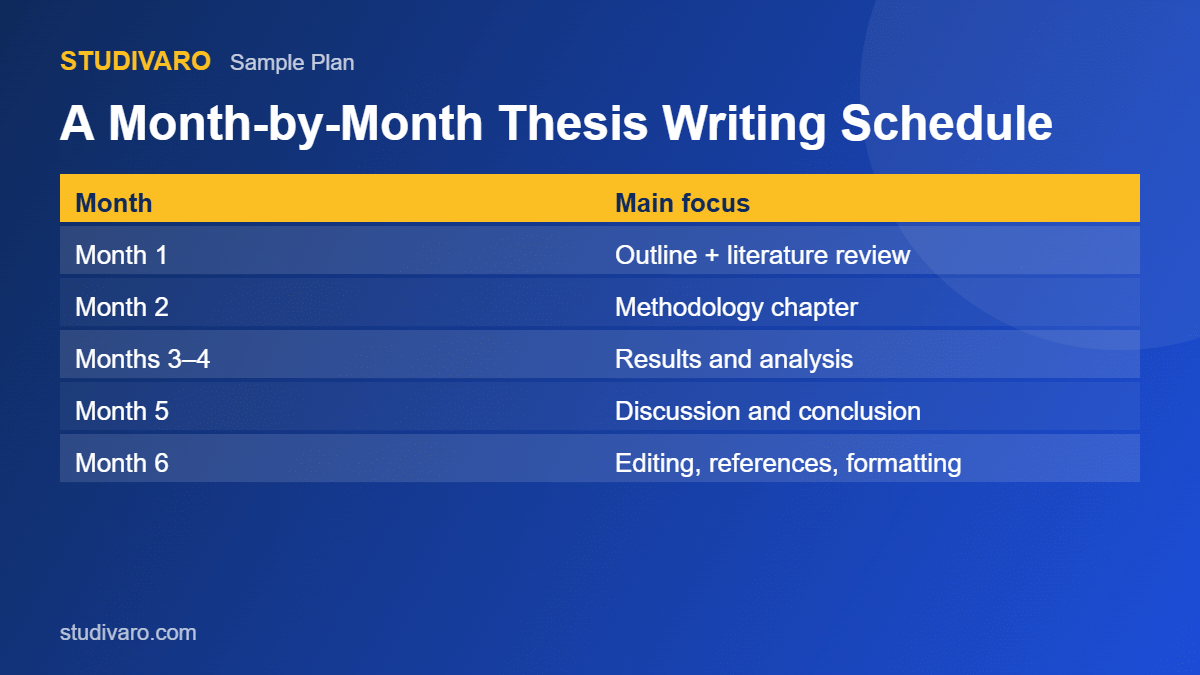
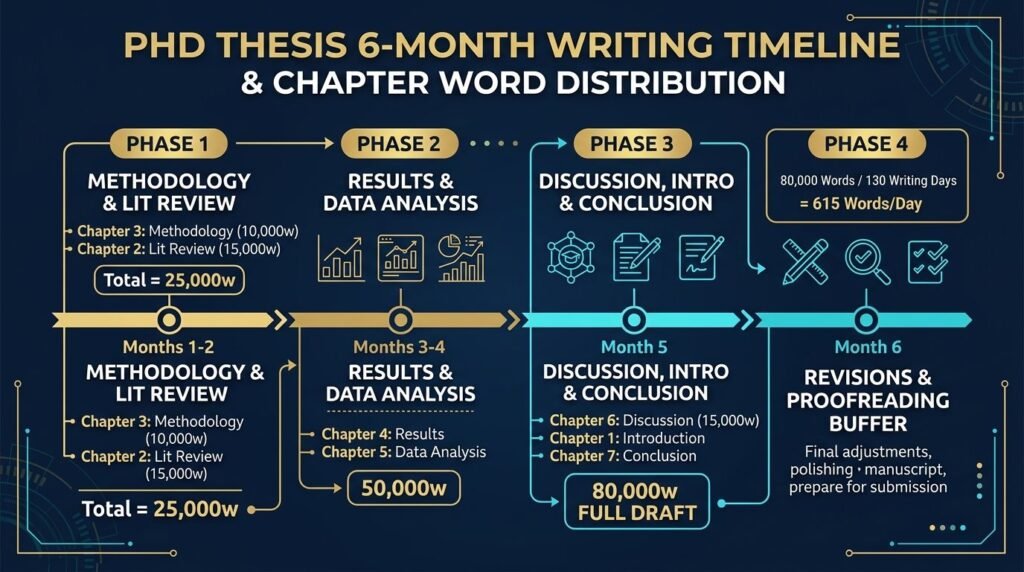
Phase 1: Months 1 & 2 (Weeks 1–8) — Foundational Drafting (25,000 Words)
- Methodology Chapter (~10,000 words): Start here. Documenting what you did, your philosophical paradigms, experimental setups, and ethical approvals is concrete and builds immediate writing momentum.
- Literature Review Chapter (~15,000 words): Synthesize existing theoretical debates and establish the explicit scholarly gap your doctoral dissertation fills.
- Cumulative Output: 25,000 words drafted.
Phase 2: Months 3 & 4 (Weeks 9–16) — Core Analysis & Findings (25,000 Words)
- Results / Empirical Analysis Chapters (~25,000 words across 2–3 chapters): Present data, textual analyses, qualitative thematic coding, or statistical models.
- Cumulative Output: 50,000 words drafted.
Phase 3: Month 5 (Weeks 17–20) — Synthesis and Framing (30,000 Words)
- Discussion Chapter (~15,000 words): Interpret findings against your literature review theoretical framework.
- Introduction & Conclusion Chapters (~10,000 words): Frame your overarching research question and articulate theoretical and policy implications.
- Abstract, Bibliography & Appendices (~5,000 words): Format front matter and citations.
- Cumulative Output: 80,000 Words (Full First Draft Completed!)
Phase 4: Month 6 (Weeks 21–26) — Critical Revision, Formatting, and Defense Preparation
- Substantive structural edits and supervisor feedback integration.
- Line editing, proofreading, citation validation, and institutional formatting compliance.
Adhering to this phased thesis writing schedule how to plan 80000 words in 6 months ensures that Month 6 remains a dedicated buffer rather than a chaotic drafting emergency.
4. Master Chapter Breakdown and Milestone Target Table
The following master reference table outlines standard chapter word distributions, target timelines, and milestone checkpoints across an 80,000-word doctoral thesis:
| Chapter / Section | Target Word Count | Phase Allocation | Completion Deadline | Primary Scholarly Objective |
|---|---|---|---|---|
| Methodology | 10,000 Words | Phase 1 (Weeks 1–4) | End of Month 1 | Document research design, data collection, and paradigms |
| Literature Review | 15,000 Words | Phase 1 (Weeks 5–8) | End of Month 2 | Critical synthesis of scholarly debates and theoretical gap |
| Results Chapter 1 | 12,000 Words | Phase 2 (Weeks 9–12) | End of Month 3 | Primary empirical findings, datasets, and thematic analysis |
| Results Chapter 2 | 13,000 Words | Phase 2 (Weeks 13–16) | End of Month 4 | Secondary empirical data, case studies, or experimental proofs |
| Discussion | 15,000 Words | Phase 3 (Weeks 17–18) | Middle of Month 5 | Critical interpretation of results against literature review |
| Introduction | 5,000 Words | Phase 3 (Week 19) | Week 19 | Framing research questions, scope, and structural overview |
| Conclusion & Impact | 5,000 Words | Phase 3 (Week 20) | End of Month 5 | Summary of contributions, limitations, and future research |
| Abstract & Citations | 5,000 Words | Phase 3 (Week 20) | End of Month 5 | Standardizing bibliography, front matter, and appendices |
| Revision & Formatting | Full Manuscript | Phase 4 (Weeks 21–26) | End of Month 6 | Structural revisions, proofreading, and supervisor sign-off |
Reviewing this comprehensive thesis writing schedule how to plan 80000 words in 6 months milestone table allows candidates to monitor individual chapter word counts systematically.
Consulting this structured thesis writing schedule how to plan 80000 words in 6 months milestone matrix guarantees that every modular component receives balanced, proportionate scholarly depth.
5. Daily Writing Habits: Structuring 90-Minute Academic Deep Work Sprints
Academic writing is a cognitive endurance marathon, not a sprint. Relying on sudden bursts of inspiration produces erratic output and eventual burnout.
The most prolific doctoral researchers utilize structured time-blocking:
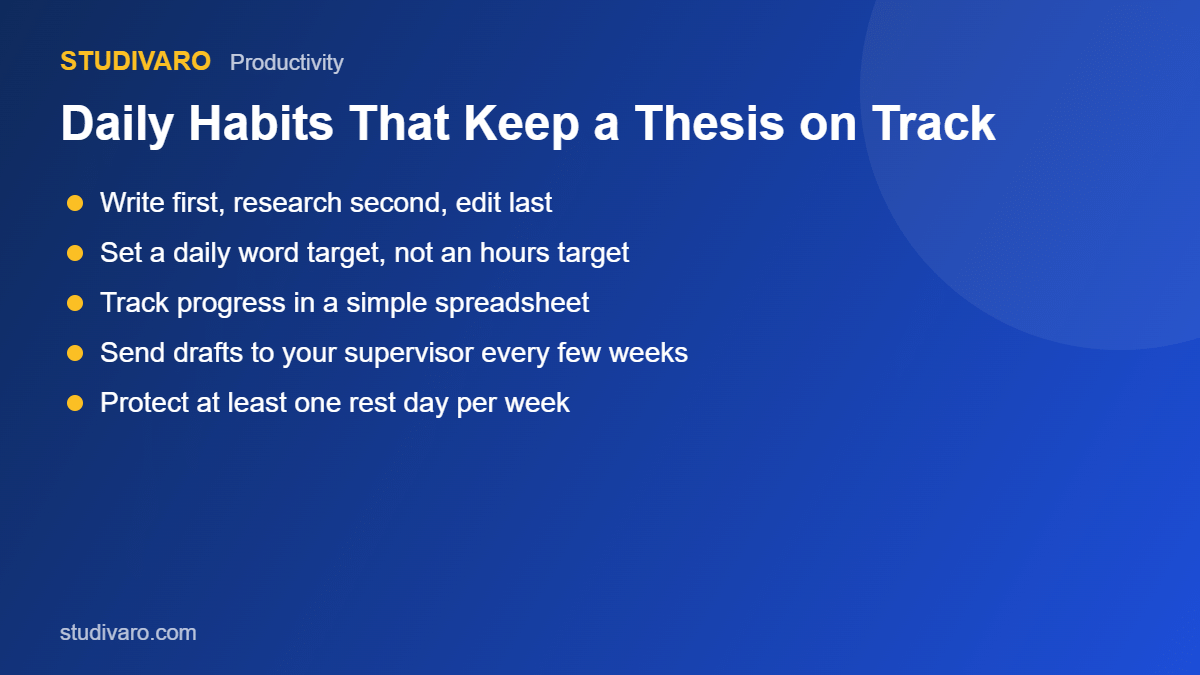
- The Morning 90-Minute Deep Work Block: Write from 8:30 AM to 10:00 AM before checking email, social media, or department notifications. Write when your cognitive executive function is fresh.
- Track Output, Not Just Time: Aim for your 615 words daily target. Once you hit 615 polished words, grant yourself permission to step away from drafting.
- Draft First, Edit Later: Turn off your internal critic. Trying to write perfect prose on your first pass slows drafting down to 100 words per hour. Separate the generation phase from the evaluation phase.
Applying these operational habits within your thesis writing schedule how to plan 80000 words in 6 months maintains high morale and prevents intellectual fatigue.
6. Managing the Revision Buffer: Why Month 6 Is Essential
One of the most dangerous miscalculations postgraduate students make is planning to finish their first draft on the final submission day. A first draft is never a submission-ready manuscript.
Month 6 in our thesis writing schedule how to plan 80000 words in 6 months is exclusively reserved as an emergency buffer:
- The “Cooling-Off” Period (Week 21): Step away from the manuscript for 5 to 7 days. Returning with fresh eyes allows you to spot logical contradictions and awkward prose instantly.
- Macro Structural Review (Weeks 22–23): Verify that each chapter directly links back to your core thesis question. Trim repetitive arguments and ensure seamless transition paragraphs.
- Micro Proofreading & Formatting (Weeks 24–25): Standardize heading typography, table captions, numbering styles, and citation libraries (Zotero, Mendeley, EndNote).
- Final Submission Buffer (Week 26): Bind physical copies or submit digital PDFs through your university graduate portal.
Reserving the final four weeks within your thesis writing schedule how to plan 80000 words in 6 months prevents last-minute panic and ensures high-quality proofreading.
7. Connecting Postgraduate Productivity to Long-Term Academic and Career ROI
Completing your doctoral thesis on time directly influences your post-graduation career opportunities and financial stability.
For UK scholars aiming for elite post-doctoral fellowships or corporate strategy positions, degree classifications and academic rigor matter; explore our guide on UK Degree Classifications First 21 and 22 Explained.
Furthermore, international scholars evaluating European doctoral research can review our detailed analysis of the German Sperrkonto Monthly Cost by City. For students transferring credits or degrees internationally, consult our ECTS to US Semester Credits Conversion Guide.
Managing research debt and postgraduate loans requires rigorous financial forecasting; project your graduate repayments using our Student Loan Monthly Payment Calculator.
Evaluating career compensation against tuition investment is equally vital; assess your long-term earnings trajectory using our College Major Salary to Debt Ratio Calculator. Finally, maintaining active research engagement protects your tuition investment; review our breakdown on How Much Does a Missed College Lecture Cost to protect your educational capital.
Following our proven thesis writing schedule how to plan 80000 words in 6 months safeguards your scholarship and launches your professional academic career.
8. Managing Supervisory Relationships and Overcoming Feedback Bottlenecks
A primary cause of dissertation derailment is uncoordinated supervisory relationships. Your supervisor is busy balancing teaching, grant writing, and administrative duties.
To keep your timeline on track:
- Send Modular Chapters, Not the Entire 80,000 Words: Send Chapter 3 as soon as it is drafted in Month 2. Do not wait until Month 5 to dump an unmanageable 60,000-word file into their inbox.
- Attach an Executive Summary Cover Note: When submitting a chapter, include a 1-page summary outlining: (a) what arguments the chapter makes, and (b) three specific questions you want feedback on.
- Agree on a 2-Week Review Window: Establish a mutually agreed turnaround expectation so your drafting never halts while waiting for comments.
Embedding supervisory communication checkpoints into your thesis writing schedule how to plan 80000 words in 6 months keeps external stakeholders aligned with your personal submission target.
9. Step-by-Step Action Plan: Launching Your 6-Month Thesis Writing Schedule
To initiate your writing journey immediately, execute this 5-point launch protocol:
- Calculate Your Target End Date: Pinpoint your formal university submission deadline and count back exactly 26 weeks to establish Day 1.
- Establish Word Budget Benchmarks: Assign strict word ranges to every chapter in consultation with your departmental handbook guidelines.
- Configure Reference Management Software: Populate your Zotero or Mendeley database and verify APA, Harvard, or Chicago output styles before typing paragraph one.
- Schedule Bi-Weekly Milestone Audits: Block out Sunday evenings to review actual word count against your planned target and calibrate upcoming weekly sprints.
- Protect Rest and Recovery: Treat weekends as mandatory cognitive recovery time to sustain creative endurance across the entire 6-month cycle.
Executing this tactical thesis writing schedule how to plan 80000 words in 6 months checklist ensures steady, anxiety-free academic production from introductory outline to final defense.
10. Frequently Asked Questions (FAQ)
Is it really possible to write an 80,000-word PhD thesis in 6 months?
Yes. When primary laboratory experimentation, archival research, or data collection is complete, writing 80,000 words in 6 months requires drafting approximately 615 words per day across a standard 5-day working week. Thousands of doctoral candidates successfully submit on this timeline annually.Consulting a realistic thesis writing schedule how to plan 80000 words in 6 months clearly proves that 615 words per day across 26 weeks is entirely achievable.
What should I do if I fall two weeks behind my thesis schedule?
Do not panic or attempt to write 2,000 words per day to catch up immediately. Rebalance your schedule by temporarily expanding your writing week from 5 days to 6 days for three weeks, or by modestly trimming 500 words from each remaining chapter scope.
Should I write my introduction or literature review first?
Start with your Methodology chapter. It is factual and procedurally straightforward, which builds confidence. Follow with your Literature Review and Empirical chapters. Write your Introduction and Conclusion last, as they must reflect your verified final findings.
How many hours a day should I spend writing my thesis?
Aim for 3 to 4 hours of focused, distraction-free drafting per day. Cognitive research shows that high-level academic prose production degrades significantly after 4 hours of intensive deep work. Use remaining daily hours for reference checking, editing, and reading.
What software is best for managing a long-form thesis?
Scrivener, Microsoft Word with institutional templates, and LaTeX (Overleaf for STEM fields) are the leading platforms. Pair your word processor with a reference manager like Zotero or EndNote and an automated cloud backup system (OneDrive, Google Drive, or Dropbox).
Thesis Writing Schedule: Key Takeaways
Use this recap to set up, or reset, your thesis writing schedule:
- Break 80,000 words into weekly targets of roughly 3,100 words, or about 620 words per writing day on a five-day week.
- Build your thesis writing schedule around chapters, with the final month reserved for editing, references, and formatting.
- Write first and polish later; heavy editing during drafting slows progress more than anything else.
- Share drafts with your supervisor every few weeks so feedback never piles up at the end.
- Track words weekly and adjust your thesis writing schedule early if you fall behind, rather than hoping to catch up in the final weeks.
- Protect rest days; a sustainable pace finishes more theses than heroic all-nighters.
A realistic thesis writing schedule turns an intimidating 80,000-word target into small, repeatable daily tasks you can actually complete.
11. Verified Higher Education Resources and Writing Guidelines
For academic writing frameworks, style guides, and postgraduate support directives, consult these verified resources:
- UK Research and Innovation (UKRI): Training and Developing Researchers
- Harvard University Writing Center: Strategies for Essay and Thesis Writing
Thesis Writing Schedule How to Plan 80000 Words in 6 Months Calculator
Interactive tool for thesis writing schedule how to plan 80000 words in 6 months calculating daily targets and chapter milestones.