
Bavarian Formula German Grade Conversion Guide: Best 2026 Guide
The bavarian formula german grade conversion guide provides international students with the official mathematical system used by German universities and uni-assist to convert foreign academic grades into the German grading scale. When applying to public universities across Germany, prospective international scholars quickly discover that Germany does not use standard 4.0 Grade Point Averages or letter marks.
Try it yourself: Use our free Bavarian Formula Grade Converter to run your own numbers in seconds. No sign-up needed.
Mastering the official bavarian formula german grade conversion guide is critical for securing admission into competitive, degree programs subject to admission restrictions (Numerus Clausus or NC). The Standing Conference of the Ministers of Education and Cultural Affairs (Kultusministerkonferenz or KMK) established the “Modified Bavarian Formula” (Modifizierte bayerische Formel) to create an equitable, legally binding conversion standard. This definitive 2026 reference guide breaks down the mathematical formula, university grade thresholds, uni-assist evaluation policies, and global conversion examples.
Table of Contents
1. What Is the Bavarian Formula German Grade Conversion Guide Standard?
In the German higher education system, academic grades run inversely to most international systems: a lower numerical score represents superior academic achievement.
The German academic scale operates on a 1.0 to 5.0 range:
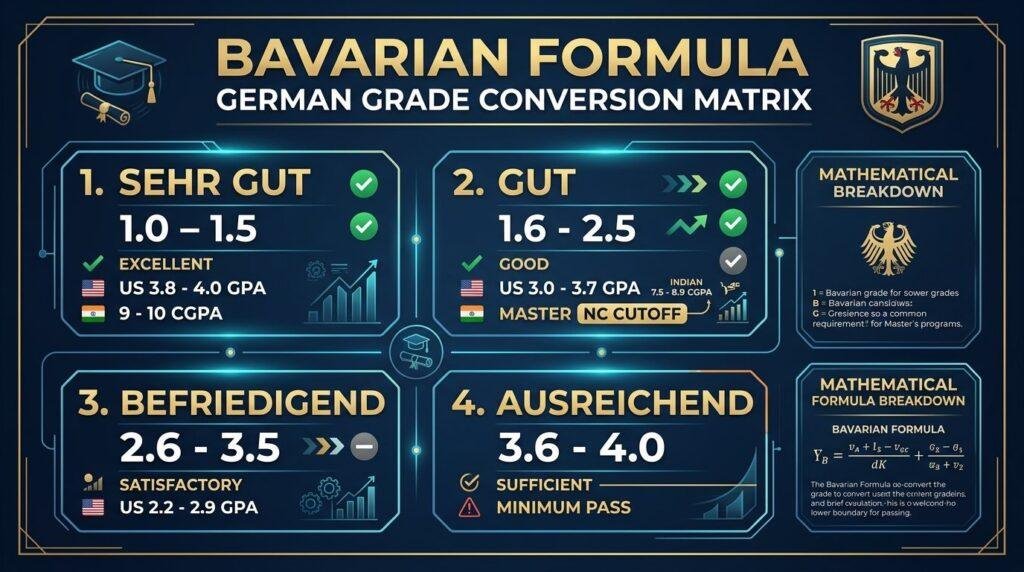
- 1.0 to 1.5 (Sehr Gut / Very Good): Outstanding academic distinction equivalent to an American 4.0 GPA or British First Class Honours.
- 1.6 to 2.5 (Gut / Good): Above-average performance meeting competitive master’s admission criteria.
- 2.6 to 3.5 (Befriedigend / Satisfactory): Average academic performance meeting baseline degree standards.
- 3.6 to 4.0 (Ausreichend / Sufficient): Minimum passing grade required to confer an academic qualification.
- 4.1 to 5.0 (Nicht Ausreichend / Unsatisfactory): Academic failure.
Our detailed bavarian formula german grade conversion guide explains that because international grading structures vary widely—from 10-point CGPA scales in India to 100-point percentages in the UK and Pakistan—the Bavarian Formula standardizes these disparities into a single, calibrated metric.
2. The Official Modified Bavarian Formula Equation
The KMK resolution establishes a standardized mathematical equation to normalize international academic transcripts:
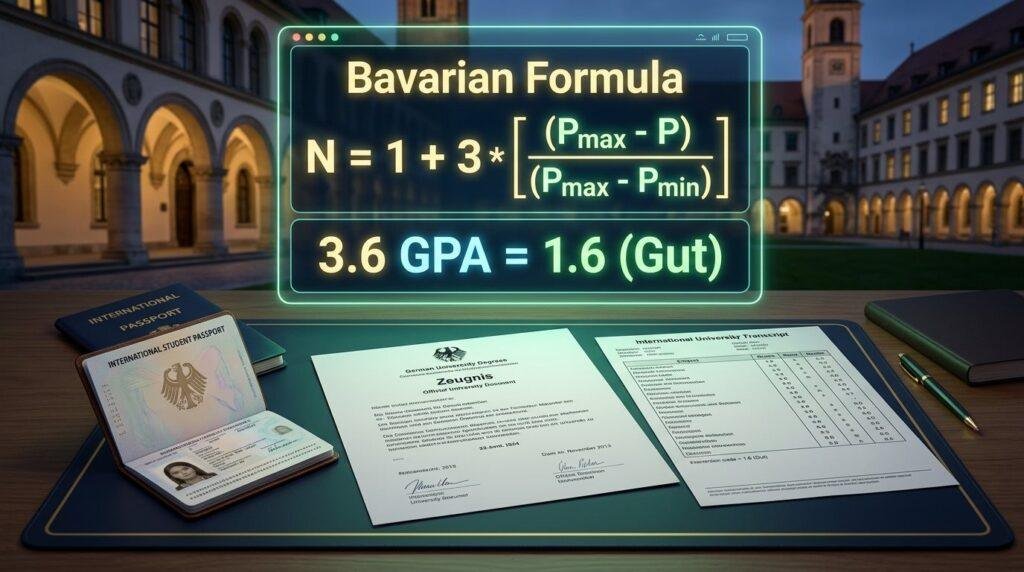
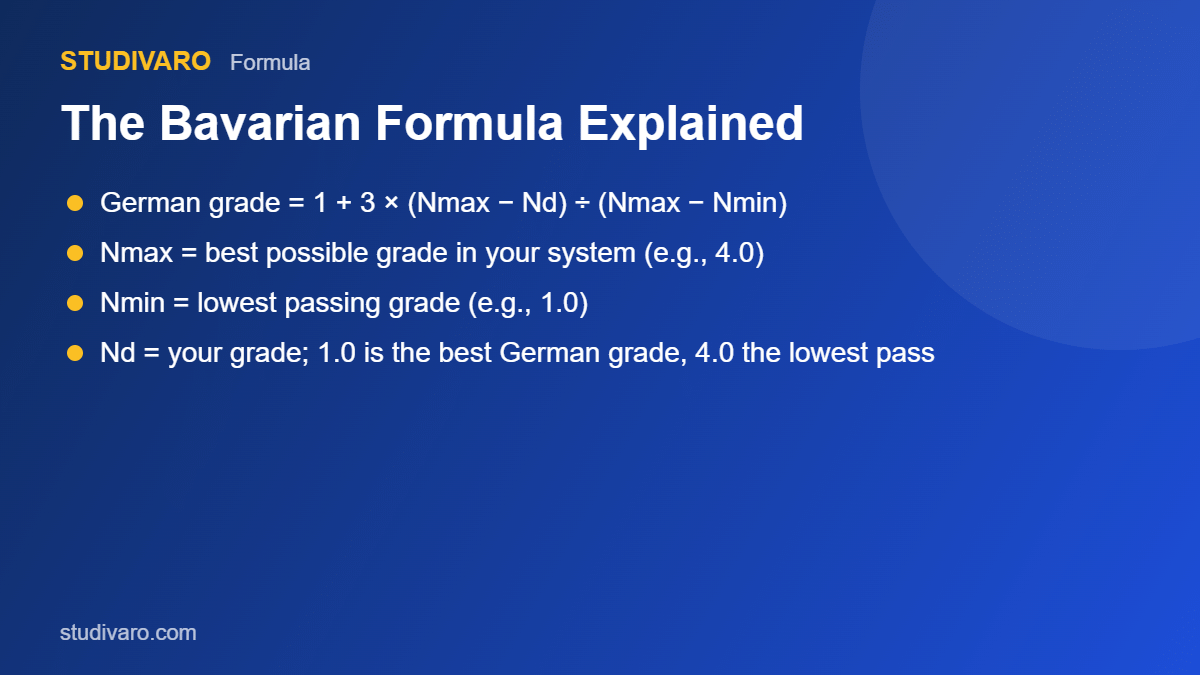
German Grade (N) = 1 + 3 × [(Pmax - P) ÷ (Pmax - Pmin)]Where each mathematical variable is defined as:
- N: The calculated German grade equivalent (rounded to one decimal place, e.g., 1.7).
- Pmax: The maximum possible passing grade attainable in your home university’s grading system.
- Pmin: The minimum passing grade required to pass a course or obtain a degree in your home system.
- P: The actual cumulative grade, GPA, or percentage mark earned by the applicant.
Referencing this bavarian formula german grade conversion guide equation demonstrates that the formula calculates the exact mathematical distance between your score and the maximum grade, scaling it proportionally across the 1.0 to 4.0 German passing spectrum.
3. Step-by-Step Worked Conversion Examples Across International Systems
To see how the formula functions in practice, consider three standard global applicant profiles:
Example 1: United States 4.0 GPA Scale
An American undergraduate applies with a cumulative GPA of 3.60. The home institution defines maximum possible GPA as 4.00 and minimum passing as 2.00.
- Pmax = 4.00, Pmin = 2.00, P = 3.60
- Calculation:
1 + 3 × [(4.00 - 3.60) ÷ (4.00 - 2.00)] 1 + 3 × [0.40 ÷ 2.00] = 1 + 3 × 0.20 = 1 + 0.60 = 1.60- Resulting German Grade: 1.6 (Gut)
Example 2: Indian 10-Point CGPA Scale
An Indian engineering graduate holds an 8.20 CGPA. The university transcripts establish maximum possible as 10.0 and minimum passing as 4.0.
- Pmax = 10.0, Pmin = 4.0, P = 8.20
- Calculation:
1 + 3 × [(10.0 - 8.20) ÷ (10.0 - 4.0)] 1 + 3 × [1.80 ÷ 6.0] = 1 + 3 × 0.30 = 1 + 0.90 = 1.90- Resulting German Grade: 1.9 (Gut)
Example 3: British / Commonwealth 100% Scale
A British student graduates with an overall percentage of 64% (Upper Second-Class 2:1). The institution defines 100% as theoretical maximum and 40% as minimum pass.
- Pmax = 100, Pmin = 40, P = 64
- Calculation:
1 + 3 × [(100 - 64) ÷ (100 - 40)] 1 + 3 × [36 ÷ 60] = 1 + 3 × 0.60 = 1 + 1.80 = 2.80- Resulting German Grade: 2.8 (Befriedigend)
Applying our calibrated bavarian formula german grade conversion guide models allows international candidates to accurately project their competitive standing before paying non-refundable university application fees.
4. Master Conversion Table: International Grades to German Note
The following comparative table illustrates typical grade conversions across leading international higher education frameworks:
| International System | Home Max (Pmax) | Home Pass (Pmin) | Sample Score (P) | German Grade (Note) | German Academic Tier | Admission Competitiveness |
|---|---|---|---|---|---|---|
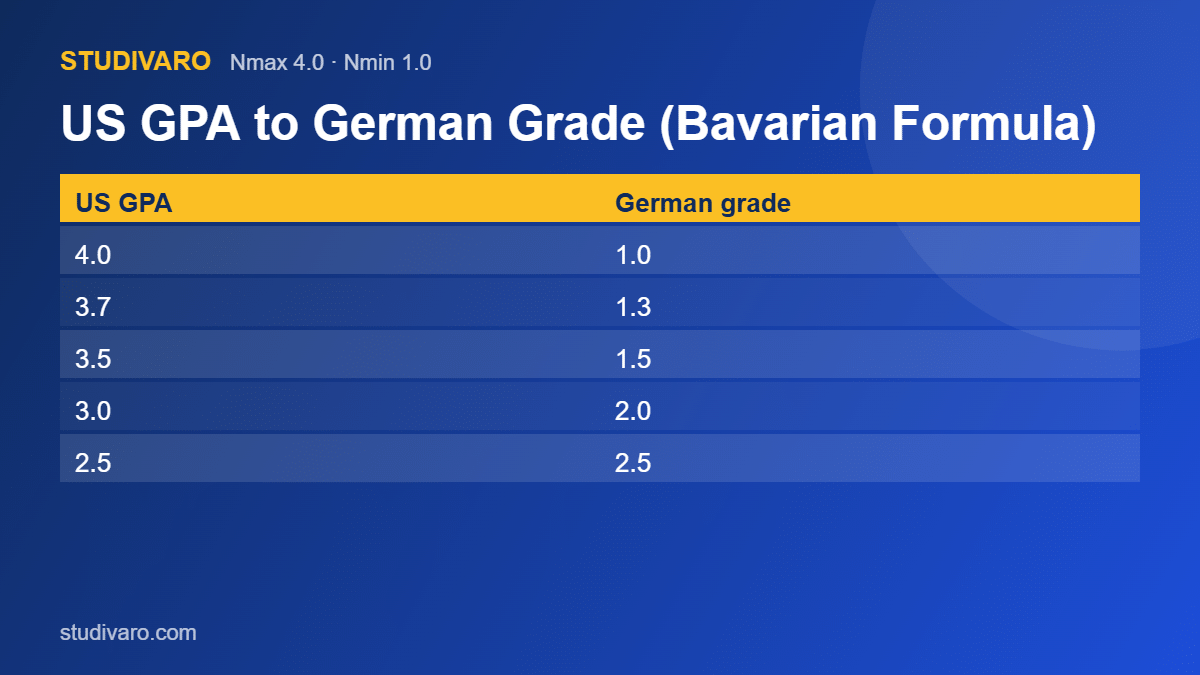
| US 4.0 GPA | 4.00 | 2.00 | 3.85 | 1.2 | Sehr Gut (Excellent) | Highly Competitive (TU9 / LMU) |
| US 4.0 GPA | 4.00 | 2.00 | 3.50 | 1.7 | Gut (Good) | Eligible for most Master’s |
| US 4.0 GPA | 4.00 | 2.00 | 3.00 | 2.5 | Gut (Good) | Standard NC Benchmark |
| US 4.0 GPA | 4.00 | 2.00 | 2.60 | 3.1 | Befriedigend (Satisfactory) | Open-admission programs |
| Indian 10-Point CGPA | 10.00 | 4.00 | 9.00 | 1.5 | Sehr Gut (Excellent) | Elite Admissions Tier |
| Indian 10-Point CGPA | 10.00 | 4.00 | 8.00 | 2.0 | Gut (Good) | Strong Master’s Eligibility |
| Indian 10-Point CGPA | 10.00 | 4.00 | 7.00 | 2.5 | Gut (Good) | Borderline for strict NC courses |
| UK Percentage Scale | 100% | 40% | 74% (1st) | 2.3 | Gut (Good) | Top Graduate Standing |
| UK Percentage Scale | 100% | 40% | 65% (2:1) | 2.7 | Befriedigend | Standard Master’s Entry |
| Percentage (PK/BD/NG) | 100% | 50% | 85% | 1.9 | Gut (Good) | Strong Academic Standing |
| Percentage (PK/BD/NG) | 100% | 50% | 70% | 2.8 | Befriedigend | Standard Eligibility |
Consulting this structured bavarian formula german grade conversion guide matrix highlights how institutional minimum passing benchmarks (Pmin) heavily influence your ultimate German grade.
5. The Role of uni-assist and the VPD (Vorprüfungsdokumentation)
Over 180 public German universities outsource the verification of international credentials to uni-assist e.V. (Verein der deutschen Hochschulen).
When evaluating international transcripts:
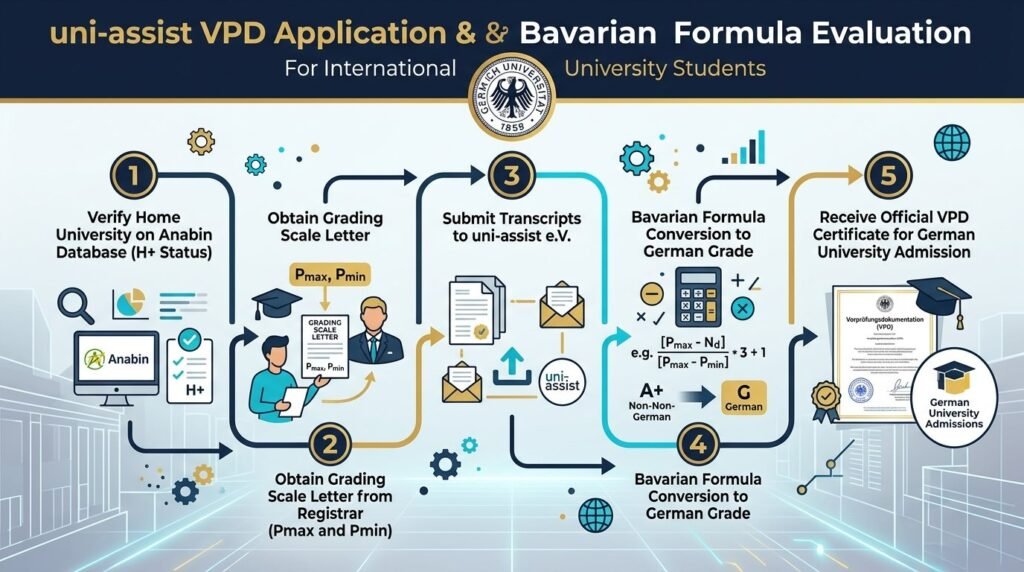
- uni-assist verifies the official accreditation status of your home institution using the KMK Anabin database.
- Evaluators extract the verified cumulative grade, theoretical maximum (Pmax), and statutory minimum passing score (Pmin) directly from your official degree transcripts or university grading regulations.
- uni-assist computes your official German GPA and issues a formal VPD (Vorprüfungsdokumentation) certificate.
Reviewing our authoritative bavarian formula german grade conversion guide principles clarifies that German university admissions committees strictly honor the GPA printed on the uni-assist VPD and will rarely recalculate marks independently.
6. Critical Nuances: Why Minimum Passing Grade (Pmin) Can Make or Break Your Application
The single most critical variable that catches international students off guard is Pmin. A higher minimum passing grade significantly elevates your converted German score.
Consider a student who earned 75% on a 100% percentage scale:
- Scenario A (Pmin = 40%):
1 + 3 × [(100 - 75) ÷ (100 - 40)] = 1 + 3 × (25 ÷ 60) = 2.25→ Converted Grade: 2.2 (Gut) - Scenario B (Pmin = 50%):
1 + 3 × [(100 - 75) ÷ (100 - 50)] = 1 + 3 × (25 ÷ 50) = 2.50→ Converted Grade: 2.5 (Gut)
If your degree transcript fails to explicitly state your university’s statutory minimum passing mark, uni-assist often applies national default values from the Anabin registry.
Our comprehensive bavarian formula german grade conversion guide advises candidates to obtain an official institutional grading scale letter from their registrar certifying the exact passing boundary before submitting documents to uni-assist.
7. Connecting German Academic Qualifications to Global Mobility
Mastering the German grading conversion is only one component of international academic planning. For students transferring European credits to North American universities, understanding credit translation is equally vital; consult our definitive ECTS to US Semester Credits Conversion Guide.
Similarly, evaluating British academic credentials requires specialized understanding; review our breakdown on UK Degree Classifications First 21 and 22 Explained. For international students preparing to fund their relocation to Germany, budgeting for blocked account mandates is essential; analyze our verified German Sperrkonto Monthly Cost by City.
For law scholars transitioning to American legal programs, explore our LSAC 4.33 GPA Recalculation Explained resource. Finally, planning educational finances requires disciplined debt projections; utilize our Student Loan Monthly Payment Calculator.
Adhering to our verified bavarian formula german grade conversion guide benchmarks ensures you maintain complete control over your international admissions portfolio.
8. What Is Numerus Clausus (NC) and How Does Your Converted Grade Impact Admission?
In Germany, university degree programs fall into two categories:
- Zulassungsfrei (Free / Open Admission): Any applicant who meets the foundational subject prerequisites and holds a recognized undergraduate degree is guaranteed admission, regardless of GPA.
- Zulassungsbeschränkt (Restricted / Numerus Clausus): Programs where available applicant volume exceeds departmental laboratory or faculty capacity. Places are allocated strictly based on converted German GPA ranking.
In competitive fields like Computer Science, Data Engineering, and Management at top TU9 institutions (such as TUM, RWTH Aachen, or TU Berlin), the NC cutoff frequently sits between 1.8 and 2.3.
Applying this bavarian formula german grade conversion guide evaluation enables applicants to strategically target universities where their converted grade falls comfortably within historical NC acceptance ranges.
9. Step-by-Step Action Plan for International University Applicants to Germany
To ensure a seamless, successful application process, execute this 5-point operational checklist:
- Verify University Anabin Status: Search the official KMK Anabin portal to ensure your home university holds “H+” institutional accreditation.
- Request an Official Grading Scheme Letter: Ask your university registrar to issue a sealed letter explicitly documenting Pmax and Pmin for your graduating cohort.
- Calculate Your Preliminary German Note: Utilize our verified formula to determine your projected German GPA across target degree programs.
- Submit uni-assist VPD Applications Early: Submit application materials at least six to eight weeks before departmental deadlines to accommodate document verification queues.
- Prepare Certified Translations: Ensure all transcripts, degree certificates, and syllabus descriptions are translated into German or English by state-certified court translators.
Executing this structured bavarian formula german grade conversion guide checklist protects your application from administrative rejection and maximizes your chances of securing university admission.
Bavarian Formula Worked Examples
The Bavarian formula looks technical, but it is just three numbers plugged into one equation: German grade = 1 + 3 × (Nmax − Nd) ÷ (Nmax − Nmin). Here are two common cases so you can check your own result.
- US GPA example: your GPA is 3.5 on a 4.0 scale, and the lowest passing grade is 1.0. So Nmax = 4.0, Nmin = 1.0, and Nd = 3.5. German grade = 1 + 3 × (4.0 − 3.5) ÷ (4.0 − 1.0) = 1 + 3 × 0.5 ÷ 3 = 1.5.
- Percentage example: your university grades out of 100 with a pass mark of 50, and your average is 75. So Nmax = 100, Nmin = 50, and Nd = 75. German grade = 1 + 3 × (100 − 75) ÷ (100 − 50) = 1 + 3 × 25 ÷ 50 = 2.5.
- Top performance: if Nd equals Nmax, the Bavarian formula always returns 1.0, the best German grade.
- Minimum pass: if Nd equals Nmin, the result is 4.0, the lowest passing German grade.
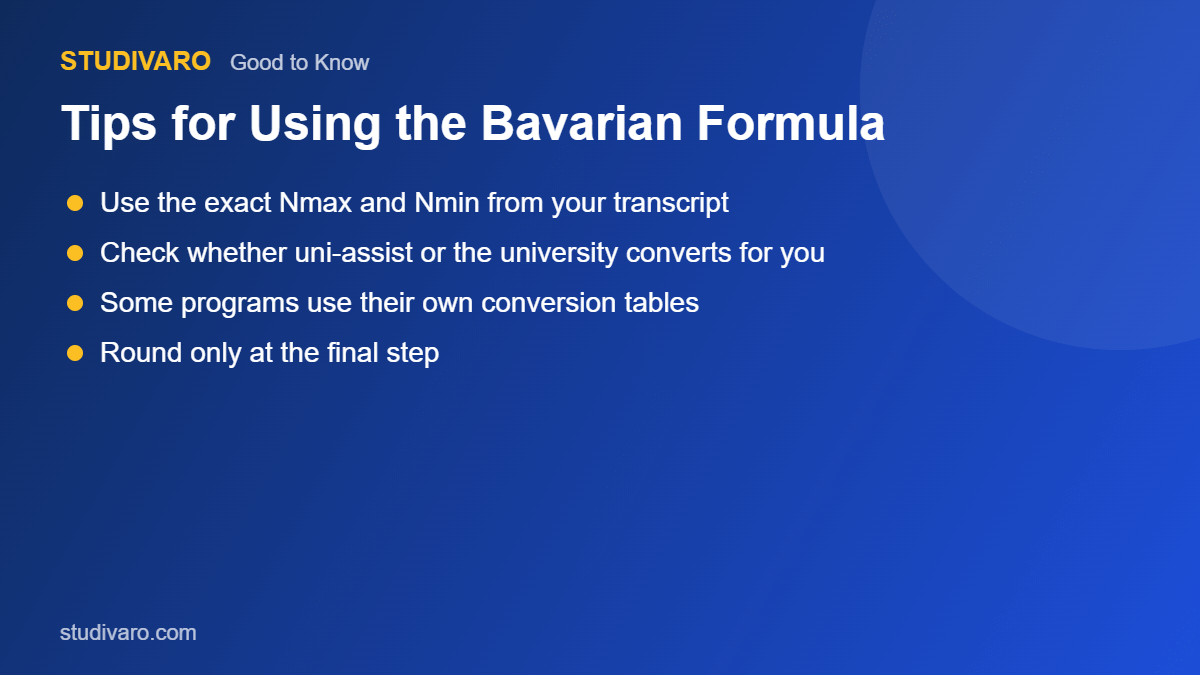
Notice how much the pass mark matters. The same 75% average converts to 2.5 when the pass mark is 50, but to 2.25 when the pass mark is 40 (1 + 3 × 25 ÷ 60 = 2.25). Always use the exact Nmax and Nmin printed on your transcript or grading legend, because a small change in either number shifts your converted grade. If your transcript does not state them clearly, ask your registrar for an official grading scale document and include it with your application so the admissions office applies the Bavarian formula with the correct values.
10. Frequently Asked Questions (FAQ)
What is considered a good German grade for Master’s admission?
A converted German grade of 2.5 or better (lower numerical value) is the standard minimum threshold for most Master’s programs across German public universities. Highly selective programs at elite research institutions frequently demand an NC grade of 2.0 or better.
Can I round my converted German grade up or down?
German universities and uni-assist truncate or mathematically round converted grades to one decimal place (e.g., 1.74 rounds to 1.7, while 1.76 rounds to 1.8). Unofficial two-decimal conversions are not recognized on official VPD documents.
What happens if my home university grading scale has no theoretical maximum?
For open-ended or curved grading systems, credential evaluators determine Pmax using the highest attainable grade awarded under institutional academic regulations, as registered within the official KMK database.
Does the Bavarian Formula apply to individual subject modules or only cumulative GPA?
While cumulative degree GPA is converted using the overall institutional scale, specific departments also apply the bavarian formula german grade conversion guide to individual prerequisite modules (such as Advanced Mathematics or Theoretical Computer Science) to verify subject-specific competency.
What is the difference between the original Bavarian Formula and the Modified Bavarian Formula?
The original historical formula was designed specifically for Bavarian state law examinations. The “Modified” Bavarian Formula was formally standardized by the KMK in 1991 to accommodate international non-linear grading scales and remains the legally binding national standard across all 16 German federal states.
Bavarian Formula: Key Takeaways
Keep these points in mind when you convert your grades for a German university application, whether you apply directly or through uni-assist:
- The Bavarian formula converts foreign grades to the German 1.0–4.0 scale, where 1.0 is the best grade and 4.0 is the lowest pass.
- You need three values: the best possible grade (Nmax), the lowest passing grade (Nmin), and your grade (Nd).
- Universities and uni-assist often calculate the conversion themselves, so your own result is an estimate for planning.
- Some programs publish their own conversion tables, which take priority over the general Bavarian formula.
- Round only at the end, and report the unrounded values if an application form asks for them.
Using the Bavarian formula early helps you see whether you meet a program’s minimum grade requirement before you pay application fees. It also makes it easier to compare programs in different German states, shortlist realistic options, and explain your academic record confidently in interviews or motivation letters.
11. Verified German Academic Resources and Citations
For official federal regulations, institutional accreditation databases, and credential evaluation portals, consult these verified agencies:
- KMK Anabin Database: Official Recognition Portal for Foreign Qualifications
- uni-assist e.V.: Official Application Portal for International Students
Bavarian Formula German Grade Conversion Guide Calculator
Interactive tool for bavarian formula german grade conversion guide calculating German grades from US GPA, UK degrees, and percentage marks.