
ECTS to US Semester Credits Conversion Guide: Best 2026 Guide
The ects to us semester credits conversion guide provides international students and study abroad scholars with the exact mathematical framework needed to transfer European academic work to American universities. Navigating international credit articulation is notoriously complex, as the European Higher Education Area (EHEA) and the United States university system rely on fundamentally different structural measures of student workload.
Try it yourself: Use our free GPA to ECTS and Bavarian Formula grade converter to check international university admissions standards in seconds. No sign-up needed.
Understanding every nuance of the ects to us semester credits conversion guide is critical whether you are participating in a semester-long exchange, transferring undergraduate coursework, or applying to competitive American graduate schools. Credential evaluation services such as World Education Services (WES) and institutional registrars enforce rigorous translation formulas. This verified 2026 guide explains the standard 2:1 conversion ratio, quarter credit calculations, contact hour requirements, and graduate degree equivalencies.
Table of Contents
1. What Is the ECTS to US Semester Credits Conversion Guide Standard?
The European Credit Transfer and Accumulation System (ECTS) was introduced under the Bologna Process to ensure transparency and cross-border mobility across European universities. Under this framework, credits measure cumulative student workload rather than classroom contact hours alone.
In contrast, the United States higher education system measures coursework using Semester Credit Hours (SCH). US credits heavily emphasize formal in-class lecture attendance combined with estimated independent study.
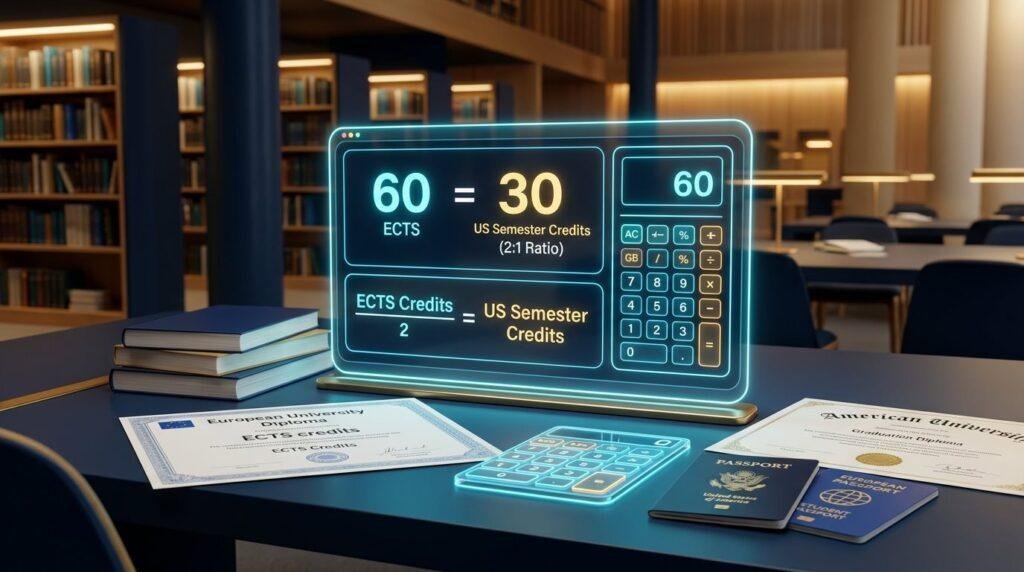
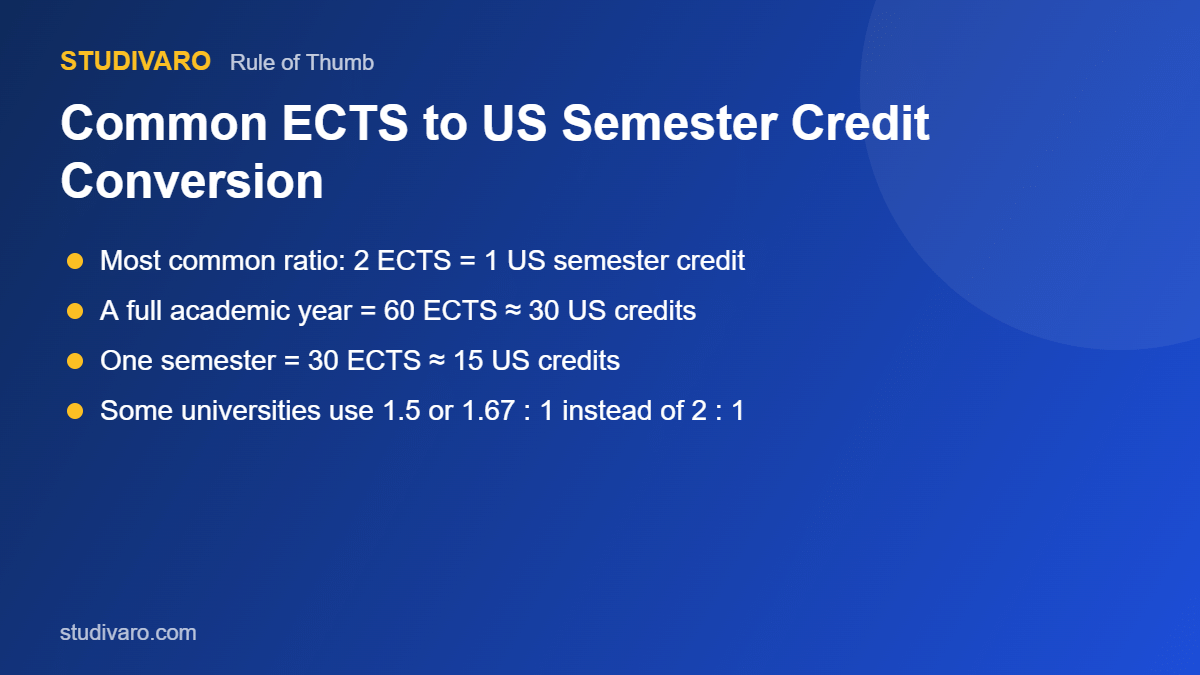
The baseline standard demonstrated in our ects to us semester credits conversion guide follows a recognized 2:1 conversion ratio:
- 2 ECTS credits = 1 US Semester Credit Hour
- 1 ECTS credit = 0.5 US Semester Credit Hour
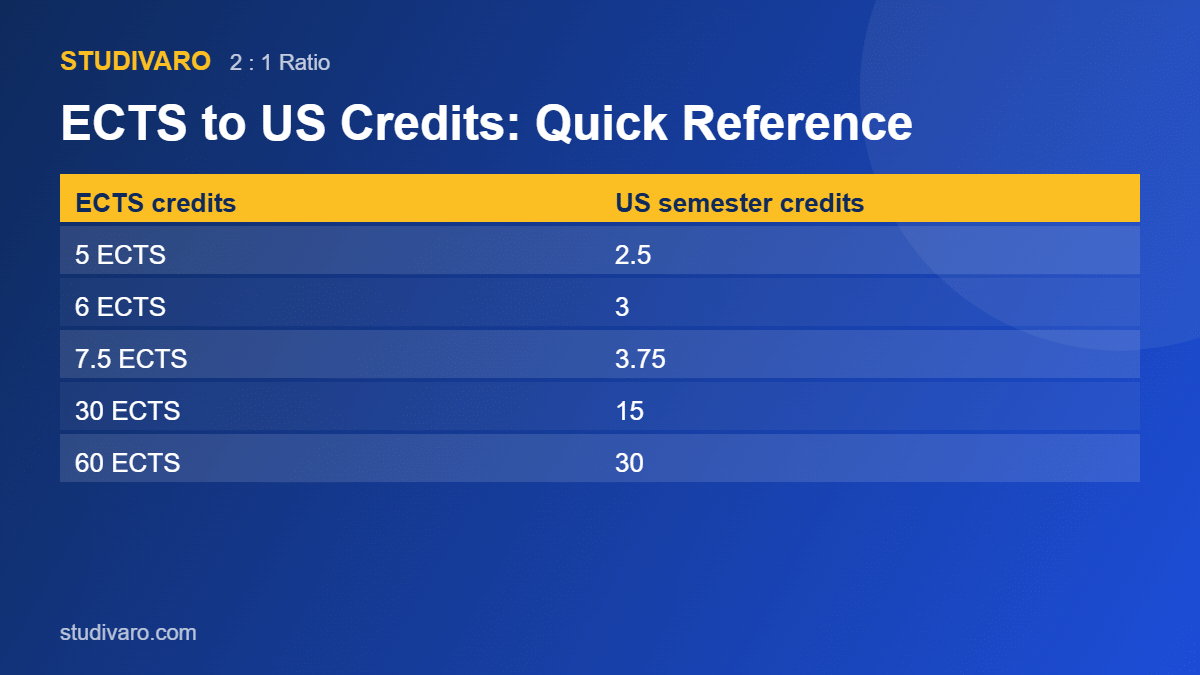
Consequently, a typical 6 ECTS European university module translates into 3 US semester credits, which represents the standard weight of a single collegiate course in the United States.
2. Comparing Workload Mechanics: ECTS Hours vs. US Carnegie Units
To understand why international credential evaluators use the 2:1 ratio, we must analyze how academic hours are calculated on each side of the Atlantic.
How ECTS Credits Are Calculated in Europe
In the European Union, one full academic year equals 60 ECTS credits, representing 30 ECTS per semester. European universities define 1 ECTS credit as representing 25 to 30 hours of total student workload.
- 60 ECTS per year = 1,500 to 1,800 annual workload hours.
- This workload accounts for lecture attendance, practical laboratory sessions, independent reading, essay preparation, and examination preparation.
How US Semester Credits Are Calculated (The Carnegie Unit)
In the United States, an undergraduate degree requires 30 semester credits per academic year (15 credits per semester). The standard US credit hour—historically rooted in the Carnegie Unit—requires 1 hour of direct faculty instruction plus a minimum of 2 hours of out-of-class student work each week across a 15-week semester.
- 1 US Semester Credit = 45 to 50 total workload hours.
- 15 US Credits per semester = 675 to 750 total workload hours.
Referencing this ects to us semester credits conversion guide mathematical proof reveals that because 1 US credit requires approximately 50 hours of total effort while 1 ECTS requires 25 to 30 hours, the mathematical ratio naturally settles at precisely 2 ECTS per 1 US credit.
3. Semester Credits vs. Quarter Credits: The Critical Difference
Not every American university operates on a traditional two-semester calendar. Prominent institutions—such as the University of California system, Stanford University, and the University of Washington—operate on a 10-week Quarter calendar.
When translating European coursework to a quarter-based institution, the standard 2:1 formula changes.
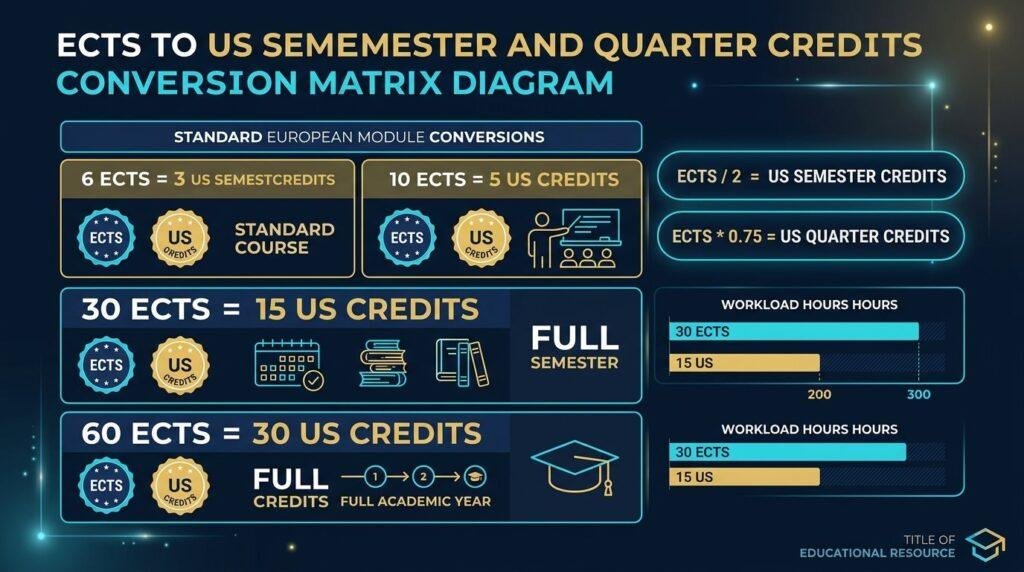
- Semester System Formula:
US Semester Credits = ECTS Credits ÷ 2 - Quarter System Formula:
US Quarter Credits = ECTS Credits × 0.75
Practical Example: A 10 ECTS Advanced Mathematics Module- On a US Semester System: 10 ÷ 2 = 5.0 US Semester Credits- On a US Quarter System: 10 × 0.75 = 7.5 US Quarter Credits
Applying an accurate ects to us semester credits conversion guide formula ensures you calculate the correct number of quarter units required to satisfy major prerequisite standards.
4. Master Conversion Table: ECTS to US Semester and Quarter Credits
The following reference table outlines the official conversion values across standard European module credit allocations:
| ECTS Credits | Total Student Workload (Hours) | US Semester Credit Equivalent | US Quarter Credit Equivalent | Typical Academic Equivalent in USA |
|---|---|---|---|---|
| 1 ECTS | 25 – 30 hours | 0.5 Semester Credits | 0.75 Quarter Credits | Half-credit workshop / lab module |
| 2 ECTS | 50 – 60 hours | 1.0 Semester Credit | 1.50 Quarter Credits | Single credit lab or seminar |
| 3 ECTS | 75 – 90 hours | 1.5 Semester Credits | 2.25 Quarter Credits | Half-course elective |
| 4 ECTS | 100 – 120 hours | 2.0 Semester Credits | 3.00 Quarter Credits | Standard 2-credit elective |
| 5 ECTS | 125 – 150 hours | 2.5 Semester Credits | 3.75 Quarter Credits | Core module (Evaluated as 2 or 3 credits) |
| 6 ECTS | 150 – 180 hours | 3.0 Semester Credits | 4.50 Quarter Credits | Standard full 3-credit lecture course |
| 7.5 ECTS | 187 – 225 hours | 3.75 Semester Credits | 5.62 Quarter Credits | Advanced course (Transfers as 3.5 or 4 credits) |
| 10 ECTS | 250 – 300 hours | 5.0 Semester Credits | 7.50 Quarter Credits | Intensive seminar or double module |
| 15 ECTS | 375 – 450 hours | 7.5 Semester Credits | 11.25 Quarter Credits | Half-semester research internship |
| 30 ECTS | 750 – 900 hours | 15.0 Semester Credits | 22.50 Quarter Credits | Full academic semester |
| 60 ECTS | 1,500 – 1,800 hours | 30.0 Semester Credits | 45.00 Quarter Credits | Full academic year |
| 180 ECTS | 4,500 – 5,400 hours | 90.0 Semester Credits | 135.0 Quarter Credits | 3-Year European Bachelor’s Degree |
| 240 ECTS | 6,000 – 7,200 hours | 120.0 Semester Credits | 180.0 Quarter Credits | 4-Year Professional European Degree |
Referencing this standardized ects to us semester credits conversion guide table ensures accurate semester workload planning before course registration.
Following this authoritative ects to us semester credits conversion guide breakdown prevents credit shortfall surprises when submitting official transcripts to university registrars.
5. The 3-Year European Bachelor’s Degree Dilemma (180 ECTS vs. 120 US Credits)
One of the most frequent hurdles international students encounter when applying to American graduate schools is the structural length of European undergraduate degrees.
Under the Bologna framework, standard bachelor’s degrees across Germany, France, Italy, and the UK require 3 years of study comprising 180 ECTS credits. Applying the 2:1 ratio yields 90 US semester credits.
However, a standard United States bachelor’s degree requires 4 years of study and a minimum of 120 semester credits. Consequently, some traditional US graduate admissions offices initially evaluate a 3-year Bologna degree as incomplete undergraduate education.
Reviewing our comprehensive ects to us semester credits conversion guide reveals that leading credential evaluation agencies (such as WES) now officially recognize 3-year Bologna-compliant degrees from accredited institutions as equivalent to a 4-year US bachelor’s degree, provided the institution holds regional accreditation and issues a formal European Diploma Supplement.
6. Official Credential Evaluators: How WES, ECE, and SpanTran Treat ECTS
When applying to US universities, professional licensure boards, or immigrant visa programs, you will rarely convert credits on your own. You must commission a course-by-course credential evaluation report.
- World Education Services (WES): WES universally applies the 0.5 multiplier (2 ECTS = 1 US Semester Credit). For fractional values like 7.5 ECTS, WES typically awards 3.5 or 4.0 semester credits depending on syllabus contact hours.
- Educational Credential Evaluators (ECE): ECE evaluates both credit hours and academic grades, verifying that overall annual workload mirrors American collegiate rigor.
- SpanTran: Widely used by professional graduate schools, offering customized institutional grade conversion matrices.
Consulting this structured ects to us semester credits conversion guide helps applicants anticipate credential evaluation outcomes and verify that their Diploma Supplement is formatted correctly prior to evaluation.
7. Grade Conversion: Translating European ECTS Grades to the US 4.0 GPA Scale
Converting academic credits is only half the battle; admissions committees must also evaluate your cumulative Grade Point Average on the American 4.0 GPA scale.
The official ECTS grading scale is based on class percentile ranking rather than raw exam scores:
- ECTS Grade A (Top 10% of cohort): Translates to a US Grade A / 4.00 GPA
- ECTS Grade B (Next 25% of cohort): Translates to a US Grade B+ / 3.50 – 3.70 GPA
- ECTS Grade C (Next 30% of cohort): Translates to a US Grade B / 3.00 GPA
- ECTS Grade D (Next 25% of cohort): Translates to a US Grade C+ / 2.50 GPA
- ECTS Grade E (Next 10% of cohort): Translates to a US Grade C / 2.00 GPA (Minimum Pass)
- ECTS Grade FX / F (Fail): Translates to a US Grade F / 0.00 GPA
Understanding British honours classifications is equally vital when comparing European degree transcripts; review our definitive breakdown on UK Degree Classifications First 21 and 22 Explained.
Furthermore, if you are planning studies in central Europe, understanding living costs is essential; explore our detailed analysis of the German Sperrkonto Monthly Cost by City. For professional law admissions, evaluate foreign credential weighting using our LSAC 4.33 GPA Recalculation Explained resource.
Finally, managing overseas tuition loans requires disciplined forecasting; calculate your monthly repayment obligations using our Student Loan Monthly Payment Calculator.
Adhering to our calibrated ects to us semester credits conversion guide standards protects your academic standing when translating European excellence into American credentials.
8. Common Pitfalls and Fractional Credit Rounding Policies
When universities convert fractional ECTS amounts, administrative policies vary between departments.
The 5 ECTS and 7.5 ECTS Rounding Dilemma
In many European universities, standard courses carry 5 or 7.5 ECTS credits.
- 5 ECTS converts mathematically to 2.5 US credits. Some universities round down to 2 credits, while others award 3 credits if laboratory components are documented.
- 7.5 ECTS converts to 3.75 US credits. US registrars frequently round this to 3.5 credits or a full 4.0 credits.
The Syllabus Contact Hour Defense
If an American university registrar attempts to award fewer credits than anticipated, students can submit their official course syllabus detailing documented contact hours and seminar time to justify higher transfer credit allowances.
Referring back to our ects to us semester credits conversion guide strategies empowers students to advocate for full credit recognition during institutional credit appeals.
Following our detailed ects to us semester credits conversion guide recommendations helps international scholars successfully petition university registrars for full credit recognition.
9. Step-by-Step Credit Transfer Checklist for Study Abroad and International Students
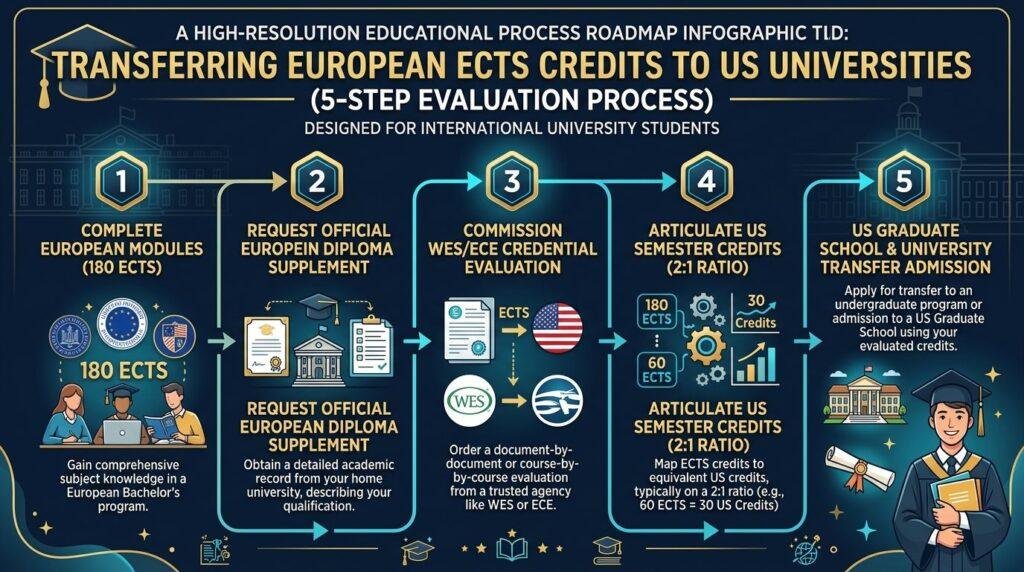
To ensure that 100% of your European academic credits transfer smoothly to your American home institution, execute this 5-point action plan:
- Obtain Pre-Approval via Learning Agreement: Secure written approval from your US academic advisor and department chair for all intended European courses before traveling abroad.
- Request an Official European Diploma Supplement: Ensure your host university issues an English-language Diploma Supplement detailing course titles, ECTS weights, and institutional grading scales.
- Archive Detailed Course Syllabi: Save copies of all syllabi, reading lists, weekly schedules, and completed assessment rubrics for every European module.
- Commission an NACES-Accredited Evaluation: If required by graduate admissions, utilize verified evaluation agencies affiliated with the National Association of Credential Evaluation Services.
- Verify Transfer Credit Transcripts Promptly: Check your domestic academic degree audit report within 30 days of transcript transmission to identify and resolve credit discrepancies.
Executing this proactive ects to us semester credits conversion guide checklist eliminates bureaucratic delays and safeguards your expected graduation date.
10. Frequently Asked Questions (FAQ)
Can I transfer European ECTS credits directly to any US university?
Yes, nearly all accredited American universities accept European transfer credits. However, individual departments determine how transferred credits apply toward specific degree requirements (major credits vs. general elective credits).
How many ECTS credits equal one full academic semester in the USA?
A full academic semester in the European Bologna system equals 30 ECTS credits, which converts directly to 15 US semester credit hours (or 22.5 quarter credit hours).
What happens if my European module does not have a direct US equivalent?
If a European course does not match a specific course code in your US university catalog, registrars typically award “General Elective Credit” at the appropriate academic level (upper-division or lower-division).
Does a 3-year European bachelor’s degree qualify for US Master’s programs?
Yes, the vast majority of competitive US graduate schools accept 3-year, 180 ECTS Bologna-compliant bachelor’s degrees as equivalent to a 4-year US degree, especially when evaluated by WES.
Why do some US universities round 7.5 ECTS down to 3 credits instead of 4?
Institutional transfer credit policies vary. If a university strictly requires 45 lecture contact hours for a 3-credit course, they may refuse to award 4 full credits unless laboratory hours or extensive seminar sessions are formally certified on the syllabus.
ECTS to US Semester Credits: Key Takeaways
Before you send transcripts or fill in a transfer credit form, review these essentials for converting ECTS to US semester credits correctly:
- The most widely used rule for converting ECTS credits, and the one most US registrars start with when turning ECTS to US semester credits, is 2 ECTS = 1 US semester credit.
- A full European academic year of 60 ECTS usually equals about 30 US semester credits, the same as a standard US full-time year.
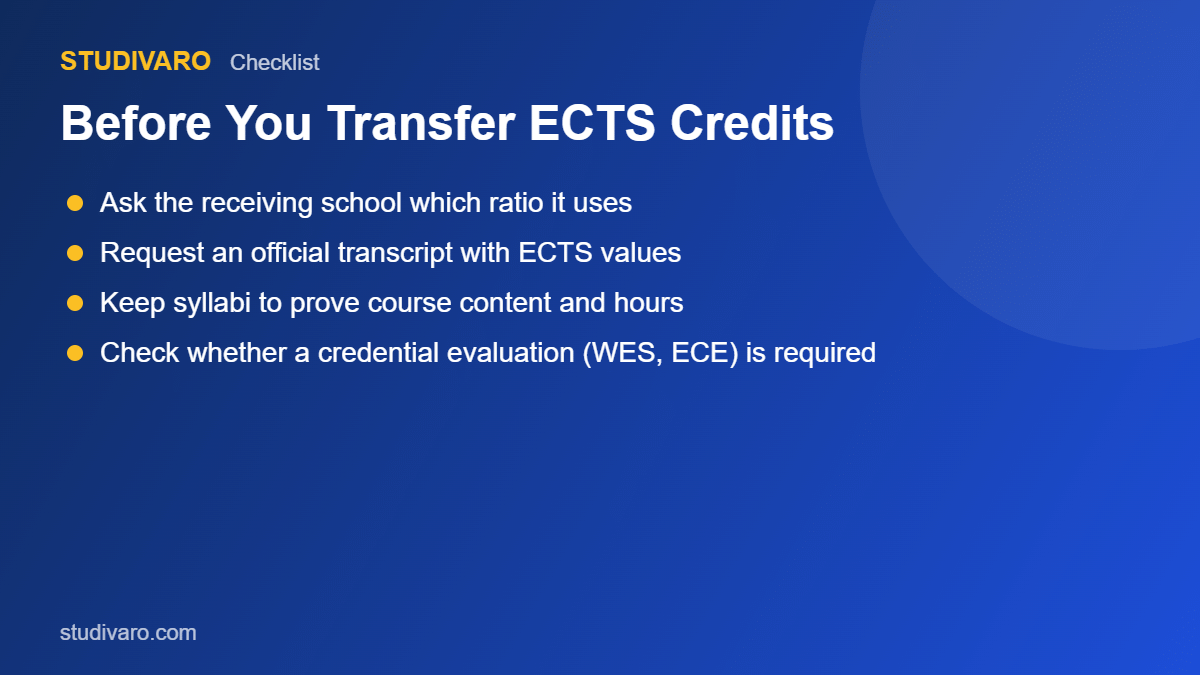
- Some US universities use a different ratio, so the receiving school’s policy always overrides general rules of thumb.
- Course content and contact hours matter: a 7.5 ECTS module might become 3 or 4 US credits depending on how the school rounds.
- Credential evaluation services such as WES or ECE may be required for graduate admission or professional licensing.
- Keep syllabi, module handbooks, and official transcripts, because they make converting ECTS to US semester credits faster and easier to approve.
Example: a semester abroad with modules worth 6, 6, 7.5, 5, and 5.5 ECTS totals 30 ECTS. Converting ECTS to US semester credits at the common 2:1 ratio gives 15 credits, a full-time term. If your home university uses a 1.5:1 ratio instead, the same 30 ECTS converts to 20 credits, so always confirm the ratio before you plan your course load.
If your advisor asks how you converted ECTS to US semester credits, show the ratio you used, the module list, and the source of the rule. Clear documentation is the fastest way to get ECTS to US semester credits approved without delays, especially when several departments need to sign off. Use the calculator above to double-check your ECTS to US semester credits total before you submit.
11. Verified International Education Resources and Citations
For official regulatory frameworks, international credit standards, and evaluation guidelines, consult these authoritative institutions:
- European Commission: Official ECTS Users’ Guide and Mobility Tools
- World Education Services (WES): Degree Evaluation Guidelines and Tools
ECTS to US Semester Credits Conversion Guide Calculator
Interactive tool for ects to us semester credits conversion guide calculating 2:1 ratios, quarter units, and workload hours.