
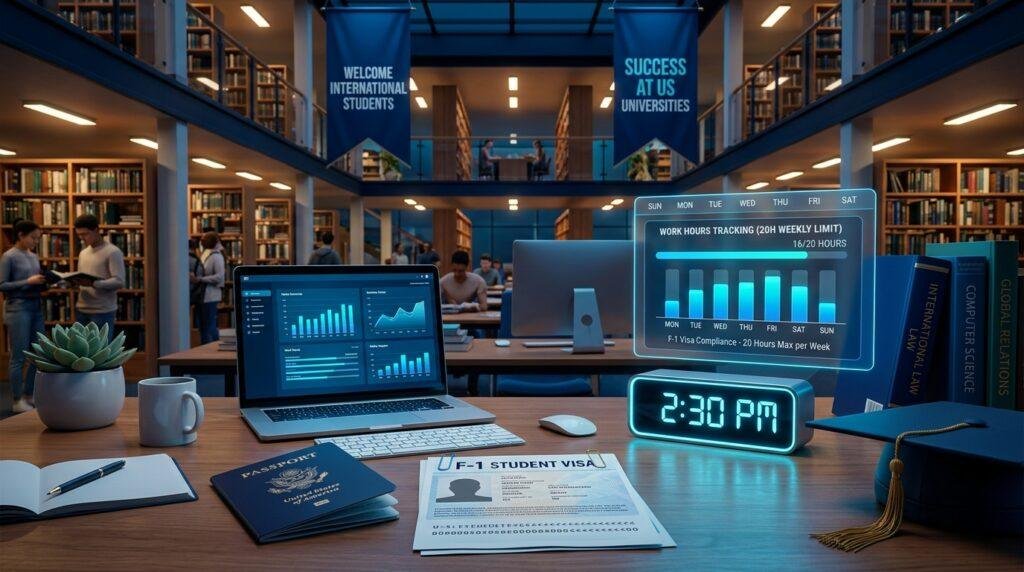
F-1 Student Visa 20 Hour Work Rule Explained: 2026 Guide
The f-1 student visa 20 hour work rule explained in federal immigration guidelines dictates how international students can lawfully work while maintaining full-time academic status. Navigating employment regulations while studying in the United States is one of the most critical legal responsibilities for international students. To maintain valid nonimmigrant status, understanding every nuance of the f-1 student visa 20 hour work rule explained in official Department of Homeland Security (DHS) directives is essential. Violating work restrictions—even accidentally by a fraction of an hour—can lead to the immediate loss of your legal status and the termination of your academic journey in the United States.
The primary purpose of the F-1 visa is full-time academic study, not commercial employment. Under Title 8 of the Code of Federal Regulations (8 CFR 214.2(f)(9)), international students are granted strictly regulated employment benefits designed to support educational goals without displacing domestic labor. This comprehensive f-1 student visa 20 hour work rule explained breakdown examines allowable work locations, holiday allowances, remote freelance prohibitions, and compliance procedures verified for 2026.
Table of Contents
1. What Is the F-1 Student Visa 20 Hour Work Rule Explained in Detail?
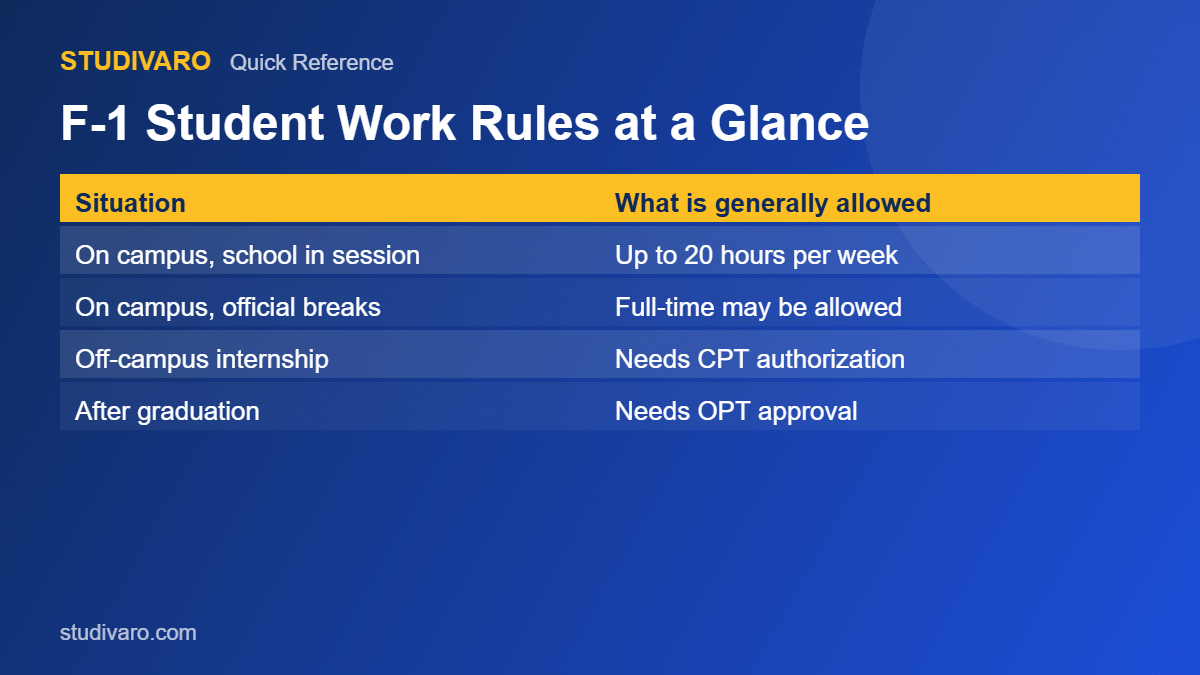
At its foundation, federal immigration law mandates that international students holding an F-1 visa may work no more than 20 hours per week while school is in session. This limit applies strictly to all combined employment activities authorized under your Designated School Official (DSO) or federal agencies.
In this legal context, how a “week” is measured is defined by your sponsoring academic institution rather than your personal schedule. Most university payroll systems define a work week running from Sunday at 12:00 AM through Saturday at 11:59 PM, or Monday morning through Sunday midnight.
An accurate f-1 student visa 20 hour work rule explained framework clarifies that hours cannot be averaged across multiple weeks. If you work 15 hours in Week One and 25 hours in Week Two, you have committed an unlawful status violation in Week Two despite averaging 20 hours across the pay period.International students balancing restricted on-campus earnings with substantial living costs should also utilize our Student Loan Monthly Payment Calculator to project realistic financial obligations.
2. On-Campus vs. Off-Campus Employment Rules
Federal regulations establish a firm boundary between jobs physically located on your university premises and positions located off-campus.
What Qualifies as On-Campus Employment?
On-campus work is an automatic benefit tied to your valid F-1 status and generally does not require formal USCIS approval, provided your academic standing remains sound. Eligible on-campus jobs fall into two distinct classifications:
- Direct University Employment: Work performed directly for your academic institution, including roles as a graduate teaching assistant (TA), graduate research assistant (RA), campus library clerk, departmental lab assistant, or resident assistant (RA).
- On-Campus Commercial Contractors: Work performed on the school’s physical premises for commercial firms providing direct services to students, such as the campus dining hall, university bookstore, or campus cafeteria.
Jobs located in university-leased commercial office buildings that do not provide direct educational or student services do not count as on-campus work. Referring back to our f-1 student visa 20 hour work rule explained standards ensures that candidates confirm their job classification with their International Student Services (ISS) office before signing an employment contract.
Off-Campus Employment Restrictions
Off-campus employment is strictly prohibited for F-1 students during their first academic year (two full semesters or three quarters). Following the first year, off-campus work is only permitted under three specialized authorizations:
- Curricular Practical Training (CPT)
- Optional Practical Training (OPT)
- Severe Economic Hardship (authorized via formal USCIS Form I-765 and Employment Authorization Document)
3. Academic Term vs. Official Breaks (20 Hours vs. 40 Hours)
One of the most frequent questions international students ask concerns work authorization during university recesses and holidays. The regulations make a clear distinction between active enrollment terms and scheduled institutional closures.
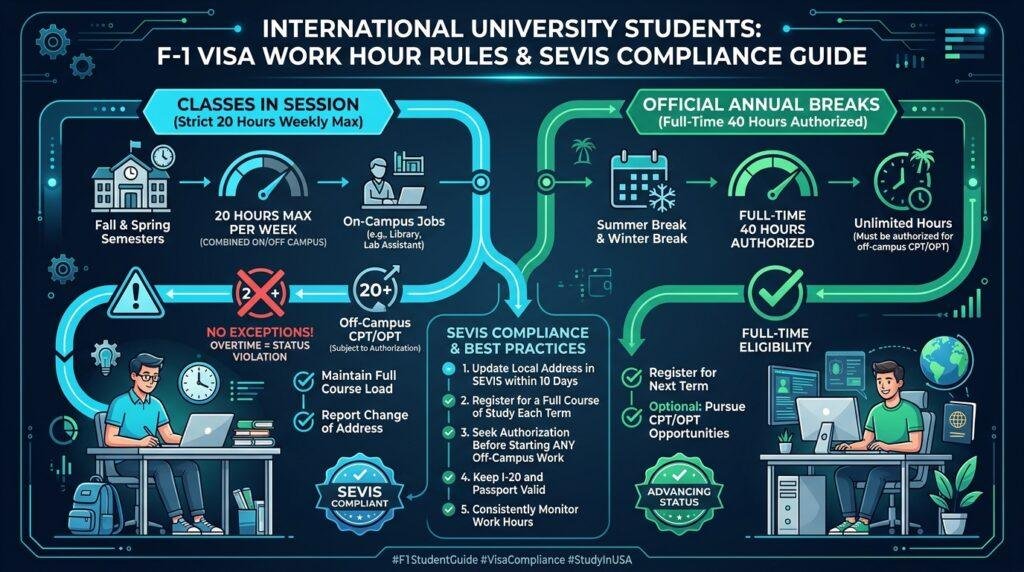
- During the Academic Semester (Fall & Spring): When classes are in session, the 20-hour weekly ceiling is absolute. This applies through regular lecture weeks, midterm examination cycles, and final exam periods.
- During Official School Vacations: Students may work full-time (up to 40 hours per week or more, subject to state labor laws and university institutional caps) during annual vacation periods and official campus breaks. This includes summer vacation, winter/holiday break, and spring recess.
- Summer Enrollment Caveat: If you are required to register for summer courses as part of your degree plan or if summer serves as your initial graduating term, you are restricted to the 20-hour ceiling.
Reviewing this f-1 student visa 20 hour work rule explained timeline allows students to maximize on-campus earnings during permissible holiday periods while maintaining complete legal integrity during instructional months.Maintaining active, full-time class attendance is mandatory to preserve nonimmigrant status; read our breakdown on How Much Does a Missed College Lecture Cost to understand the real financial loss of absent lecture hours.
4. The Multiple Jobs Trap: Can You Work 20 Hours at Two Different Jobs?
A common and dangerous misconception among newly arrived international students is that the 20-hour rule applies to each job independently. This is completely false.
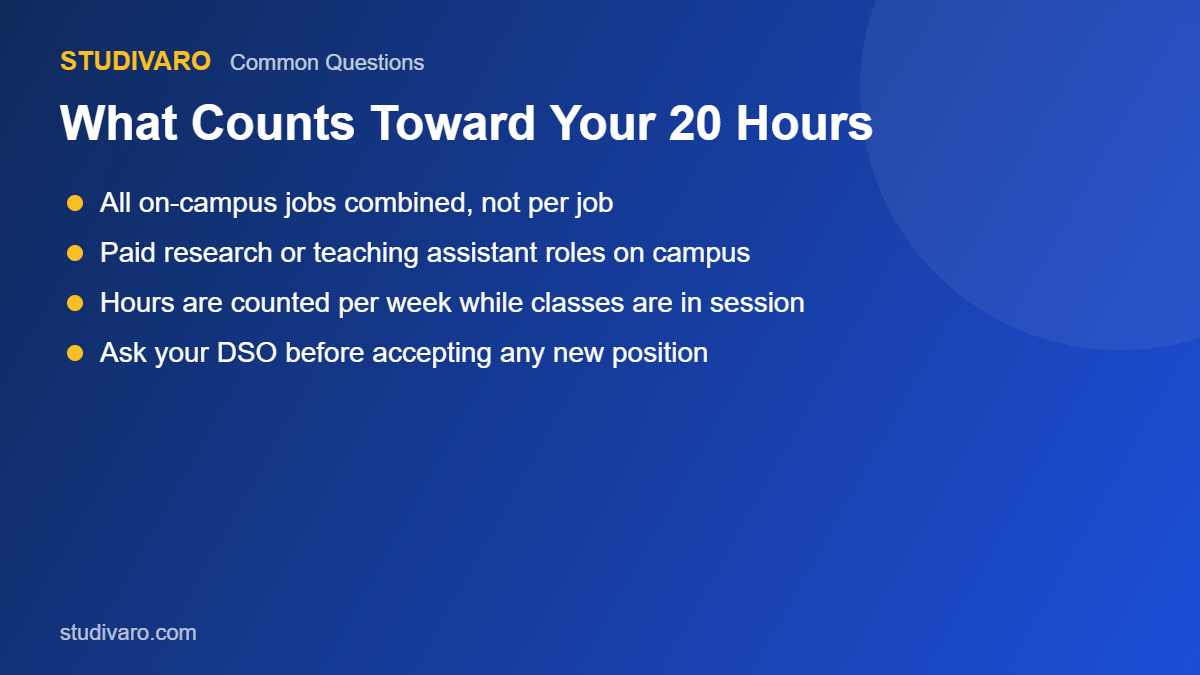
The 20-hour ceiling is cumulative across all concurrent employment positions.
Permissible Schedule:Job A (University Library Assistant): 12 hours/weekJob B (Campus Dining Services): 8 hours/weekTotal Weekly Hours Worked: 20 hours/week (Fully Compliant)Illegal Schedule:Job A (Department Research Lab): 18 hours/weekJob B (Campus Bookshop Clerk): 6 hours/weekTotal Weekly Hours Worked: 24 hours/week (SEVIS Status Violation)
If you hold a graduate assistantship that contractually accounts for 15 hours per week, you have precisely 5 remaining hours available for any secondary on-campus job. As highlighted throughout this f-1 student visa 20 hour work rule explained analysis, tracking your actual recorded clock-in and clock-out timestamps across multiple departments is solely your legal obligation.
5. Freelancing, Remote Work, and Side Hustles: What Does USCIS Say?
The modern gig economy creates significant compliance challenges for nonimmigrant visa holders. Students frequently question whether passive online income, app-based driving, or freelance contracting violate their status.
Under U.S. immigration jurisprudence, any labor or service performed while physically located on United States soil in exchange for compensation constitutes employment. This holds true regardless of where the hiring entity is registered or where funds are deposited.
- Freelance Platforms (Upwork, Fiverr, Freelancer): Operating as an independent contractor (receiving 1099 income) without specific CPT or OPT work authorization is illegal under F-1 status.
- Rideshare and Delivery Apps (Uber, Lyft, DoorDash): Registering as a driver or courier represents unauthorized off-campus self-employment.
- Remote Work for Overseas Companies: Working remotely for a firm based in your home country while physically seated in your U.S. dorm room or apartment constitutes unauthorized employment according to prevailing USCIS policy guidance.
- Content Creation & Monetization (YouTube, Twitch, TikTok): Generating active advertising revenue or brand sponsorships while physically creating content inside the United States requires explicit employment authorization.
An authoritative f-1 student visa 20 hour work rule explained assessment makes one truth clear: if you are trading personal labor for monetary gain while inside the United States on an F-1 visa, you must possess explicit, verifiable authorization from your DSO or USCIS.
- Consulting this clear f-1 student visa 20 hour work rule explained breakdown prevents unintentional status violations through unauthorized freelance platforms.
6. CPT and OPT: When Do the 20-Hour Limits Change?
Practical training programs provide authorized avenues for international students to gain industry experience directly related to their major area of study.
Curricular Practical Training (CPT)
CPT is authorized by your institution’s DSO directly on page 2 of your Form I-20.
- Part-Time CPT: Limited to a maximum of 20 hours per week. When classes are active, working 20 hours on CPT leaves zero remaining hours for on-campus employment unless specifically approved by your international student office.
- Full-Time CPT: Exceeds 20 hours per week (typically 40 hours). Accruing 12 months or more of full-time CPT completely eliminates your eligibility for Optional Practical Training (OPT).
Optional Practical Training (OPT)
- Pre-Completion OPT: Undertaken prior to graduation; restricted to 20 hours per week during the school term.
- Post-Completion OPT: Undertaken after degree conferral; requires a minimum of 20 hours per week of qualifying employment to avoid accruing days of unemployment toward the 90-day maximum limit.
Applying this f-1 student visa 20 hour work rule explained perspective ensures you never jeopardize your long-term 24-month STEM OPT extension through uncoordinated off-campus training assignments.
7. Master Comparison Table: F-1 Employment Categories & Hour Limits
The following reference table outlines the legal constraints across all categories of F-1 visa employment:
| Employment Category | In-Session Weekly Limit | Official Vacation Limit | Required Authorization Document | Permitted Locations |
|---|---|---|---|---|
| On-Campus (Direct) | 20 hours / week | 40+ hours / week | Valid Form I-20 & Social Security Number | School campus |
| On-Campus (Contractor) | 20 hours / week | 40+ hours / week | Valid Form I-20 & I-9 Verification | University bookstore, dining hall |
| Part-Time CPT | 20 hours / week | 20 hours / week | Form I-20 with DSO CPT Endorsement | Specified employer site |
| Full-Time CPT | Prohibited (Unless approved) | 40+ hours / week | Form I-20 with DSO CPT Endorsement | Specified employer site |
| Pre-Completion OPT | 20 hours / week | 40+ hours / week | USCIS EAD Card (Form I-766) | Directly related to field of study |
| Post-Completion OPT | Full-Time (Min 20 hrs) | Full-Time (Min 20 hrs) | USCIS EAD Card (Form I-766) | Any location directly related to major |
| Economic Hardship | 20 hours / week | 40+ hours / week | USCIS EAD Card & DSO Recommendation | Any off-campus location |
- This comparative f-1 student visa 20 hour work rule explained summary clearly distinguishes between on-campus permissions and off-campus training authorizations.
Following the parameters of this f-1 student visa 20 hour work rule explained comparative matrix prevents accidental cross-category labor infractions.
F-1 Weekly Work Hour & Overtime Risk Calculator
Calculate cumulative weekly hours and verify SEVIS compliance in real time.
8. Severe Consequences of Exceeding 20 Hours (SEVIS Termination & Deportation)
The United States government enforces nonimmigrant employment compliance through automated institutional reporting and federal databases. The consequences of violating the weekly hour limit are immediate and severe.
1. SEVIS Record Termination
Designated School Officials are legally required by federal statute to terminate an international student's Student and Exchange Visitor Information System (SEVIS) record under the reason "Unauthorized Employment" upon discovering a work violation.
2. Immediate Loss of Legal Status (Out of Status)
When your SEVIS record is terminated:
- You immediately lose lawful F-1 status.
- You do not receive a 60-day or 15-day grace period; you are subject to immediate departure requirements.
- You become ineligible for on-campus employment, CPT, OPT, and travel endorsements.
International scholars must review our verified f-1 student visa 20 hour work rule explained standards before accepting campus contractor positions.
3. Reinstatement Denial
While students whose status lapses due to technical errors can apply to USCIS for Form I-539 reinstatement, federal regulations strictly state that unauthorized employment automatically disqualifies a student from reinstatement eligibility.
4. Visa Revocation and Future Entry Bars
A termination for unauthorized employment remains permanently marked on your immigration history. When reapplying for future visas (such as H-1B specialty occupation visas, L-1 intracompany transfers, or permanent residency green cards), unauthorized work triggers intense scrutiny and can lead to inadmissibility under INA 212(a)(9)(B) for unlawful presence accrual. Keeping our f-1 student visa 20 hour work rule explained guidelines at the forefront of your university career protects both your degree and your future global mobility.
For international students planning to pursue graduate or professional degrees in the United States, maintaining an unimpeachable academic record is crucial. Pre-law applicants can benchmark their credentials using our LSAC 4.33 GPA Recalculation Explained resource, while aspiring medical students should reference our AMCAS BCPM GPA Calculation Guide.
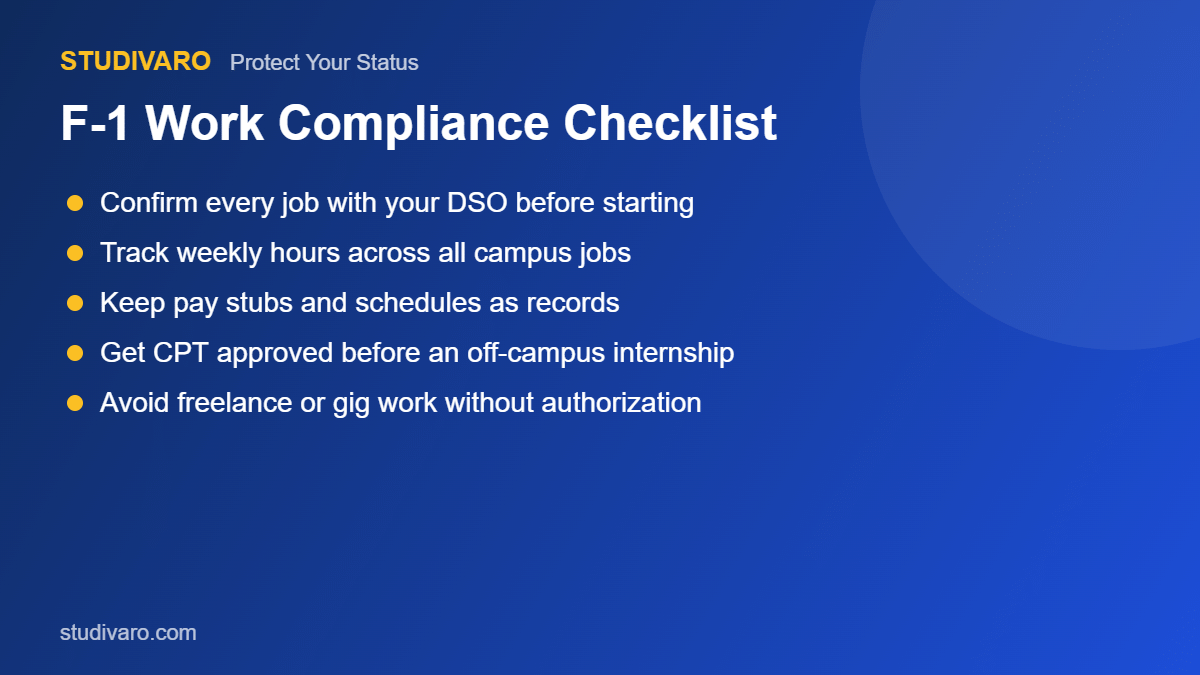
9. Step-by-Step F-1 Student Work Hour Compliance Checklist
To guarantee you remain fully compliant across every academic term, execute this 5-point operational checklist:
- Verify Your University Work Week Schedule: Consult your payroll office to confirm the exact day and minute your university's official weekly pay period starts and concludes.
- Buffer Your Scheduled Shifts: Never schedule yourself for exactly 20.0 hours. Aim for 18.0 to 19.0 hours maximum to prevent accidental clock-in drift from pushing you over the limit.
- Consolidate Multi-Department Timecards: If you work in a research laboratory and the university gym, cross-reference both electronic timecards before submitting weekly hours.
- Acquire Written Authorization Before Starting: Never perform a single hour of labor—including paid orientation or mandatory department training—before receiving your updated Form I-20 or valid EAD.
- Report Institutional Break Dates Accurately: Check the official university academic calendar for verified recess start dates before expanding your shift schedule to 40 hours.
Reviewing this practical f-1 student visa 20 hour work rule explained checklist at the beginning of each semester keeps your SEVIS status unimpeachable.
10. Frequently Asked Questions (FAQ)
What happens if I work 20.5 hours in a single week on an F-1 visa?
Exceeding the 20-hour threshold by even 30 minutes constitutes a technical violation of federal immigration regulations. While some university payroll systems flag timecards and alert your DSO before formal transmission, working over 20 hours during an active term places your SEVIS record at risk of termination for unauthorized employment.
Does volunteer work or unpaid internships count toward the 20-hour limit?
True volunteer work for a recognized charitable, civic, or humanitarian non-profit organization without any promise of compensation does not count toward the 20 hours. However, performing unpaid work for a commercial for-profit enterprise (such as an unpaid corporate internship) violates federal labor law under the Fair Labor Standards Act (FLSA) and requires formal CPT or OPT authorization.
Can an F-1 student invest in the U.S. stock market or cryptocurrency?
Yes. Passive investment in equities, index funds, mutual funds, or digital assets is legal for international students. However, engaging in high-frequency day trading, running an active investment fund for third parties, or trading as a registered broker-dealer crosses the legal line into active commercial enterprise without authorization.
Does working as a resident assistant (RA) in dorms count against the 20 hours?
Yes. Resident Assistant positions that provide free room and board are considered forms of non-monetary employment compensation by USCIS. Most universities assign an equivalent weekly hour value (often 15 to 20 hours) to RA roles, which restricts your ability to accept additional campus positions according to our f-1 student visa 20 hour work rule explained directives.
Can I work off-campus if my university cannot provide on-campus jobs?
No. Lack of available on-campus employment does not grant an automatic right to work off-campus. You may only pursue off-campus employment through approved CPT, approved OPT, or after receiving a formal USCIS Employment Authorization Document based on demonstrated, unforeseen severe economic hardship.
Always rely on an up-to-date f-1 student visa 20 hour work rule explained reference to safeguard your SEVIS record and future visa applications.
F-1 Student Visa Work Rules: Key Takeaways
Here is a short recap of the F-1 student visa work rules covered in this guide. Keep it handy before you accept any job offer:
- On an F-1 student visa, on-campus work is generally limited to 20 hours per week while school is in session.
- The 20-hour limit applies to all on-campus jobs combined, not to each job separately.
- Full-time on-campus work may be allowed during official school breaks if you plan to enroll for the next term.
- Off-campus work on an F-1 student visa requires specific authorization, such as CPT, OPT, or approved economic hardship employment.
- Unauthorized work can put your F-1 student visa status at serious risk and may affect future immigration benefits.
- Your Designated School Official (DSO) is the right person to confirm whether a job is allowed before you start.
Rules and school policies can change, so always confirm current requirements with your international student office and official government sources before making decisions that affect your F-1 student visa.
Before your first shift, ask three questions: Is this job on campus? Will my total hours across all campus jobs stay within 20 per week during the term? Has my DSO confirmed it fits my F-1 student visa conditions? If any answer is unclear, wait. Protecting your F-1 student visa status is worth more than a few extra hours of pay, and a quick email to your international office can prevent problems with future OPT, H-1B, or green card applications that review your F-1 student visa history. Many students also keep a simple weekly hours log with their F-1 student visa records, which makes it easy to prove compliance if questions ever come up.
11. Verified Immigration & Academic References
For primary regulatory texts and official agency directives, consult these verified federal resources:
- U.S. Department of Homeland Security: Study in the States Student Employment Guide
- U.S. Citizenship and Immigration Services: F-1 Students Working in the United States
(Yahan apna Interactive Work Hour Tracking & Overtime Risk Calculator Widget embed karein)