
AMCAS BCPM GPA Calculation Guide: Best 2026 Tool
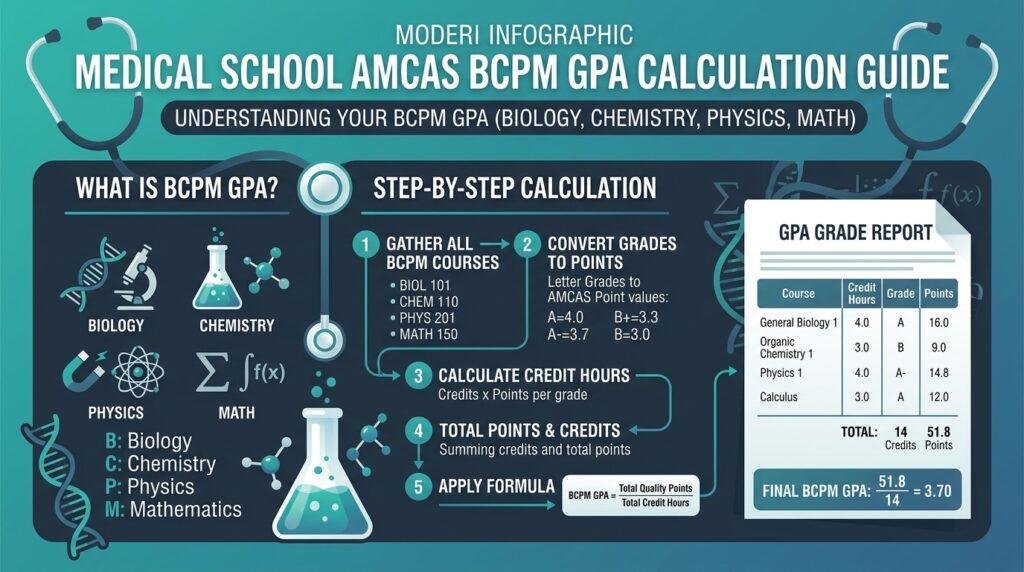
This comprehensive amcas bcpm gpa calculation guide breaks down exactly how the American Medical College Application Service (AMCAS) standardizes and calculates your Science GPA. For pre-med students applying to allopathic (M.D.) medical schools, your BCPM (Biology, Chemistry, Physics, and Mathematics) GPA is the single most scrutinizing academic metric reviewed by admissions committees alongside your MCAT score.
Try it yourself: Use our free AMCAS science GPA and college GPA calculator to compute your cumulative BCPM grade points in seconds. No sign-up needed.
Executive Summary: What Every Pre-Med Must Know About BCPM
Table of Contents
Understanding this amcas bcpm gpa calculation guide prevents costly transcript surprises during the primary application cycle:
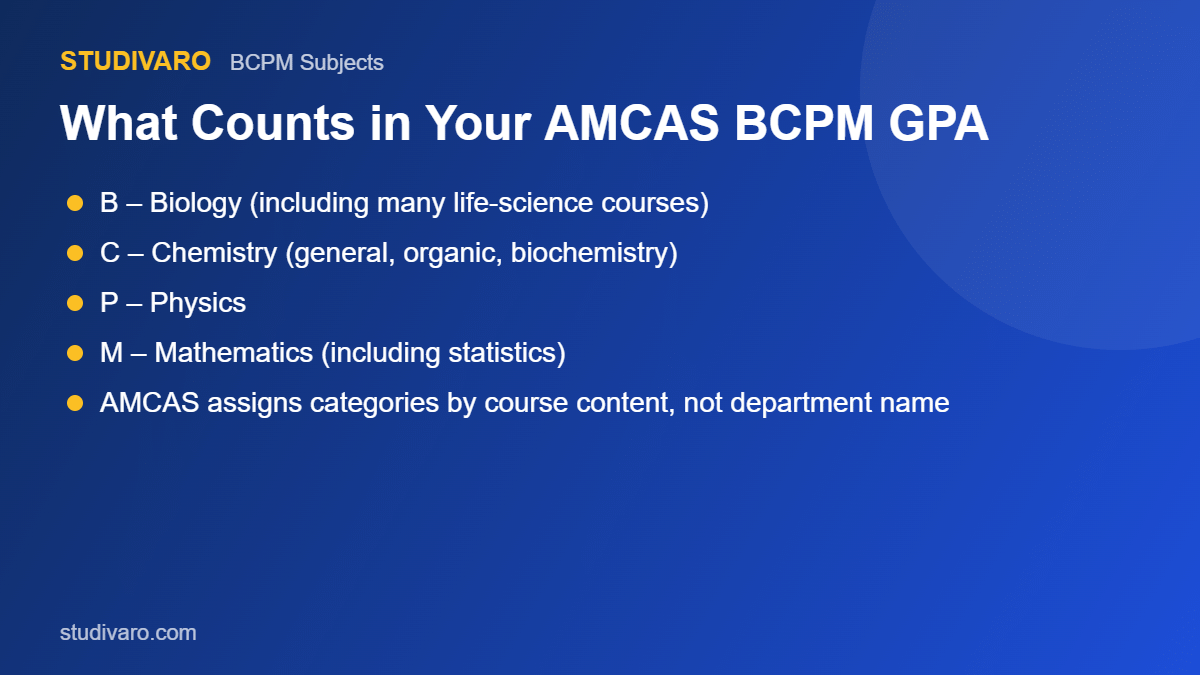
- What BCPM Stands For: Biology, Chemistry, Physics, and Mathematics. Only courses falling under these four core scientific disciplines factor into your AMCAS Science GPA.
- The A+ Cap (Unlike LSAC): AMCAS caps A+ grades at 4.00. Unlike law school admissions where an A+ is worth 4.33, an A+ and an A carry identical weight in the AMCAS system.
- No Grade Replacement / Forgiveness: If you retook Organic Chemistry or Physics and your university expunged the original C- or F from your institutional transcript, AMCAS counts both course attempts in your cumulative BCPM GPA.
- The 50% Content Rule: Course classification depends strictly on the primary subject matter of the syllabus, not the department code. For example, a “Biostatistics” course listed under Psychology counts toward BCPM if more than 50% of the course content is pure mathematics/statistics.
Official AMCAS BCPM Science GPA Calculator
Calculate your Biology, Chemistry, Physics, and Math GPA on the official AAMC 4.0 scale.
What Is the AMCAS BCPM GPA and Why Does It Matter?
The foundation of our amcas bcpm gpa calculation guide centers on how allopathic medical schools evaluate academic preparedness. Medical school curricula demand intense biochemical, physiological, and analytical mastery. Because grading curves and non-science major requirements vary wildly across universities, medical schools rely on AMCAS to generate two distinct grade metrics:Pre-med applicants should routinely consult this verified amcas bcpm gpa calculation guide breakdown when determining whether dual-enrollment or interdisciplinary courses qualify as science credit.
- BCPM (Science) GPA: Calculated exclusively from undergraduate courses in Biology, Chemistry, Physics, and Mathematics.
- AO (All Other) GPA: Calculated from all humanities, social sciences, languages, arts, and business courses.
- Cumulative Total GPA: The combined weighted average of both BCPM and AO coursework.
Admissions screening software frequently sets automatic cutoff filters specifically on your BCPM GPA. A high cumulative GPA driven by humanities electives will not compensate for a lagging BCPM metric.
Which Courses Count Toward Your BCPM GPA?
A central question in any amcas bcpm gpa calculation guide is determining which courses qualify as science. The Association of American Medical Colleges (AAMC) classifies courses based on the following departmental disciplines:
1. Biology (B)
- General Biology I & II (with labs)
- Molecular & Cell Biology
- Genetics & Genomics
- Anatomy & Human Physiology
- Microbiology & Immunology
- Neuroscience & Neurobiology (physiological focus)
- Virology, Ecology, and Evolution
2. Chemistry (C)
- General Chemistry I & II
- Organic Chemistry I & II (with labs)
- Biochemistry
- Physical Chemistry
- Quantitative Analysis & Analytical Chemistry
- Chemical Biology
3. Physics (P)
- General Physics I & II (algebra- or calculus-based)
- Classical Mechanics & Electromagnetism
- Thermodynamics
- Optics & Modern Physics
- Biophysics & Astronomy / Astrophysics
4. Mathematics (M)
- College Algebra & Pre-Calculus
- Calculus I, II, & III
- Differential Equations & Linear Algebra
- Statistics, Biostatistics, & Probability
- Logic (taught through mathematics departments)
Courses That DO NOT Count as BCPM (Common Pre-Med Traps)
Many pre-med students falsely inflate their expectations because they assume every health-related class counts toward science. As highlighted in this amcas bcpm gpa calculation guide, the following disciplines are classified as All Other (AO) coursework:
- Healthcare & Nursing: Clinical nursing courses, patient care, physical therapy, and occupational therapy.
- Nutrition: General human nutrition or dietetics (unless primarily focused on advanced biochemical metabolic pathways).
- Behavioral Sciences: General Psychology, Social Psychology, Abnormal Psychology, and Sociology (these count toward the MCAT, but not BCPM).
- Kinesiology & Exercise Science: Sports physiology, motor learning, and physical education.
- Computer Science & Engineering: Software engineering, coding, electrical engineering, and biomedical engineering design courses (unless the syllabus is over 50% pure calculus/physics).
The Official AMCAS Letter Grade Conversion Table
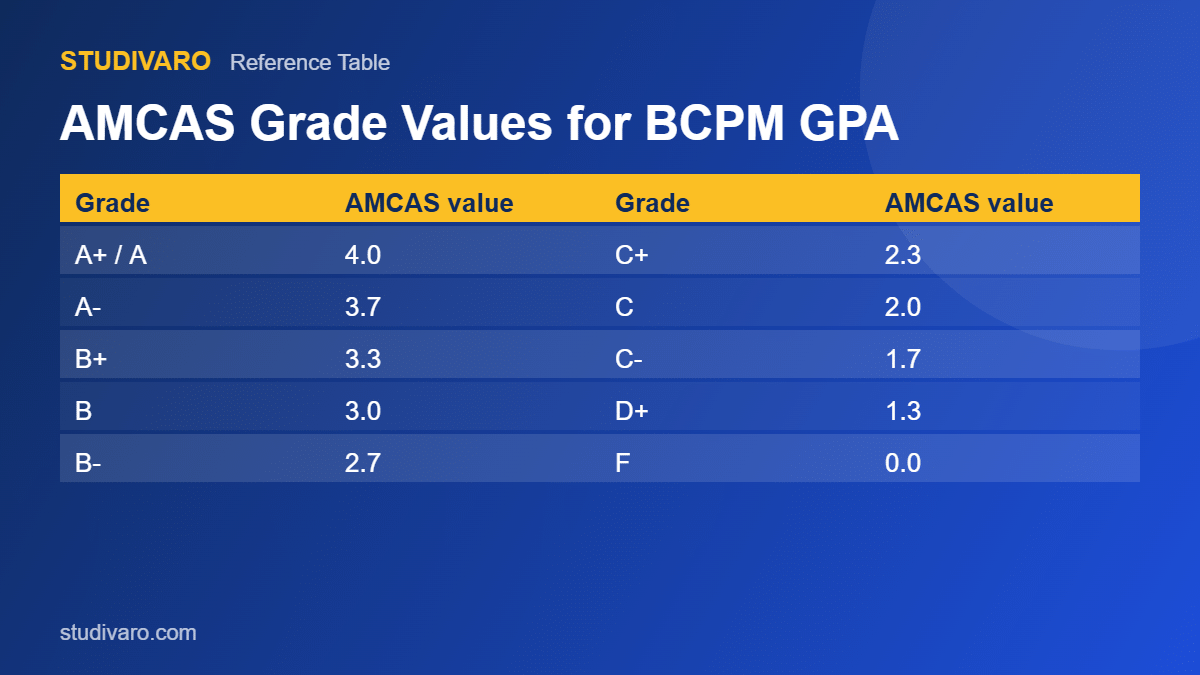
To model your academic record accurately using this amcas bcpm gpa calculation guide, review the standardized AMCAS numerical point values:
| Letter Grade | AMCAS Quality Points (Per Credit) | Comparison to LSAC Scale |
|---|---|---|
| A+ | 4.00 | Capped at 4.00 (No 4.33 advantage) |
| A | 4.00 | Standard Excellent |
| A- | 3.70 | Superior |
| B+ | 3.30 | Very Good |
| B | 3.00 | Good |
| B- | 2.70 | Above Average |
| C+ | 2.30 | Average Plus |
| C | 2.00 | Average |
| C- | 1.70 | Below Average |
| D+ | 1.30 | Minimum Passing |
| D | 1.00 | Poor |
| D- | 0.70 | Minimum Credit |
| F / WF / Unearned F | 0.00 | Complete Failure |
Following our standardized amcas bcpm gpa calculation guide grade matrix ensures that plus/minus variations across different university grading policies are evaluated accurately.
(Note: Advanced Placement (AP) credits accepted by your undergraduate institution and marked as “Pass” or “Credit” satisfy prerequisite requirements but carry zero quality points, having no impact on your numerical GPA).
How to Calculate Your AMCAS BCPM GPA: Worked Example
The mathematical formula presented in this amcas bcpm gpa calculation guide follows standard credit-hour multiplication:
The Mathematical Formula
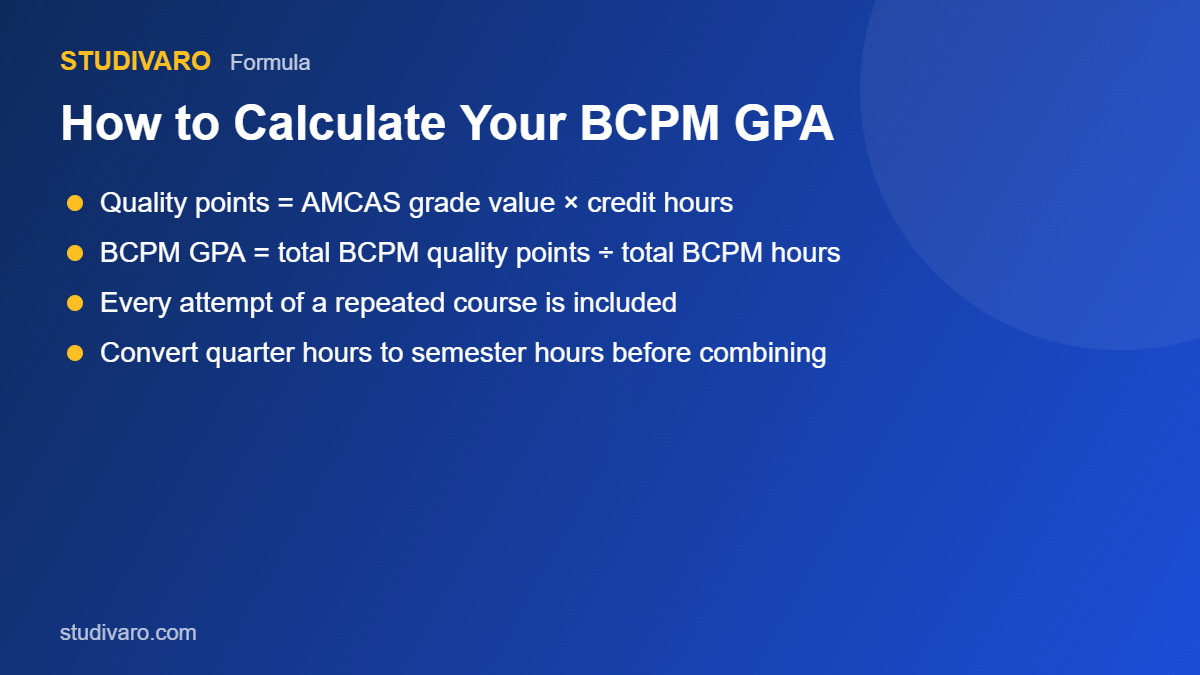
BCPM GPA = Total Science Quality Points Earned ÷ Total Science Attempted Credits
Where:
Quality Points = Course Credit Hours × AMCAS Letter Grade Value
A Concrete Pre-Med Semester Example
Suppose a sophomore pre-med completes the following four science courses (14 attempted credit hours):
- Organic Chemistry I (3 credits): Grade B+ (3.30) →
3 × 3.30 = 9.90 quality points - Organic Chemistry Lab (1 credit): Grade A (4.00) →
1 × 4.00 = 4.00 quality points - Cell Biology (4 credits): Grade A- (3.70) →
4 × 3.70 = 14.80 quality points - Calculus II (3 credits): Grade B (3.00) →
3 × 3.00 = 9.00 quality points - Physics I (3 credits): Grade A (4.00) →
3 × 4.00 = 12.00 quality points
Calculating the Semester BCPM Metrics:
- Total Science Credits:
3 + 1 + 4 + 3 + 3 = 14 credit hours - Total Science Quality Points:
9.90 + 4.00 + 14.80 + 9.00 + 12.00 = 49.70 points - Calculated AMCAS BCPM GPA:
49.70 ÷ 14 = 3.55
This step-by-step mathematical breakdown reflects the standard methodology demonstrated throughout our complete amcas bcpm gpa calculation guide for all 4-year undergraduate tracks.
Testing your multi-year science transcripts inside an interactive calculator allows you to establish an exact baseline before submitting AMCAS primary applications.
How Does AMCAS Handle Repeated Courses? (The Retake Policy)
One of the most vital warnings in this amcas bcpm gpa calculation guide involves course retakes.
If you take General Chemistry I and receive an F (0.00), and subsequently retake the identical course at your home university and achieve an A (4.00):
- Your University Transcript: Likely replaces the original F, showing a 4.00 institutional GPA for that course.
- AMCAS Primary Verification: Mandates that both course attempts be entered. AMCAS averages the 0.00 and the 4.00 across the combined 6 credit hours, resulting in an effective C (2.00) average for that sequence.
Because grade forgiveness is not recognized, pre-med students must focus on upward grade trends across upper-division coursework rather than relying on retakes to erase early academic missteps.
Unlike undergraduate forgiveness rules that overwrite failed grades, our amcas bcpm gpa calculation guide emphasizes that AMCAS requires both original and repeated attempts to be calculated into your cumulative BCPM score.
5 Critical Mistakes Pre-Med Students Make With BCPM GPA
Following our amcas bcpm gpa calculation guide helps you steer clear of these five common verification pitfalls:
- Attempting to Hide Low Community College Grades: Every post-secondary institution you attended must be reported. If you took an introductory physics or calculus course at a community college during high school or summer break, AMCAS requires official transcripts. Failing to disclose coursework can trigger an AAMC investigative red flag.
- Misclassifying Psychology as BCPM: Unless a course is designated as Neuroanatomy or Physiological Psychology with over 50% biological content, AMCAS verifiers will reclassify standard psychology courses into AO (All Other), potentially altering your calculated GPA.
- Assuming Lab Credits Are Included in Lecture Units: Many universities separate lecture (3 credits) and laboratory (1 credit) grades. Ensure both components are listed individually as reported on your official registrar transcript.
- Expecting Quarter Credits to Equal Semester Hours: AMCAS automatically converts quarter hours into semester credits by multiplying quarter units by 0.667.
- Ignoring Post-Baccalaureate Grade Separation: Undergraduate post-baccalaureate coursework is factored into your cumulative undergraduate BCPM GPA. However, graduate coursework (Master’s or Ph.D.) is segregated into an entirely separate graduate GPA table on your official AMCAS summary.
AMCAS BCPM GPA Worked Example
Seeing the math on a real schedule makes the AMCAS BCPM GPA much easier to understand. The example below uses four common pre-med courses and the standard AMCAS grade values.
| Course | BCPM category | Grade | Semester hours | Quality points |
|---|---|---|---|---|
| General Biology I | Biology | A (4.0) | 4 | 16.0 |
| General Chemistry I | Chemistry | B+ (3.3) | 4 | 13.2 |
| Calculus I | Math | A- (3.7) | 4 | 14.8 |
| Physics I | Physics | B (3.0) | 4 | 12.0 |
| Total | 16 | 56.0 → 3.50 BCPM GPA |
How Retakes Affect Your AMCAS BCPM GPA
AMCAS includes every attempt of a course, even if your college replaced the first grade. Imagine you earned a C (2.0) in Organic Chemistry I, then retook it and earned a B+ (3.3), both for 4 semester hours. Your school might show only the B+, but AMCAS counts 8.0 + 13.2 = 21.2 quality points over 8 hours, an average of 2.65 for that course.
That is why your AMCAS BCPM GPA is often lower than the science GPA on your transcript if you have retakes. It also explains why an upward trend matters: strong grades in upper-level biology and biochemistry show admissions committees that an early setback does not define your ability.
Common AMCAS BCPM GPA Mistakes to Avoid
Small entry errors can change your numbers or delay verification. Watch out for these frequent problems, which admissions advisors see every application cycle, and double-check each one before you certify and submit your AMCAS application:
- Classifying by department name. A psychology course on neuroscience methods may still not be BCPM; AMCAS looks at content, so follow its course classification guide.
- Leaving out community college or dual-enrollment courses. Every college-level course must be reported, including classes taken in high school for college credit.
- Forgetting quarter-hour conversion. Quarter hours are multiplied by 0.667 to get semester hours.
- Assuming retakes replace grades. Both attempts appear and both count.
- Using your school’s A+ value. AMCAS caps an A+ at 4.0.
Frequently Asked Questions
What is considered a competitive AMCAS BCPM GPA for medical school?
According to national AAMC matriculant data, the average accepted student at U.S. allopathic medical schools possesses an overall cumulative GPA of 3.77 and a BCPM Science GPA of approximately 3.71. A BCPM GPA of 3.80+ is considered highly competitive across top-tier institutions.Utilizing a structured amcas bcpm gpa calculation guide will quickly clarify how introductory neuroscience counts toward Biology, while clinical neuroscience often falls outside BCPM classifications.
How does AMCAS handle Pass/Fail grades during the COVID-19 pandemic?
Passing grades designated as “P” or “CR” carry zero numerical weight and do not affect your BCPM GPA. However, receiving an explicit “Fail” or “No Credit” on a Pass/Fail grading scale is processed as an F (0.00 quality points) if classified as punitive by your registrar.
Can I appeal a course classification if AMCAS changes my BCPM designation?
Yes. During the AMCAS verification process, if a verifier moves a borderline course (such as Biostatistics or Chemical Engineering) from BCPM to AO, you can submit an official Academic Change Request accompanied by your course syllabus to prove that more than 50% of the course content was biological, chemical, physical, or mathematical.
Does DO school application (AACOMAS) calculate science GPA the same way as AMCAS?
No. AACOMAS (osteopathic medical school application service) does not include Mathematics in its science GPA calculation (it uses BCP: Biology, Chemistry, Physics). AACOMAS also categorizes certain allied health and nursing coursework differently than AMCAS.
Can an outstanding MCAT score overcome a low BCPM GPA?
A strong MCAT score (515+) demonstrates standardized scientific knowledge and can mitigate a moderate BCPM GPA (3.4 to 3.6). However, an extremely low science GPA (below 3.2) typically requires formal post-baccalaureate or Special Master’s Program (SMP) coursework to prove academic readiness.
Next Steps for Pre-Med Applicants: Long-Term Educational Planning
Navigating this amcas bcpm gpa calculation guide is an essential milestone in your medical career journey. Once your target science GPA is determined, evaluating the broader economic reality of medical education is critical:
- To estimate your future medical school student loan repayments and interest accruals, use our Student Loan Monthly Payment Calculator.
- To compare physician starting salaries against average residency debt burdens, consult our College Major Salary to Debt Ratio Calculator.
- For applicants comparing pre-law and pre-med grading curves, review our LSAC 4.33 GPA Recalculation Explained Guide.
AMCAS BCPM GPA: Key Takeaways
Before you submit your application, confirm these points. Each one reflects a rule that regularly catches pre-med applicants off guard, so a quick review now can save you from an unpleasant surprise later:
- Your AMCAS BCPM GPA includes biology, chemistry, physics, and math courses, classified by course content.
- AMCAS uses its own grade values, and an A+ counts as 4.0, not 4.33.
- Every attempt of a repeated course is averaged into your AMCAS BCPM GPA.
- Quarter hours must be converted to semester hours before you combine grades from different schools.
- Medical schools look at your AMCAS BCPM GPA alongside your cumulative GPA, MCAT score, and grade trends.
- Enter your coursework exactly as it appears on your transcripts so AMCAS verification goes smoothly.
Estimating your AMCAS BCPM GPA early, ideally after sophomore year, gives you time to plan retakes, add upper-level science courses, or consider a post-baccalaureate program if you need to strengthen your record.
Verified Medical Admissions References & Sources
For official documentation on AMCAS transcript processing, course classification rules, and matriculant statistics, review these verified AAMC resources:
- Official subject categorization rules: AAMC AMCAS Course Classification Guide
- National medical school applicant and matriculant data: AAMC Medical School Admission Requirements (MSAR)
Disclaimer: This educational AMCAS BCPM GPA calculation guide provides informational guidance based on public AAMC regulations. The Association of American Medical Colleges (AAMC) exercises sole authority over final transcript verification and course classifications.
Pingback: Cumulative GPA vs Major GPA: 5 Best Rules to Calculate the Difference