
LSAC 4.33 GPA Recalculation Explained: Best 2026 Guide
In this detailed breakdown, the lsac 4.33 gpa recalculation explained step by step reveals how the Law School Admission Council (LSAC) standardizes undergraduate transcripts across thousands of colleges and universities. If you are applying to law school, understanding that your undergraduate institutional GPA is rarely the same as your official LSAC Credential Assembly Service (CAS) GPA is the single most critical factor in determining your admissions competitiveness.
Try it yourself: Use our free College GPA Calculator to run your own numbers in seconds. No sign-up needed.
Executive Summary: Why the LSAC GPA Matters More Than Your Transcript
Table of Contents
A clear guide with the lsac 4.33 gpa recalculation explained helps law school applicants avoid devastating surprises during the application cycle:
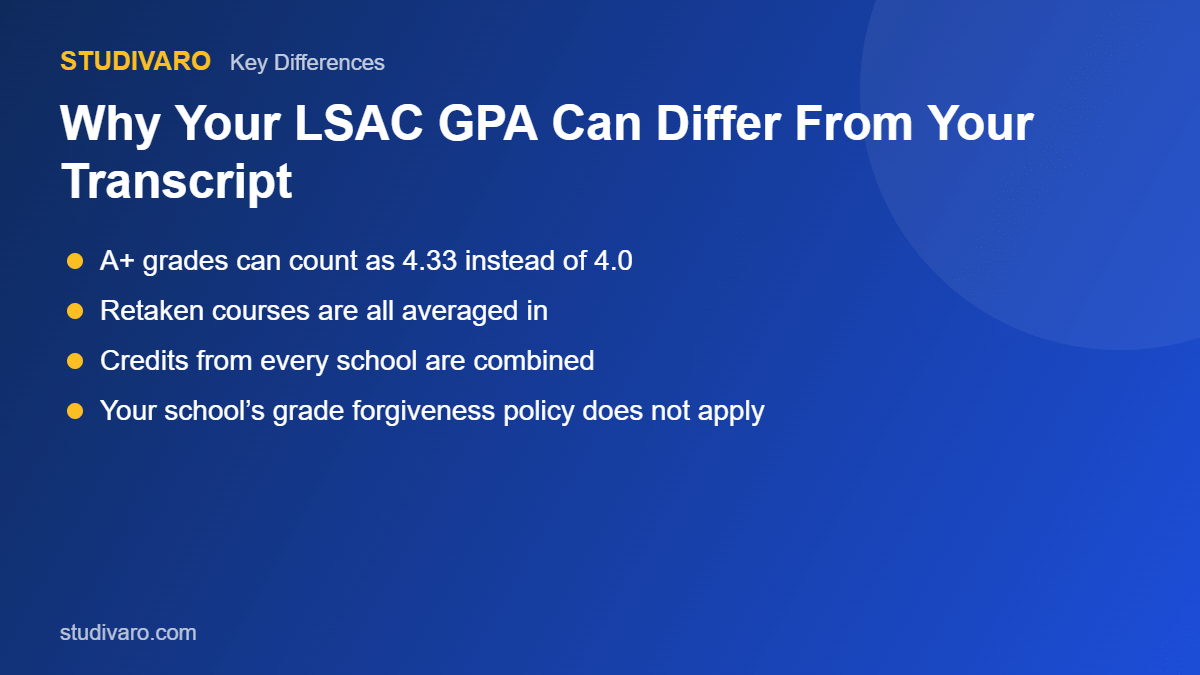
- The 4.33 Maximum Scale: Unlike standard 4.0 collegiate scales, LSAC assigns an A+ a numerical weight of 4.33. Applicants from institutions that award A+ grades can achieve cumulative GPAs above a 4.00.
- No Grade Replacement / Forgiveness: If you retook a failed class and your university replaced the old grade on your official transcript, LSAC includes both attempts in its recalculation.
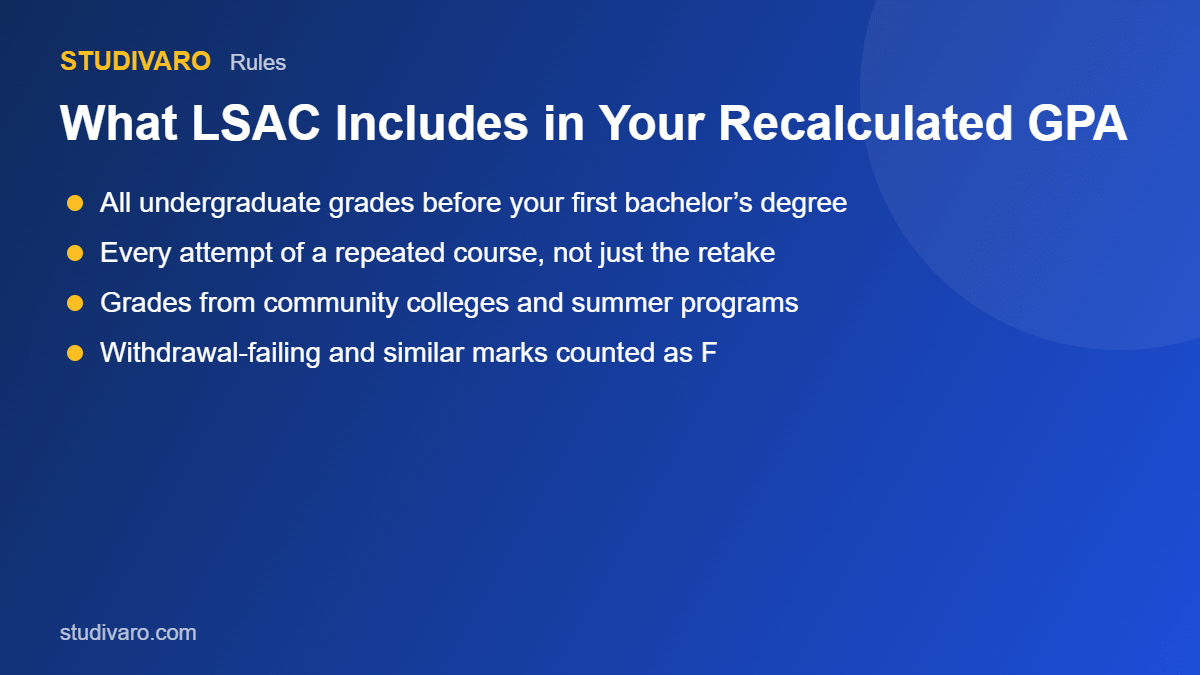
- All Undergraduate Work Counts: Every college-level credit completed prior to the conferral of your first bachelor’s degree—including community college, dual-enrollment high school courses, and transfer credits—is factored into your LSAC GPA.
- Graduate School Is Excluded: Master’s degrees, doctorates, and post-baccalaureate coursework completed after your first bachelor’s degree conferral do not change your cumulative LSAC GPA.
Official LSAC 4.33 GPA Calculator
Calculate your standardized LSAC GPA with 4.33 A+ weights and cumulative credit hours.
What Is an LSAC GPA and Why Does It Exist?
To understand the lsac 4.33 gpa recalculation explained, applicants must recognize the admissions dilemma faced by American Bar Association (ABA) accredited law schools.
With more than 3,000 undergraduate institutions in the United States using drastically different grading policies, minus scales, honors weights, and grade-inflation curves, law schools cannot directly compare a 3.70 from one college against a 3.70 from another.
To level the playing field, the Law School Admission Council operates the Credential Assembly Service (CAS). When your undergraduate registrar submits your transcripts, LSAC strips away all institutional grade-forgiveness policies and recalculates your academic record using a strict, uniform mathematical model.
The Official LSAC Grade Conversion Table
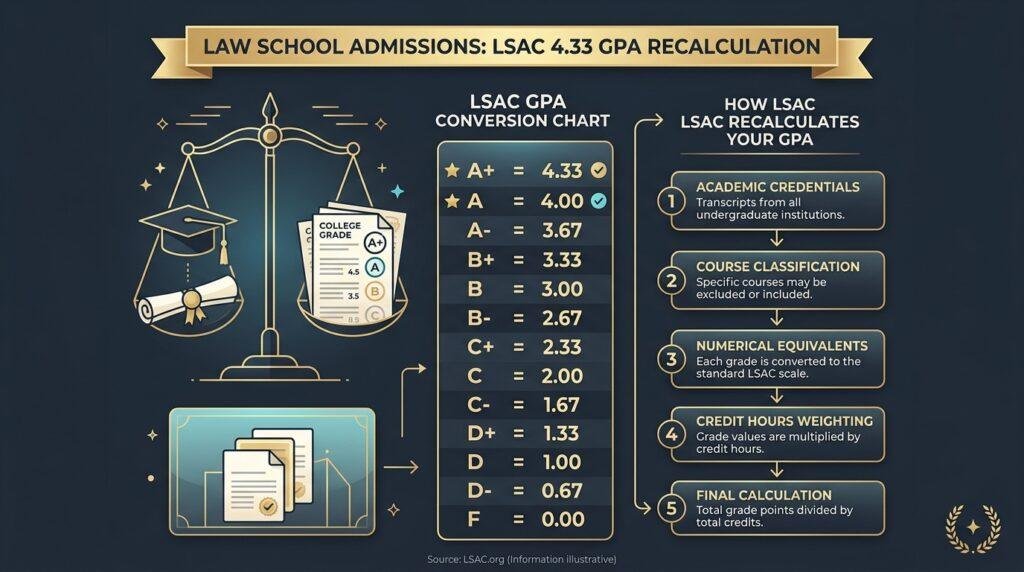
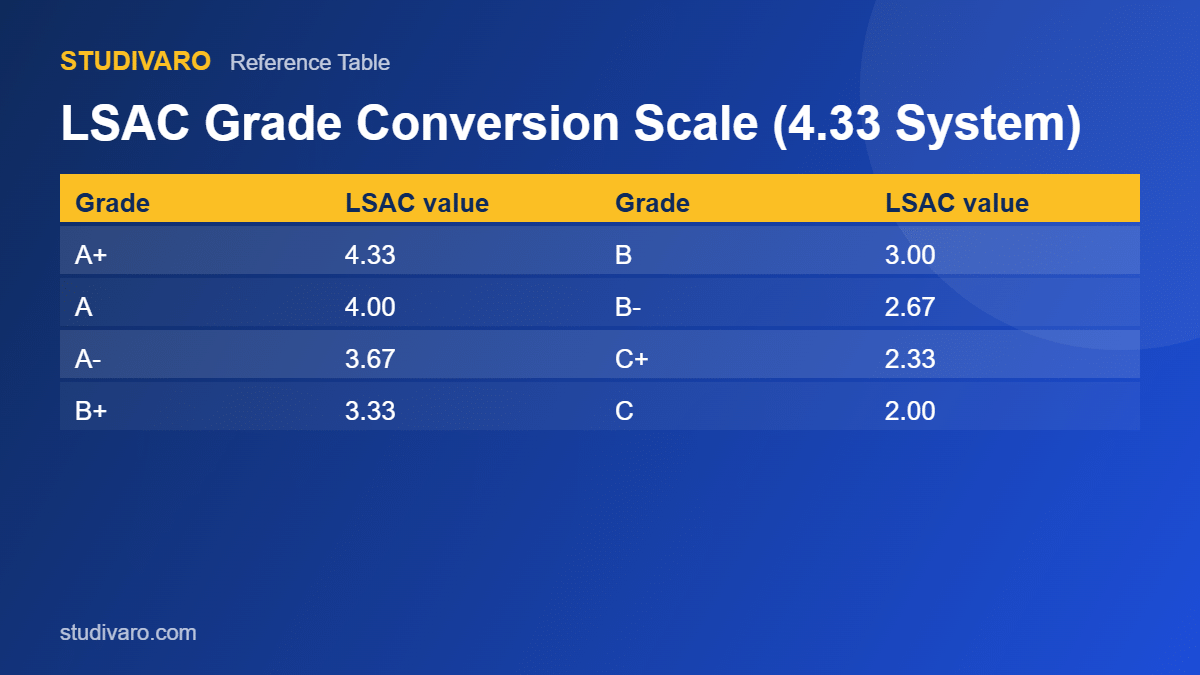
The foundation of the lsac 4.33 gpa recalculation explained is the official LSAC letter-grade conversion table. Every course on your transcript is converted to these exact numerical point values per credit hour:
| Letter Grade | LSAC Quality Points (Per Credit Hour) | Performance Level |
|---|---|---|
| A+ | 4.33 | Exceptional (Above Standard 4.0) |
| A | 4.00 | Excellent |
| A- | 3.67 | Superior |
| B+ | 3.33 | Very Good |
| B | 3.00 | Good |
| B- | 2.67 | Above Average |
| C+ | 2.33 | Average Plus |
| C | 2.00 | Average |
| C- | 1.67 | Below Average |
| D+ | 1.33 | Poor Plus |
| D | 1.00 | Poor |
| D- | 0.67 | Minimum Passing |
| F / WF / Unofficial Drop | 0.00 | Failure (Punitive Zero) |
Reviewing this conversion table within our lsac 4.33 gpa recalculation explained guide reveals how individual plus and minus grades shift your cumulative standing.
(Note: Non-punitive withdrawals marked as “W”, audited classes, and standard “Pass” grades on Pass/Fail systems carry zero quality points and do not count toward your GPA hours).
How to Calculate Your LSAC GPA: Step-by-Step Mathematical Formula
The mathematical formula behind the lsac 4.33 gpa recalculation explained follows standard semester credit weighting:
The Mathematical Formula
LSAC GPA = Total Quality Points Earned ÷ Total Attempted Credit Hours
Where Quality Points for each course are determined by:
Quality Points = Course Credit Hours × Numerical Grade Weight
A Concrete Worked Example
Suppose a student completes a semester with four 3-credit courses (12 total attempted credits):
- Constitutional Law (3 credits): Grade A+ →
3 × 4.33 = 12.99 quality points - Economics 101 (3 credits): Grade A- →
3 × 3.67 = 11.01 quality points - Philosophy & Logic (3 credits): Grade B+ →
3 × 3.33 = 9.99 quality points - Statistics (3 credits): Grade C →
3 × 2.00 = 6.00 quality points
Calculating the Semester Totals:
- Total Attempted Credits:
3 + 3 + 3 + 3 = 12 credits - Total Quality Points:
12.99 + 11.01 + 9.99 + 6.00 = 39.99 points - Calculated LSAC GPA:
39.99 ÷ 12 = 3.3325 (Rounds to 3.33)
Testing your cumulative undergraduate coursework inside an interactive calculator allows you to model these exact transcript conversions ahead of time.
Following the mathematical steps in this lsac 4.33 gpa recalculation explained example ensures you calculate your quality points accurately.
Why Is Your LSAC GPA Different From Your College Transcript? (The 4 Major Shocks)
Applicants frequently experience significant score disparities between what is printed on their university diploma and what appears on their CAS Law School Report. Having the lsac 4.33 gpa recalculation explained highlights the four most common reasons for this discrepancy:
1. The Retake / Grade Forgiveness Trap (The Biggest GPA Drop)
Many undergraduate colleges allow students to repeat a failed course (e.g., retaking an F or D and earning an A) while removing the original low grade from the institutional GPA calculation.
LSAC does not honor institutional grade forgiveness. If the original failing grade was punitive, LSAC includes both the original F (counted as 0.00) and the new grade in your cumulative GPA, effectively halving the benefit of retaking the class.
2. The A+ Boost (The 4.33 Advantage)
Undergraduate institutions that recognize A+ grades rarely award more than 4.0 quality points on their own transcripts. However, because LSAC assigns 4.33 points to every verified A+, students graduating from colleges with an active A+ tier often see their official LSAC GPA rise significantly higher than their college transcript.
3. Community College & Dual-Enrollment High School Credits
Every credit taken at any accredited post-secondary institution prior to your bachelor’s degree must be submitted to LSAC. That includes:
- General education courses completed at a community college during summer breaks.
- Dual-enrollment college classes taken while still enrolled in high school. Even if your degree-granting university did not accept those transfer credits toward your major, LSAC will mandate their transcripts and calculate those grades into your cumulative record.
4. Punitive vs. Non-Punitive Withdrawals
If you withdrew from a class and your university transcript marks it as a punitive drop (such as “WF”, “Withdrawn Failing”, or “Unearned F”), LSAC treats that mark as an outright 0.00 Failure. Only clean, non-punitive “W” designations are excluded from GPA hours.
As our lsac 4.33 gpa recalculation explained overview demonstrates, institutional grade forgiveness is the most common reason for unexpected GPA drops.
How Does LSAC Handle Quarter Credits?
If you attended an institution on an academic quarter system, LSAC normalizes your quarter hours into standard semester hours so that they carry appropriate weight:
- Semester Hours = Quarter Credit Hours × 0.667
For example, a 4-quarter-hour course equals 2.67 semester credit hours. Quality points are then recalculated against this converted semester weight, ensuring fairness when combining transcripts from quarter and semester universities.
“Having the official lsac 4.33 gpa recalculation explained early in your pre-law journey prevents costly miscalculations during law school admissions.
5 Common Mistakes Applicants Make When Estimating Their LSAC GPA
Having the lsac 4.33 gpa recalculation explained helps you avoid these critical miscalculations:
- Relying on Your Degree Audit GPA: Your university’s internal degree evaluation tool only measures credits applied directly toward graduation requirements. LSAC counts all attempted credits, including electives, failed courses, and excess units.
- Assuming Graduate School Grades Raise a Low Undergraduate GPA: Law schools report their undergraduate 25th, 50th, and 75th percentile GPAs to the American Bar Association and U.S. News. Graduate school grades are noted on your report, but they are never combined with your undergraduate LSAC GPA.
- Failing to Order All Transcripts: Failing to disclose a community college transcript where you took a single class can result in an LSAC misconduct investigation and delayed application processing.
- Misinterpreting Pass/Fail Grading: A true “Pass” has zero effect on your GPA. However, receiving a “No Credit” or “Fail” on a Pass/Fail system is classified by LSAC as a punitive 0.00 failure unless your registrar certifies in writing that it is non-punitive.
- Ignoring Coursework Completed Up to the Exact Date of Graduation: Any class completed on or before the official degree conferral date listed on your diploma affects your LSAC GPA. Courses taken even one week after graduation are designated as uncounted post-baccalaureate work.
How to Estimate Your LSAC 4.33 GPA Step by Step
You can estimate your LSAC 4.33 GPA before you ever submit transcripts to the Credential Assembly Service (CAS). Doing this early helps you build a realistic law school list and spot surprises, such as an old retake or a community college class you forgot about. It also gives you time to request missing transcripts, fix records, and plan how to present your academic history in the strongest honest way.
- Gather every transcript. Include community colleges, dual-enrollment programs, summer sessions, and any school you attended before earning your first bachelor’s degree.
- List every course attempt. If you repeated a class, list both attempts. LSAC generally averages in all graded attempts even when your school replaced the original grade.
- Convert each grade to the LSAC scale. Use the 4.33 values shown in the table above, so an A+ becomes 4.33 rather than 4.0.
- Multiply by credits. Grade value × credit hours = quality points for each course.
- Divide. Total quality points ÷ total graded credits = your estimated LSAC GPA.
Here is a simple example showing how an A+ changes the result under LSAC 4.33 GPA recalculation compared with a school that caps grades at 4.0:
| Course | Grade | Credits | LSAC points (4.33 scale) | School points (A+ capped at 4.0) |
|---|---|---|---|---|
| Constitutional History | A+ | 3 | 12.99 | 12.00 |
| Statistics | A | 3 | 12.00 | 12.00 |
| Biology with Lab | B+ | 4 | 13.32 | 13.32 |
| Philosophy | A- | 3 | 11.01 | 11.01 |
| Total | 13 | 49.32 → 3.79 GPA | 48.33 → 3.72 GPA |
In this example the same transcript produces a 3.79 under LSAC rules and a 3.72 on the school’s own scale. The gap can go the other way too: a low grade that your college forgave through a retake will usually pull your LSAC 4.33 GPA down. This is exactly why an early LSAC 4.33 GPA estimate matters so much.
Frequently Asked Questions
Can my LSAC GPA be higher than a 4.00?
Yes. If your undergraduate college awards A+ letter grades and your professors assign them on official transcripts, each A+ carries a value of 4.33 quality points. Students with numerous A+ marks routinely earn cumulative LSAC GPAs of 4.05, 4.15, or even 4.25+.
What if my college does not award A+ grades?
If your university’s official grading scale caps maximum marks at an A (4.00), you cannot receive 4.33 points for any course. While this creates a recognized disadvantage against applicants from schools with A+ tiers, law school admissions committees examine institutional grading curves noted in your CAS academic summary.
Does an LSAC GPA expire?
No. Your LSAC Credential Assembly Service (CAS) GPA remains permanent on file. Even if you apply to law school five or ten years after finishing your undergraduate degree, your recalculated GPA will remain identical.
How does LSAC treat study abroad coursework?
If you completed study abroad coursework sponsored by an accredited American or Canadian university, your grades will be processed through standard transcript conversion. Foreign study abroad sponsored directly by international universities is processed under foreign evaluation rules and is typically not assigned a cumulative numerical GPA.
Can I appeal my LSAC GPA calculation?
You cannot appeal the mathematical formulas or conversion weights. However, if your transcript reflects an administrative error (such as a professor mistakenly filing a grade or an incorrect withdrawal code), you can have your university registrar submit an amended official transcript to LSAC for automatic recalculation.
Next Steps for Law School Applicants: Strategic Financial Planning
Mastering the lsac 4.33 gpa recalculation explained is only the first step in your legal career roadmap. Once your target law schools are identified based on your numbers, financial planning is essential:
- To estimate the true long-term debt impact of funding a J.D. program, use our companion Student Loan Monthly Payment Calculator.
- To evaluate whether your target legal sector (public interest vs. private corporate law) justifies your educational debt, consult our College Major Salary to Debt Ratio Calculator.
LSAC 4.33 GPA Recalculation: Key Takeaways
Use this checklist to make sure your numbers match what admissions committees will see, and revisit it whenever you add a new transcript or finish another term of coursework:
- LSAC 4.33 GPA recalculation puts every applicant on the same scale, so your reported GPA may differ from your transcript.
- A+ grades can raise your LSAC GPA because they count as 4.33 at schools that award them.
- Repeated courses and grades from every institution attended before your first bachelor’s degree are combined.
- Your school’s grade forgiveness or replacement policy does not change your LSAC GPA.
- Estimate your LSAC 4.33 GPA early and compare it with the medians of the law schools on your list.
- Check your CAS Academic Summary Report carefully once it is ready and report any errors to LSAC promptly.
Understanding these rules turns the recalculated number from a surprise into a planning tool, so you can focus your energy on your LSAT score, personal statement, and letters of recommendation.
When to calculate: Run your LSAC 4.33 GPA estimate at least once before junior year ends and again after your final undergraduate term. The first estimate shows how much room you still have to improve; the second confirms the LSAC 4.33 GPA that law schools will actually see alongside your LSAT score. If the two numbers differ a lot from your transcript GPA, mention the reason briefly in an addendum only when it genuinely helps explain your record.
Verified Academic Sources & Official Regulatory Links
For official documentation on law school admission standards and transcript processing rules, review these authorized resources:
- Official transcript processing guidelines: Law School Admission Council (LSAC) CAS Transcript Summarization
- Accreditation and law school enrollment data: American Bar Association (ABA) Section of Legal Education
Disclaimer: This educational guide provides informational analysis regarding LSAC transcript policies. The Law School Admission Council (LSAC) reserves the right to make final authoritative determinations regarding all submitted candidate credentials.
Bookmark our comprehensive lsac 4.33 gpa recalculation explained resource as you finalize your undergraduate transcripts and law school applications.