

College Attendance Below 75 Percent: Rules, Penalties & Appeals
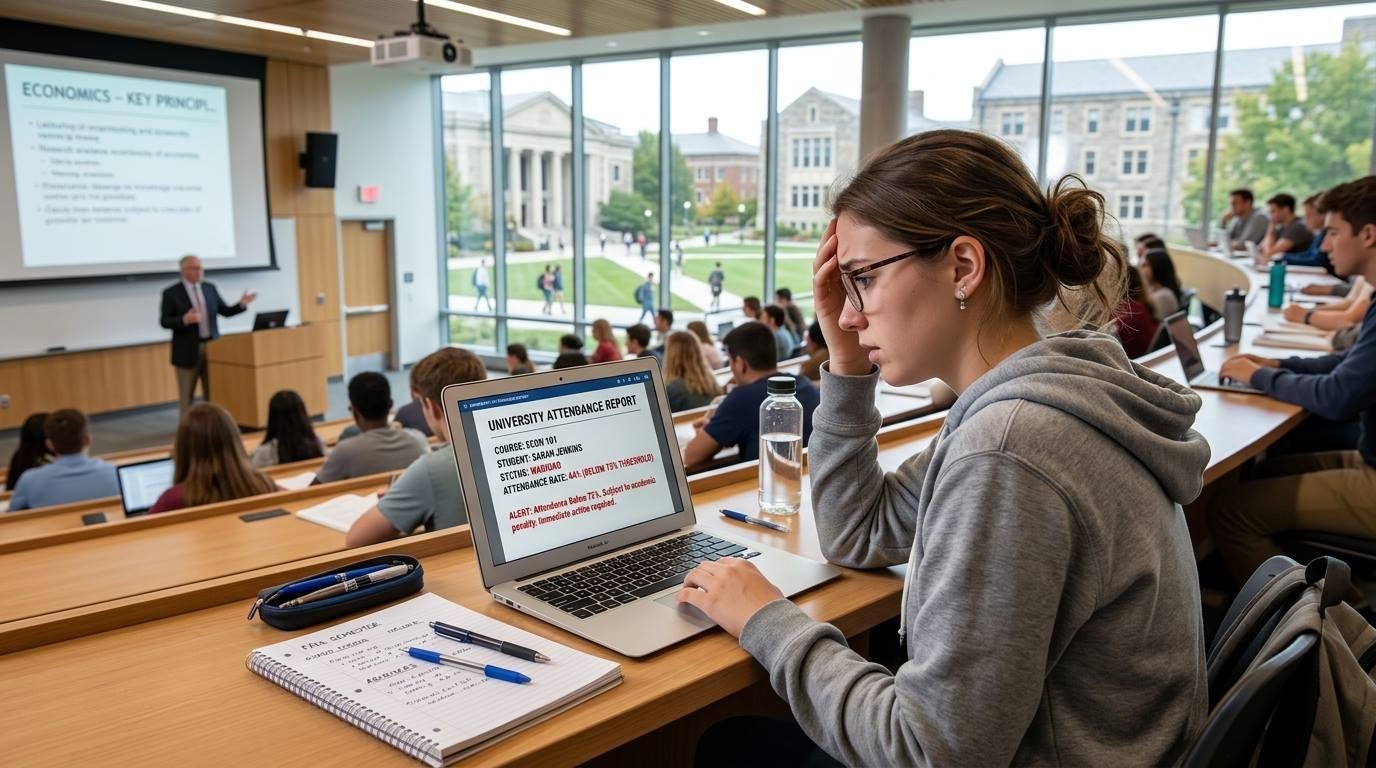
Discovering that your semester attendance has dipped into the danger zone is one of the most alarming crises an undergraduate can face. When dealing with college attendance below 75 percent, students suddenly confront the reality of semester debarment, withheld admit cards, internal assessment deductions, and severe institutional penalties. The seventy-five percent threshold is not an arbitrary number; across thousands of collegiate institutions worldwide, it represents the statutory minimum required to earn course credit and qualify for final examinations.
If you are currently worried about college attendance below 75 percent, panic will not solve the issue. You must understand the administrative bylaws of your university, execute the recovery mathematics needed to lift your percentage back above the threshold, and prepare a formal medical or personal appeal if condonation is required. By checking your current margin with an interactive Attendance Safe Bunk Calculator, you can determine precisely how many consecutive lectures you must attend to restore your standing.
In this definitive academic guide, we break down global university attendance policies, establish the mathematical recovery formula for attendance shortages, detail the three distinct penalty severity tiers, outline legitimate grounds for condonation, provide a proven appeal letter template, and explain how to permanently resolve issues surrounding college attendance below 75 percent before final exams arrive.
Why Universities Enforce the 75% Attendance Benchmark
Higher education accreditation boards, including statutory bodies governed under UGC Higher Education Regulations and institutional standards monitored by the U.S. Department of Education Federal Student Aid Attendance Requirements, view lecture participation as an indispensable component of educational quality.
When your college attendance below 75 percent triggers an automated institutional flag, administrators are adhering to three core regulatory principles:
1. Contact Hour and Credit Weight Compliance
Every accredited college credit hour corresponds directly to a mandated number of instructional contact minutes. If a student misses more than one-quarter of the semester, accrediting agencies argue that the student has failed to receive the minimum instructional exposure required for degree certification. Consequently, facing college attendance below 75 percent jeopardizes your institution’s authority to grant accredited degree credits.
2. Financial Aid Disbursement Audits
In the United States and Canada, federal financial aid programs (such as Title IV Pell Grants and Direct Loans) require institutions to verify “Satisfactory Academic Progress” and continuous active attendance. When a student allows college attendance below 75 percent without documented justification, universities risk federal audit penalties, forcing registrars to administratively withdraw the student.
3. International Student Visa Mandates
For international students studying on F-1, J-1, or UK Student visas, maintaining rigorous class attendance is a legal condition of maintaining valid immigration status. A pattern of college attendance below 75 percent can prompt the Designated School Official (DSO) to report a status violation, resulting in the termination of the student’s legal stay.
The Mathematics of Attendance Shortage Recovery
Most students who find their college attendance below 75 percent attempt to guess how many classes they need to fix the deficit. Guessing frequently leads to miscalculations that result in last-minute exam disqualification.
The Basic Attendance Formula
$$\text{Current Attendance Percentage} = \left( \frac{\text{Total Lectures Attended } (A)}{\text{Total Lectures Conducted } (T)} \right) \times 100$$
When this percentage calculates to less than 75.00%, you have entered an attendance shortage deficit.
The Mathematical Recovery Equation
Suppose your college has conducted $T$ total lectures so far, and you have attended $A$ lectures, putting your current college attendance below 75 percent. To determine the exact number of consecutive upcoming classes ($X$) you must attend without missing a single lecture to reach exactly 75.00%, we solve the following inequality:
$$\frac{A + X}{T + X} \ge 0.75$$
$$A + X \ge 0.75(T + X)$$
$$A + X \ge 0.75T + 0.75X$$
$$0.25X \ge 0.75T – A$$
$$X \ge \frac{0.75T – A}{0.25}$$
Multiplying through by 4 simplifies this into the universal Consecutive Attendance Recovery Formula:
$$X_{\text{recovery}} = 3T – 4A$$
Where:
- $X_{\text{recovery}}$ = Number of consecutive future lectures you must attend without missing.
- $T$ = Total lectures conducted to date.
- $A$ = Total lectures attended to date.
Real-World Recovery Scenarios
To illustrate the mathematical reality of addressing college attendance below 75 percent, consider the following reference table:
| Total Classes Held ($T$) | Classes Attended ($A$) | Current Attendance % | Classes Missed | Consecutive Classes Needed ($X$) | New Total Classes ($T + X$) | Resulting Attendance % |
|---|---|---|---|---|---|---|
| 30 Lectures | 18 Lectures | 60.00% | 12 Lectures | 18 Classes | 48 Lectures | 75.00% |
| 40 Lectures | 26 Lectures | 65.00% | 14 Lectures | 16 Classes | 56 Lectures | 75.00% |
| 45 Lectures | 30 Lectures | 66.67% | 15 Lectures | 15 Classes | 60 Lectures | 75.00% |
| 50 Lectures | 34 Lectures | 68.00% | 16 Lectures | 14 Classes | 64 Lectures | 75.00% |
| 60 Lectures | 40 Lectures | 66.67% | 20 Lectures | 20 Classes | 80 Lectures | 75.00% |
If the semester does not have enough remaining lectures on the syllabus to satisfy $X_{\text{recovery}}$, reaching the 75% threshold through regular attendance becomes mathematically impossible. In that event, reversing college attendance below 75 percent requires institutional condonation or a formal medical appeal.
The Three Penalty Severity Tiers for Low Attendance
Colleges do not treat every attendance deficit identically. Depending on the exact percentage point deficit, universities classify students with college attendance below 75 percent into three distinct administrative tiers:
Tier 1: The Warning and Condonation Zone (70% to 74.9%)
Falling between 70% and 74.9% represents a minor attendance deficit. Most university regulations allow the Head of Department (HOD) or Dean to grant condonation upon payment of a standardized condonation fine (often ranging from $25 to $100 depending on the institution) and submission of an explanation letter.
- Consequences: Warning email sent to student, small monetary condonation fee, minor deduction in internal continuous assessment marks.
- Resolution Pathway: Submit standard form to department office before the semester cutoff date.
Tier 2: The Critical Medical Review Zone (60% to 69.9%)
A student experiencing college attendance below 75 percent that drops below 70% enters the high-risk zone. At this stage, departmental heads typically lack the unilateral legal authority to excuse the absence.
- Consequences: Automatic withholding of examination hall tickets, mandatory appearance before the college Academic Review Committee, forfeiture of internal attendance points.
- Resolution Pathway: You must present verified medical certificates, hospitalization records, or documentation of university representation along with a formal appeal letter to the Academic Dean.
Tier 3: The Strict Debarment Zone (Below 60%)
Allowing college attendance below 75 percent to slip beneath the 60% baseline leads to severe punitive action at virtually all accredited institutions.
- Consequences: Unconditional debarment from taking mid-term or final exams, an automatic grade of “F” or “FA” (Failure due to Attendance), loss of academic term credits, and potential assignment to academic probation.
- Resolution Pathway: If this occurs, review our Academic Probation GPA Recovery Guide immediately to plan course retakes and protect your cumulative grade point average.
Global University Attendance Policies Compared
Attendance enforcement varies across geographic jurisdictions, but the underlying concern regarding college attendance below 75 percent remains universal.
Commonwealth and Indian University Norms (UGC, AICTE, Bar Council)
Universities in India, Pakistan, Nigeria, and other Commonwealth countries enforce some of the strictest legal mandates regarding college attendance below 75 percent:
- General Undergraduates: 75% mandatory attendance across theory and laboratory subjects. The Vice-Chancellor can condone up to a maximum of 10% (lowering the floor to 65%) strictly on genuine medical grounds.
- Law and Medical Students: The Bar Council and Medical Councils mandate an unyielding 70% to 75% minimum with near-zero condonation leniency.
- Failure Consequence: Students below the cutoff receive an “Attendance Detained” notice, requiring them to re-register for the entire subject in the subsequent academic year.
North American Universities (US and Canada)
In North America, individual course professors typically establish attendance policies in the syllabus, though institutional thresholds govern institutional retention:
- Syllabus Penalty Policies: Professors frequently deduct full letter grades (e.g., dropping an “A” to a “B”) once unexcused absences exceed three or four sessions.
- Administrative Drop (“W” / “WF”): If college attendance below 75 percent continues unexcused past midterms, professors can initiate an administrative drop, leaving a “W” or “WF” on the student transcript.
- GPA Impact: Use our College GPA Calculator to project how a forced administrative drop or zero-grade attendance penalty will affect your cumulative transcript.
UK and European Universities (ECTS & Tier 4 Monitoring)
In the United Kingdom, lecture attendance is monitored via digital badge swiping or biometric scanners:
- Home Students: Persistent attendance shortages result in academic warnings and meeting summons with personal tutors.
- International Students: UK Visas and Immigration (UKVI) requires universities to report students who miss ten consecutive expected contact points, triggering visa curtailment proceedings.
The Ripple Effect: How Low Attendance Damages Your Entire Academic Record
The damage caused by college attendance below 75 percent extends far beyond simply missing a single morning lecture. It sets off a domino effect across your entire semester.
1. Destruction of Continuous Internal Assessment Marks
Most collegiate grading rubrics allocate 5% to 15% of the total semester grade strictly to attendance and active in-class participation. Falling into college attendance below 75 percent guarantees that you forfeit these free marks, making it nearly impossible to earn an “A” even if you ace the final exam.
2. Cascading Late Submission Penalties
When you miss class, you miss critical assignment announcements, rubric adjustments, and project milestones. Inevitably, assignments are handed in past deadline. You can calculate the cumulative point deduction of overdue coursework with our Academic Late Submission Penalty Calculator to measure the damage.
3. Final Exam Panic and Cramming
Students who miss one-quarter of lectures must work twice as hard during finals week to teach themselves missed concepts. To calculate the exact score you will need on your final exam to compensate for lost attendance marks, consult our Final Exam Grade Calculator.
4. Direct Financial Loss per Missed Lecture
College education represents a substantial financial investment. Missing classes literally discards tuition dollars. Determine the exact financial waste of skipped lectures using our Semester Tuition Per Lecture ROI tool.
Legitimate Grounds for Attendance Condonation
If you already find your college attendance below 75 percent and need formal institutional condonation, universities will only accept verifiable, documented grounds. Generic claims of “oversleeping” or “personal stress” will be summarily rejected.
Acceptable categories for condonation include:
- Documented Medical Illness or Surgery: Prolonged hospitalization, contagious illness (e.g., infectious viral infections), or major surgical procedures documented by registered physicians.
- Bereavement and Family Emergencies: Death or acute critical illness of an immediate family member (parent, sibling, guardian).
- Official Institutional Representation: Representing the college or university in recognized inter-collegiate sports, academic conferences, cultural festivals, or national youth programs.
- Legal and Civic Duties: Mandated court appearances, legal jury service, or immigration appointments.
Step-by-Step Blueprint to Appeal Low Attendance
When your college attendance below 75 percent is officially announced on the departmental notice board or student portal, follow this systematic five-step appeal blueprint:
Step 1: Collect Medical and Official Verification
Do not approach the dean empty-handed. Assemble an organized documentation dossier containing:
- Official medical certificate with the physician’s medical registration number.
- Pharmacy bills and laboratory test reports verifying the dates of illness.
- Hospital admission and discharge certificates (if applicable).
- Event participation letters signed by faculty advisors (for university representation).
Step 2: Calculate Your Exact Percentage Deficit
Before walking into the dean’s office, know your exact numbers. Determine precisely how many lectures you missed, how many total lectures were held, and what your percentage would be with medical condonation applied.
Step 3: Secure Signatures from Course Professors
Most Academic Deans will not grant condonation if individual course instructors object. Visit each subject instructor during office hours. Apologize for your absence, show that you have caught up on missed lecture notes, and request their preliminary recommendation on your condonation petition.
Step 4: Submit a Formal Written Appeal Letter
Draft a clear, professional, respectful appeal letter addressed to the Dean of Academic Affairs. Avoid blaming professors or making excuses.
Step 5: Follow Up with the Academic Registrar
After submitting your letter, confirm that your petition is logged in the administrative register. Obtain an official acknowledgment receipt so your exam hall ticket is released before testing begins.
Formal Attendance Appeal Letter Template
If you need to appeal your college attendance below 75 percent, customize this formal template for your institution:
To:
The Dean of Academic Affairs / Head of Department
[Name of University / College]
[Campus Department Name]
[City, State, Zip Code]Date: [Insert Date]
Subject: Formal Request for Attendance Condonation on Medical Grounds – [Your Name] (Roll No: [Your Student ID])
Respected Dean / Head of Department,
I am writing this formal petition to respectfully request attendance condonation for the [Fall/Spring 2026] academic semester in the [Your Degree Program, e.g., B.S. Computer Science], Semester [Your Semester Number].
According to the recent departmental attendance register, my cumulative attendance in [Course Name & Course Code] has fallen to [Insert Your Percentage, e.g., 68.5%], which places my college attendance below 75 percent required by institutional bylaws for examination eligibility.
I deeply regret this shortfall and wish to submit that my absences were entirely unintentional and caused by unforeseen medical circumstances. During the period between [Start Date] and [End Date], I suffered from [Specify Medical Condition, e.g., Acute Viral Bronchitis / Severe Gastroenteritis], which required medical bed rest and restricted my physical mobility under physician care.
During my recovery, I made proactive efforts to stay current with course syllabi:
- I reviewed all distributed lecture slides and reading assignments.
- I completed and submitted all required problem sets and homework assignments.
- I consulted with my classmates to transcribe and study missed lecture notes.
Attached to this petition, please find complete supporting documentation verifying the validity of my medical condition:
- Official Medical Certificate issued by Dr. [Physician Name] (License Reg. No: [Number])
- Copies of clinical lab test reports and prescription receipts dated [Dates]
- Recommendation notes signed by course instructors [Optional if obtained]
Given my strong academic commitment and regular attendance across previous semesters, I humbly request that you condone my attendance shortage of [Insert Percentage Deficit, e.g., 6.5%] and grant me permission to appear for the upcoming end-semester examinations.
Thank you for your valuable time, understanding, and consideration of my petition.
Sincerely,
[Your Handwritten Signature]
[Your Full Name]
Roll / Registration Number: [Your Student ID]
Department of [Your Major]
Contact Phone: [Your Phone Number]
Student Email: [Your Email Address]
Preventive Attendance Strategies: How to Never Fall Below 75% Again
Once you resolve your current crisis regarding college attendance below 75 percent, establish strict safeguards to prevent recurrence in future semesters.
1. Build an 80% Safety Cushion Early
During the first six weeks of the semester, attend 100% of your classes. Building an 85% to 90% attendance buffer early ensures that if you fall ill later in the term, your cumulative percentage will comfortably absorb the absence without triggering college attendance below 75 percent.
2. Pre-Calculate Safe Bunk Margins
Never skip a class on a whim. Before deciding to miss a lecture, use our Attendance Safe Bunk Calculator to verify your exact safety margin and ensure skipping will not drop your standing into the danger zone.
3. Calibrate Your Weekly Course Schedule
Overloading your timetable with back-to-back early morning lectures often causes missed classes. Use our College Study Hours Planner and apply The Carnegie 2:1 Study Hour Rule to build a balanced, realistic weekly study schedule.
Frequently Asked Questions (FAQ)
Can I sit for final exams if my college attendance falls below 75 percent?
In most universities, you cannot sit for final exams if your college attendance below 75 percent remains unresolved before the examination cutoff date. However, if your percentage is between 65% and 74%, you can often secure exam eligibility by applying for formal medical condonation or paying a condonation fee. If your attendance is below 60%, exam debarment is usually mandatory.
What is the formula to calculate how many classes I need to reach 75 percent?
The universal formula to find the number of consecutive classes ($X$) needed to reach 75% is $X = 3T – 4A$, where $T$ is the total classes conducted so far and $A$ is the total classes you attended. For example, if 40 classes were held and you attended 26, you must attend $3(40) – 4(26) = 120 – 104 = 16$ consecutive classes without missing.
Will a medical certificate excuse college attendance below 75 percent automatically?
No, a medical certificate does not guarantee automatic approval. It serves as evidence for the university Academic Review Committee. The committee reviews your previous academic record, checks the authenticity of the doctor’s credentials, and decides whether to grant condonation within the statutory limits allowed by institutional regulations.
Does college attendance below 75 percent affect financial aid and scholarships?
Yes. In the United States, federal Title IV financial aid mandates that students maintain active academic engagement under Satisfactory Academic Progress (SAP) rules. Persistent college attendance below 75 percent can prompt instructors to report an unofficial withdrawal, resulting in aid cancellation or tuition clawbacks.
What happens if I miss classes because of representing my college in sports?
If you miss classes while officially representing your university in sports tournaments, academic debates, or cultural festivals, those absences are typically categorized as “On Duty” (OD) attendance. Provided you submit pre-approved participation letters from the sports department, your attendance percentage will be adjusted accordingly.
Can an individual professor override the 75 percent attendance policy?
In Commonwealth and state-regulated universities, professors cannot legally override statutory attendance mandates because admit cards are issued by the central university controller of examinations. However, in private US institutions, individual professors have substantial discretion over grading penalties and attendance requirements outlined in their course syllabus.
College Attendance Below 75 Percent Recovery Calculator
Calculate your current attendance rate and find out exactly how many consecutive lectures you must attend to resolve college attendance below 75 percent.