
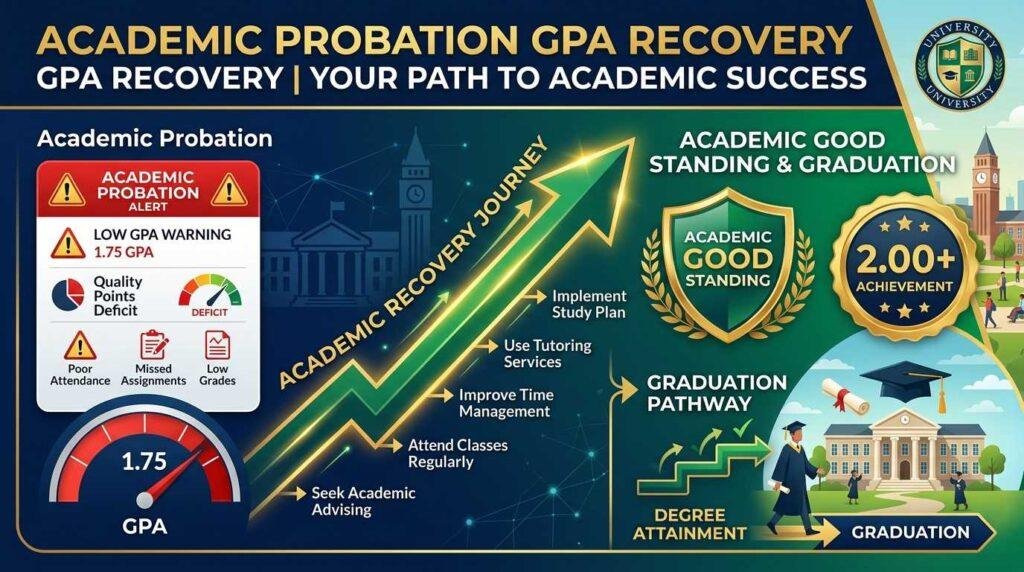
Academic Probation GPA Recovery: Proven 2026 Guide
Receiving a collegiate academic probation notice is an overwhelming experience, but mastering Academic Probation GPA Recovery is the single most important turnaround skill an undergraduate can develop. Every semester, tens of thousands of university students fall below institutional academic standards due to challenging coursework transitions, mental health struggles, family emergencies, or unoptimized study habits. While an official warning letter from the dean can feel devastating, understanding the mathematical mechanics of Academic Probation GPA Recovery transforms panic into structured execution and clear academic progress.
Try it yourself: Use our free GPA recovery and College GPA Calculator to calculate the exact term grades needed to get off academic probation in seconds. No sign-up needed.
Academic probation is designed not as a permanent punitive barrier, but as a mandatory diagnostic intervention. However, failing to take decisive action can lead to irreversible setbacks, including suspension of federal financial aid, dismissal from degree majors, and formal academic disqualification. Successfully navigating Academic Probation GPA Recovery requires auditing cumulative quality points, understanding course repeat policies, structuring realistic credit loads, and executing proven daily academic triage routines. This comprehensive 2026 guide provides the mathematical formulas, registrar policies, SAP appeal frameworks, and recovery blueprints you need to return to good academic standing.
Quick Answer
Under Academic Probation GPA Recovery, the objective is to elevate your cumulative grade point average above your institution’s minimum threshold (typically a 2.00 on a 4.0 scale) by earning term GPAs substantially higher than your current average. Cumulative GPA is a weighted average of total quality points divided by total graded credit hours, meaning rapid recovery depends on eliminating points deficits through high semester grades or retaking failed courses for grade replacement.
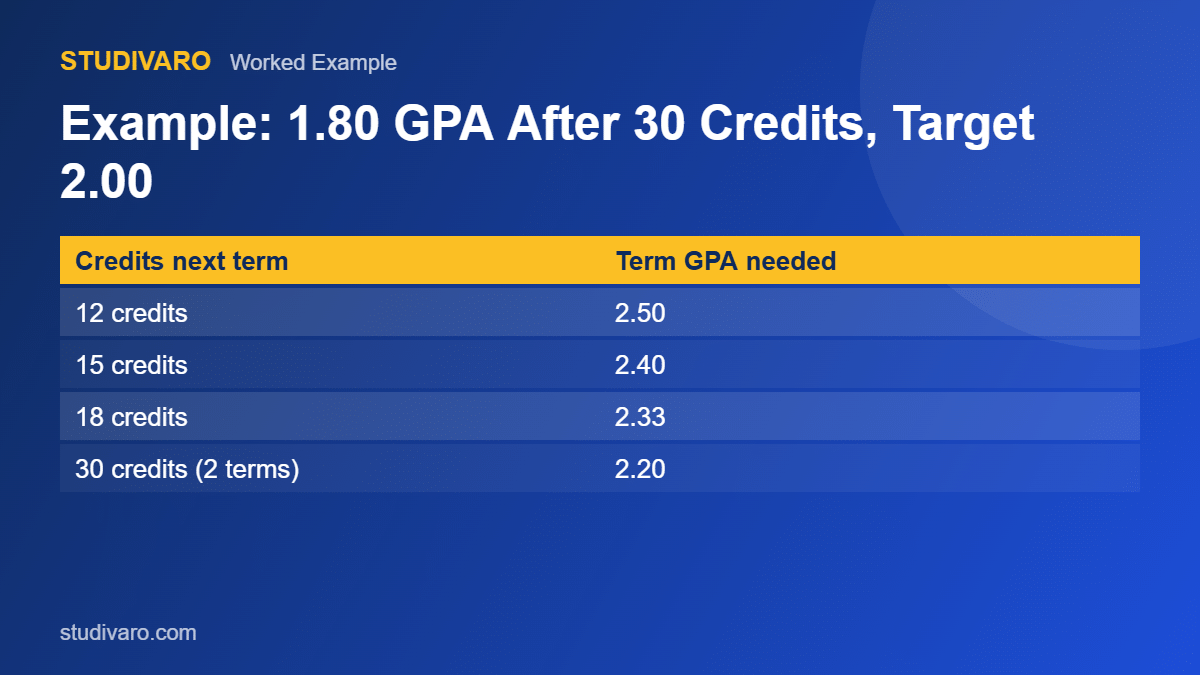
For example, when planning Academic Probation GPA Recovery, students must focus on quality point deficits rather than raw letter grade averages. A student with 30 credits and a 1.70 GPA has a deficit of 9 quality points below a 2.00 standing; earning a 2.60 term GPA across 15 credits the following semester immediately wipes out this deficit and lifts cumulative standing to a safe 2.00 GPA.
`
The Core Academic Probation Recovery Rule:
- DEFICIT AUDIT —> Calculate exact quality points needed to reach 2.00
- STRATEGIC REPEAT —> Retake courses where you earned D or F (Grade Forgiveness)
- CREDIT TRIAGE —> Cap semester load at 12-14 credits to ensure high marks
`
Use our interactive calculator above to enter your current GPA, total completed credits, institutional target GPA, and planned semester credit hours.
Table of Contents
How Academic Probation Works in College
Understanding the institutional timeline is the foundation of Academic Probation GPA Recovery. Universities operate under rigorous accreditation standards that require monitoring undergraduate academic performance at the conclusion of each fall, spring, and summer term.
In higher education, institutions structure Academic Probation GPA Recovery around three sequential accountability stages:
- Academic Warning (Early Notice): Triggered when a student’s semester GPA drops below 2.00, even if their cumulative GPA remains above the good-standing threshold. This is an early alert signaling that study habits require immediate correction.
- Formal Academic Probation: Initiated when cumulative GPA falls below 2.00 (or a sliding credit-hour threshold, such as 1.75 for freshmen and 2.00 for juniors). Registration holds are placed on student accounts, requiring mandatory meetings with academic advisors.
- Academic Suspension or Dismissal: Imposed if a student fails to meet mandatory term GPA benchmarks (typically earning at least a 2.00 or 2.25 term GPA) while on probation. Suspension mandates sitting out from the university for one or two full semesters before petitioning for reinstatement.
Under standard academic regulations, returning to good standing is strictly mathematical: the moment your cumulative GPA crosses the institutional baseline, probation holds are automatically released by the registrar.
Academic Probation Recovery Comparison Matrix
Understanding how institutional statuses differ enables you to navigate registrar policies effectively, as shown in this comprehensive Academic Probation GPA Recovery comparison matrix:
| Status Tier | GPA Requirement | Registration Status | Financial Aid Impact | Primary Academic Action |
|---|---|---|---|---|
| Good Standing | Cumulative GPA >= 2.00 | Full registration access (up to 18 credits) | Eligible for all federal, state, and institutional aid | Maintain balanced coursework and study habits |
| Academic Warning | Term GPA < 2.00, Cumulative >= 2.00 | Normal enrollment permitted | Financial aid monitored; warnings issued | Review study routines using academic planning tools |
| Academic Probation | Cumulative GPA < 2.00 | Mandatory advising hold; capped at 12–14 credits | SAP warning status; risk of scholarship suspension | Formalize advisor contract and retake D/F courses |
| Continued Probation | Cumulative < 2.00, Term >= 2.25 | Enrollment permitted under strict contract | Must file SAP appeal with academic plan | Continue upward term trajectory without pause |
| Academic Suspension | Cumulative < 2.00, Term < 2.00 | Registration revoked for 1–2 terms | Complete cancellation of financial aid eligibility | Complete community college credits or submit appeal |
| Academic Dismissal | Repeated failed suspensions | Permanent separation from the university | Permanent termination of degree candidacy | Reapply for fresh-start admission after 3–5 years |
The Mathematical GPA Recovery Formula: Calculating Quality Points & Credits Needed
The mathematical engine behind Academic Probation GPA Recovery is quality point accounting. Cumulative GPA does not average semester percentages directly; it reflects total quality points earned divided by total graded credit hours attempted.
`
Collegiate Cumulative GPA Equation
                      Total Quality Points
     Cumulative GPA = --------------------
                      Total Graded Credits
Where:
- Quality Points = Sum of (Course Credits * Grade Value)
[A=4.0, A-=3.7, B+=3.3, B=3.0, B-=2.7, C+=2.3, C=2.0, D=1.0, F=0.0] - Graded Credits = Sum of all credits completed under standard letter grades
`
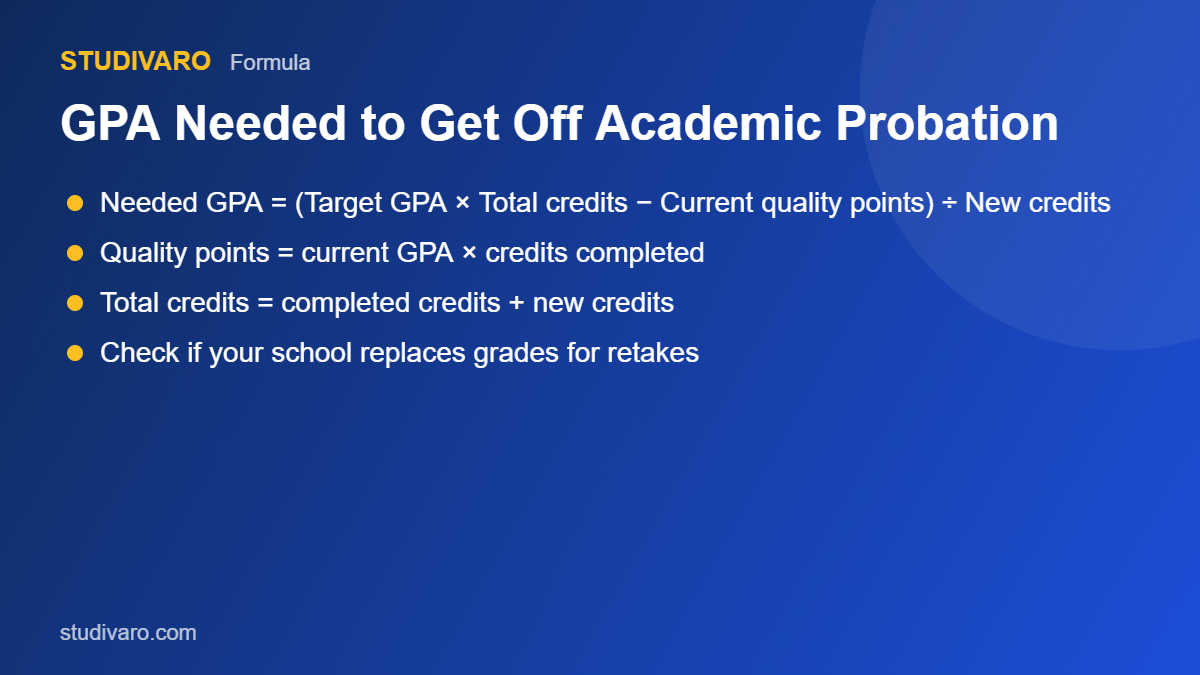
When modeling Academic Probation GPA Recovery, isolating your required target GPA delivers the exact grade points needed:
`
Quality Points Deficit Calculation Formula
Points Deficit = (Target GPA * Completed Credits) - Current Quality Points
Required Term GPA = Target GPA + [ Points Deficit / New Semester Credits ]
`
This formula proves that the earlier you intervene in your college career, the fewer semester credits are required to wipe out an academic deficit.
To determine the exam scores needed to lock in high semester letter grades, consult our How to Calculate the Grade You Need on Your Final Exam guide.
Worked Example 1: Sophomore on Academic Probation (1.75 GPA) Recovering to Good Standing (2.00 GPA)
To see the quantitative reality of Academic Probation GPA Recovery, examine a sophomore carrying a 1.75 GPA across 32 completed credits who must reach a 2.00 cumulative GPA to lift their probation hold.
- Current Completed Graded Credits: 32 credits
- Current Cumulative GPA: 1.75
- Current Quality Points: 32 × 1.75 = 56.0 quality points
- Target Cumulative GPA: 2.00 (Good Standing)
- Planned Term Credits: 12 credits (Capped probation schedule)
Step 1: Calculate Quality Points Deficit
To reach a 2.00 across 32 credits, the student needed 64 points (32 × 2.00 = 64.0).
- Deficit = 64.0 – 56.0 = 8.0 Quality Points
Step 2: Determine Required Semester Term Grades
Across the new 12-credit term, total credits will become 44 (32 + 12 = 44).
- Total Quality Points Needed = 44 × 2.00 = 88.0 points
- Quality Points Needed in New Term = 88.0 – 56.0 = 32.0 points
- Required Term GPA = 32.0 ÷ 12 = 2.67 Term GPA (Between a B- and B average)
Step 3: Compare Results and Strategic Takeaway
This demonstrates the mathematical feasibility of Academic Probation GPA Recovery: one disciplined semester with a 2.50 to 2.67 term GPA completely restores good academic standing, releasing all registration holds.
Worked Example 2: Junior with a 2.30 GPA Aiming for Graduate School Cutoff (3.00 GPA)
Consider an ambitious Academic Probation GPA Recovery scenario where a student seeks upward mobility for graduate school admissions:
- Current Completed Graded Credits: 64 credits
- Current Cumulative GPA: 2.30
- Current Quality Points: 64 × 2.30 = 147.2 quality points
- Target Cumulative GPA: 3.00 (B Average)
- Remaining Degree Credits: 56 credits (Four 14-credit terms)
Step 1: Calculate Total Points Needed for Graduation
- Total Graduation Credits = 64 + 56 = 120 credits
- Total Quality Points Required = 120 × 3.00 = 360.0 points
Step 2: Calculate Required Remaining Performance
- Points Needed Across Remaining Credits = 360.0 – 147.2 = 212.8 points
- Required Remaining Average GPA = 212.8 ÷ 56 = 3.80 Term GPA (Near-flawless A/A- average)
Step 3: Compare Results and Strategic Takeaway
Applying Academic Probation GPA Recovery across multiple consecutive terms reveals that cumulative averages require sustained, multi-semester consistency. If an unachievable term GPA is required, repeating prior D and F grades under institutional grade forgiveness replaces the low grade entirely, cutting the required term GPA dramatically.
What Factors Influence Academic Probation GPA Recovery?
Successfully escaping probation requires managing five critical institutional levers:
1. Institutional SAP (Satisfactory Academic Progress) Rules
Federal Title IV regulations directly govern Academic Probation GPA Recovery through SAP standards monitored by the National Center for Education Statistics (NCES). To maintain eligibility for Pell Grants, Direct Loans, and campus work-study, students must satisfy two quantitative thresholds:
- Maintain a minimum cumulative GPA of 2.00.
- Maintain a cumulative pace of completion of at least 67% (Earned Credits ÷ Attempted Credits >= 0.67).
2. Course Repeat and Grade Forgiveness Policies
The single fastest lever in Academic Probation GPA Recovery is repeating failed courses under grade replacement policies. At institutions like Cornell University Academic Policies and state flagship universities, retaking a course where you previously earned an F replaces the 0.00 quality points with your new grade (e.g., an A awards 4.0 quality points), instantly erasing the previous deficit from your cumulative GPA calculation.
3. Financial Aid Suspension and SAP Appeal Letters
A vital component of Academic Probation GPA Recovery is defending financial aid eligibility. When placed on probation, financial aid is flagged for suspension. Students must draft a formal SAP appeal letter documenting mitigating circumstances (such as medical emergencies, family loss, or documented mental health treatment) accompanied by an academic turnaround plan signed by an academic counselor.
4. Semester Credit Hour Load Restrictions
Colleges frequently impose credit caps during Academic Probation GPA Recovery to prevent cognitive overload. Rather than attempting 16 to 18 credits, students on probation are typically restricted to 12 or 13 credit hours. This restriction protects study time and ensures higher quality points per course.
5. Mandatory Advising Contracts and Academic Holds
Formalizing an academic success contract is a core institutional milestone during Academic Probation GPA Recovery. Academic advising holds block course registration, schedule adjustments, and transcript requests until the student completes mandatory diagnostic meetings, registers for campus tutoring, and submits midterm grade check-ins.
To balance non-punitive grading options during recovery, review our guide on Pass Fail vs Letter Grade to understand when alternative grading protects your GPA.
Common Academic Probation Mistakes and Myths
Undergraduates frequently sabotage their Academic Probation GPA Recovery by believing prevailing campus myths:
Mistake 1: Attempting an Overloaded Semester to Recover Quickly
Believing that taking 18 credits will accelerate recovery is the most dangerous error during Academic Probation GPA Recovery. An overloaded schedule dilutes weekly preparation, frequently leading to another sub-2.00 semester and immediate suspension.
Mistake 2: Ignoring Course Repeat Grade Replacement Rules
Enrolling in new, unfamiliar electives instead of retaking previous D and F courses leaves negative quality points on your transcript. Retaking a failed class provides 3 to 4 times the GPA lift of completing a brand-new course.
Mistake 3: Overlooking Minimum Grade Cutoffs for Financial Aid (SAP)
Passing classes with straight D grades may prevent course failure, but D grades (1.00 quality point) drag cumulative averages downward, violating 2.00 SAP rules and triggering financial aid termination.
Mistake 4: Ghosting Your Academic Advisor and Committee
Avoiding emails from the academic advising dean guarantees administrative suspension. Advisors possess discretionary authority to grant probation extensions when students demonstrate proactive communication.
Mistake 5: Failing to Address Non-Academic Root Causes
Academic struggles are rarely caused by a lack of intelligence; they stem from unmanaged mental health, full-time employment conflicts, or sleep deprivation. Real recovery requires fixing environmental stressors alongside academic study plans.
How to Use the Academic Probation GPA Recovery Calculator
Our interactive recovery simulator models your path back to good standing across four straightforward steps:
- Enter your current cumulative collegiate GPA and total graded credits completed.
- Specify your university’s good-standing target GPA (standard is 2.00; select 3.00 for graduate school benchmarks).
- Input the number of credit hours you plan to enroll in for your upcoming recovery semester.
- Instantly view your total quality point deficit, your required semester term GPA, and tailored academic action advice.
Strategic Decision Framework: Academic Probation Recovery Action Plan
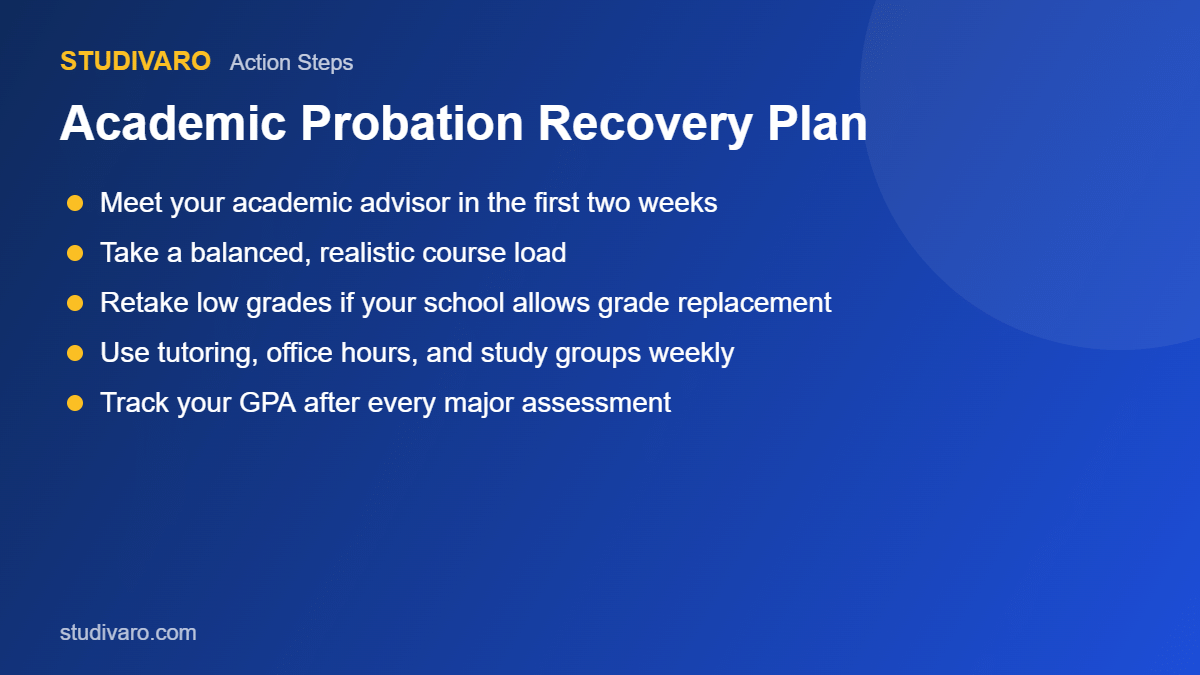
Execute your semester turnaround using this structured Academic Probation GPA Recovery triage matrix:
`
Academic Probation Triage Matrix
Recovery Phase Target Action Plan Execution Milestone
- Week 1 – 2 Syllabus & Schedule Audit Build daily study calendar
Immediate Triage Meet with Academic Advisor using Carnegie 2:1 rule - Week 3 – 6 Active Intervention Attend campus tutoring
Midterm Focus Check Course Repeat Options Log office hours weekly - Week 7 – 10 Withdrawal Evaluation (W) Drop failing classes before
Deadline Check SAP Financial Aid Audit deadline to avoid F grades - Finals Sprint Targeted Final Exam Prep Execute exam calculation
End of Term Lock In Mandatory Term GPA formulas to hit 2.50+ term
`
To master weekly preparation and eliminate late penalties, integrate our College Study Hours Planner, audit lecture attendance with the College Attendance & Bunk Calculator, and minimize deductions using the Academic Late Submission Penalty Calculator.
Frequently Asked Questions About Academic Probation GPA Recovery
How long does it take to recover from academic probation?
Most students return to good academic standing within one to two consecutive semesters. If your cumulative deficit is under 10 quality points, executing an Academic Probation GPA Recovery plan with a 2.50 to 3.00 term GPA across 12 credits resolves probation in a single term.
Does academic probation appear on official university transcripts?
At most universities, academic probation is an internal administrative standing notation that appears on unofficial student portal transcripts but is removed or omitted from official transcripts once you return to good standing. However, academic suspensions and dismissals remain permanent entries.
Can I appeal a financial aid suspension while on probation?
Yes. Financial aid officers review Academic Probation GPA Recovery appeals with emphasis on mitigating personal circumstances. Submitting a comprehensive SAP appeal letter with medical documentation, an advisor-approved education plan, and proof of academic tutoring yields high appeal approval rates.
What happens if I fail to raise my GPA while on academic probation?
If your cumulative GPA remains below 2.00, universities assess your term performance. If you earn at least a 2.25 term GPA, you are typically granted Continued Probation. If your term GPA falls below 2.00, the institution issues an academic suspension.
Should I take summer school courses to recover my GPA?
Yes. Summer school offers intensive, focused coursework with smaller class sizes, allowing undergraduates to retake one or two failed classes without the competing distractions of a 15-credit fall or spring load.
How does academic probation affect federal student loans and repayment?
Probation does not accelerate student loan repayment obligations while you remain enrolled at least half-time. However, if academic suspension terminates your enrollment, your 6-month loan grace period activates. Model your borrowing scenarios with our Student Loan Monthly Payment Calculator.
Related Student Tools
Explore Studivaro’s full suite of collegiate academic tools:
- College GPA Calculator: Model semester and cumulative GPA across credit hours and letter grades.
- How to Calculate the Grade You Need on Your Final Exam: Calculate exact exam percentages required to hit target letter grades.
- Pass Fail vs Letter Grade: Understand the transcript and GPA implications of non-traditional grading options.
- The Carnegie 2:1 Study Hour Rule Explained: Calculate realistic study hour allocations based on enrolled credit hours.
- Curved Grading & Bell Curves Explained: Learn how statistical grading curves shift course percentages.
- College Attendance & Bunk Calculator: Track class attendance and avoid procedural grade penalties.
- Student Loan Monthly Payment Calculator: Estimate loan repayment schedules, interest accrual, and repayment terms.
Final Takeaway: Mastering Academic Probation GPA Recovery
Mastering Academic Probation GPA Recovery is proof of resilience, maturity, and academic growth. A low GPA semester does not define your intellectual capability; it highlights procedural adjustments that must be made to your study habits, course selection, and weekly time allocation. By understanding quality points math, leveraging course repeat policies, and maintaining consistent communication with academic advisors, you can navigate your way back to good standing and graduate on schedule. Audit your current standing with our College GPA Calculator and begin your academic turnaround today.
Academic Probation GPA Recovery Calculator
Calculate your exact quality point deficit and determine the semester term GPA required to return to good standing.
Pingback: What Happens If You Fail a Class in College? 5 Critical Rules (2026)