
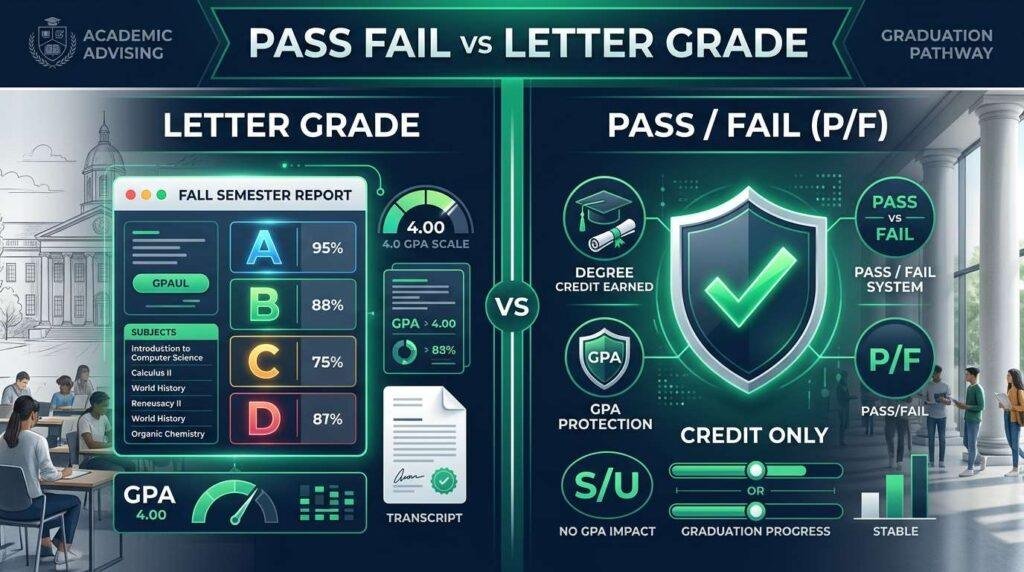
Pass Fail vs Letter Grade: Easy 2026 College Guide
Deciding whether to take a challenging course under Pass Fail vs Letter Grade grading is one of the most critical decisions a college student faces. Every semester, undergraduates encounter rigorous general education requirements, difficult STEM prerequisites, or unexpected personal emergencies that threaten their cumulative grade point average. In these high-stakes moments, understanding the nuances of Pass Fail vs Letter Grade empowers undergraduates to make informed choices, protect their academic transcript, and optimize their weekly study commitments.
Try it yourself: Use our free College GPA Calculator to run your own numbers in seconds. No sign-up needed.
However, electing the wrong grading option can carry long-term consequences, including disqualified graduate school prerequisites, forfeited financial aid scholarships, and delayed degree audits. Successfully navigating Pass Fail vs Letter Grade policies requires balancing cumulative GPA protection against professional credibility. This comprehensive 2026 guide provides the exact mathematical formulas, institutional rules, admissions expectations, and decision checklists you need to master your collegiate grading strategy.
Quick Answer
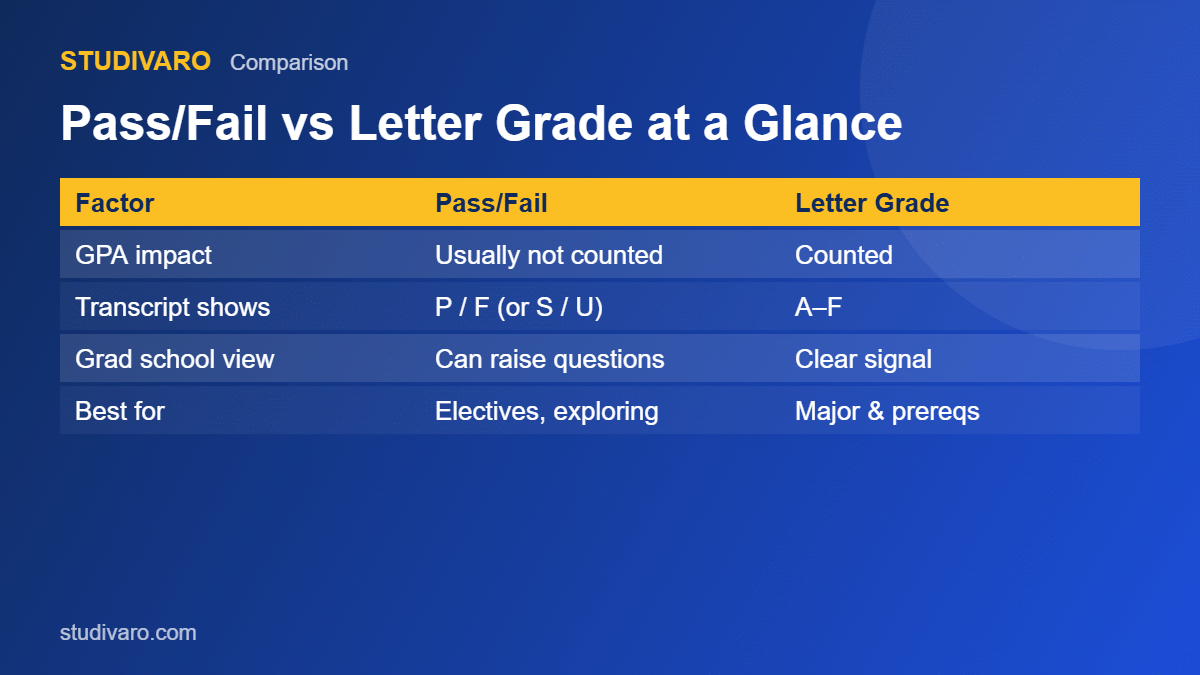
Under Pass Fail vs Letter Grade, the core difference is how your academic work is recorded on your official transcript and whether completed credits contribute numerical quality points to your grade point average. A traditional letter grade (A through F) awards between 0.0 and 4.0 quality points that directly impact your GPA, whereas a pass/fail option converts your final standing into a binary notation (Pass or Fail) that awards degree credits without altering your cumulative GPA.
For example, when analyzing Pass Fail vs Letter Grade, a student passing a difficult elective receives degree credits while freezing their GPA, completely shielding a 3.80 average from being dragged down by a C+. Conversely, a student earning an A in a course under pass/fail forfeits a valuable opportunity to pull their GPA upward.
`
The Core Pass/Fail Rule of Thumb:
- Take PASS/FAIL —> When expected grade is LOWER than your current GPA
- Take LETTER GRADE —> When expected grade is HIGHER than your current GPA
`
Use our interactive calculator above to simulate your current GPA, completed credit hours, expected course grade, and custom degree scenarios.
Table of Contents
How Pass Fail vs Letter Grade Works in College
In traditional grading scales, students receive letter marks from A down to F, whereas evaluating Pass Fail vs Letter Grade reveals fundamentally distinct institutional goals. Letter grades provide granular differentiation among student performance levels. Graduate admissions committees and corporate recruiters review letter grades to assess relative mastery, intellectual work ethic, and mastery of course concepts.
In contrast, colleges and universities establish Pass Fail vs Letter Grade options for three primary reasons:
- Encouraging Academic Exploration: Allowing students to enroll in challenging subjects outside their primary discipline (such as computer programming, foreign languages, or advanced statistics) without anxiety over lowering their GPA.
- Managing Personal Crises: Providing academic relief during unforeseen family emergencies, acute illness, or high-stress semesters.
- Standardizing Experiential Learning: Grading internships, clinical practicums, research tutorials, and thesis credits where numerical tests are non-standard.
Under standard university policies, earning a Pass requires demonstrating competency at a C- or D level (depending on the institution). While earning a Pass grants full credit toward the 120 credit hours needed for graduation, the underlying percentage is hidden on the official transcript.
Pass Fail vs Letter Grade Comparison Matrix
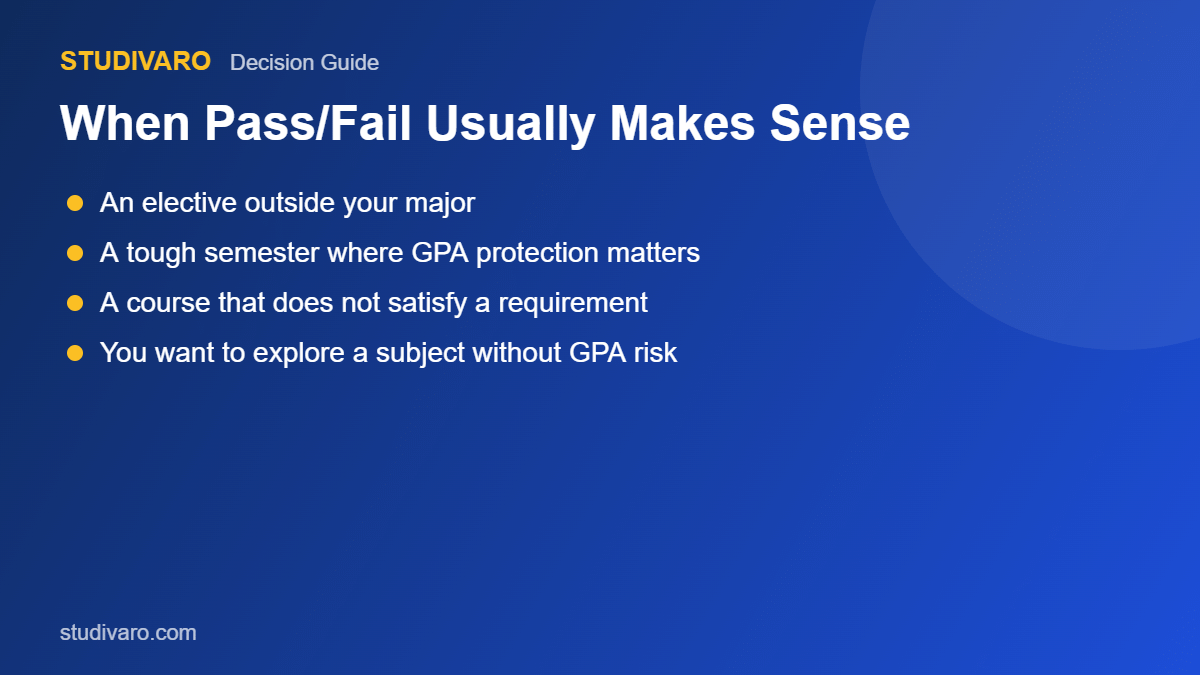
Understanding how institutional policies treat each grading basis allows you to make strategic decisions before the registrar deadline, as demonstrated in this comprehensive Pass Fail vs Letter Grade comparison matrix:
| Evaluation Dimension | Traditional Letter Grade Basis | Pass/Fail (or S/U, CR/NC) Basis | Practical Takeaway |
|---|---|---|---|
| Transcript Notation | Specific letter mark (A, B, C, D, F) | Binary outcome code (P/F, S/U, CR/NC) | P/F conceals borderline performance |
| Cumulative GPA Impact | 0.00 to 4.00 quality points applied | Passing grades award 0 quality points | P/F freezes GPA; letter grade moves it |
| Degree Credits Earned | Full credit awarded for D- or higher | Full credit awarded if pass threshold met | Both fulfill 120-credit graduation total |
| Failing Grade Consequence | 0.00 quality point hit to GPA | Often counts as 0.00 GPA or unearned credit | Failing under either option harms standing |
| Major/Minor Eligibility | Universally accepted for all majors | Heavily restricted; often barred for core | Check departmental handbook first |
| Graduate School Scrutiny | Preferred standard across all disciplines | Accepted for electives; red flag for pre-med | Keep letter grades in prerequisites |
| Scholarship Credit Load | Counts toward minimum graded credits | May drop semester below 12 graded credits | Audit financial aid rules before switching |
The Mathematical GPA Formula: How Quality Points Work
The mathematical foundation of Pass Fail vs Letter Grade is rooted in weighted quality points. In standard collegiate accounting, your cumulative grade point average represents total quality points divided by total graded credit hours completed.
`
Collegiate Cumulative GPA Formula
                           Total Quality Points
         Cumulative GPA = ----------------------
                           Total Graded Credits
Where:
- Quality Points = Course Credit Hours * Grade Point Value (A=4.0, B=3.0, C=2.0, D=1.0, F=0.0)
- Graded Credits = Sum of all credits completed under standard letter grades
`
When evaluating Pass Fail vs Letter Grade, the formula isolates non-graded credit hours from both the numerator and denominator:
`
Pass/Fail GPA Impact on Completed Credits
             Current Total Quality Points + 0
New GPA = --------------------------------------- = Current GPA (Frozen)
             Current Graded Credits + 0
`
Because zero quality points and zero graded credit hours enter the equation, a passing mark completely insulates your cumulative standing.
To determine how individual assignments impact your overall course standing prior to grading deadlines, utilize the How to Calculate the Grade You Need on Your Final Exam guide to establish your exact mathematical floor.
Worked Example 1: Junior with a 3.80 GPA Taking a Difficult 4-Credit Course
To understand the practical impact of Pass Fail vs Letter Grade, consider a junior with a 3.80 cumulative GPA who has completed 60 graded credit hours. The student is enrolled in a notoriously challenging 4-credit physical chemistry elective and expects a final grade of C+ (2.3 quality points).
- Current Cumulative GPA: 3.80
- Total Graded Credits Completed: 60 credits
- Current Total Quality Points: 60 × 3.80 = 228.0 points
- Target Course Credits: 4 credits
- Expected Course Grade: C+ (2.30 quality points)
Step 1: Calculate GPA Under Letter Grade Basis
If the student keeps the course for a letter grade:
- New Total Quality Points = 228.0 + (4 × 2.30) = 228.0 + 9.2 = 237.2 points
- New Total Graded Credits = 60 + 4 = 64 credits
- New Cumulative GPA = 237.2 ÷ 64 = 3.706
Step 2: Calculate GPA Under Pass/Fail Basis
If the student elects the pass/fail option and passes:
- New Total Quality Points = 228.0 + 0 = 228.0 points
- New Total Graded Credits = 60 + 0 = 60 credits
- New Cumulative GPA = 228.0 ÷ 60 = 3.800
Step 3: Compare Results and Strategic Takeaway
Applying Pass Fail vs Letter Grade in this scenario prevents an irreversible 0.08 drop in cumulative GPA, preserving the student’s eligibility for Magna Cum Laude honors and competitive internship benchmarks.
Worked Example 2: Sophomore with a 2.40 GPA Rebuilding Academic Standing
Now examine how Pass Fail vs Letter Grade functions for a student in academic recovery. Consider a sophomore carrying a 2.40 cumulative GPA across 30 completed credits who is currently earning a solid B+ (3.3 quality points) in a 3-credit sociology course.
- Current Cumulative GPA: 2.40
- Total Graded Credits Completed: 30 credits
- Current Total Quality Points: 30 × 2.40 = 72.0 points
- Target Course Credits: 3 credits
- Expected Course Grade: B+ (3.30 quality points)
Step 1: Calculate GPA Under Letter Grade Basis
If the student takes the class for a traditional letter grade:
- New Total Quality Points = 72.0 + (3 × 3.30) = 72.0 + 9.9 = 81.9 points
- New Total Graded Credits = 30 + 3 = 33 credits
- New Cumulative GPA = 81.9 ÷ 33 = 2.482 (an immediate +0.082 upward boost)
Step 2: Calculate GPA Under Pass/Fail Basis
If the student mistakenly elects pass/fail:
- New Cumulative GPA = 72.0 ÷ 30 = 2.400 (frozen, zero gain)
Step 3: Compare Results and Strategic Takeaway
In this case, Pass Fail vs Letter Grade proves that taking the course for a letter grade is far more beneficial. Choosing pass/fail would waste crucial upward momentum needed to climb out of academic probation. For structured recovery techniques, explore our Academic Probation GPA Recovery Guide.
What Factors Influence the Pass Fail vs Letter Grade Decision?
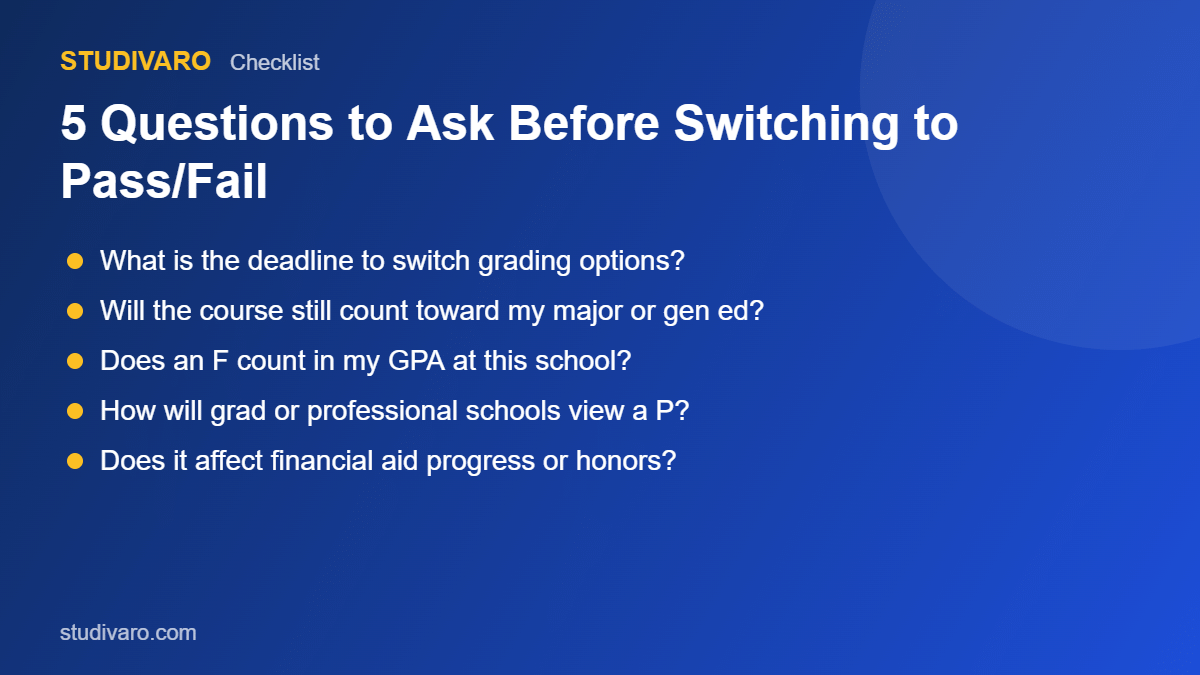
Accurately evaluating your grading basis requires reviewing five decisive institutional factors:
1. Major and Minor Core Requirements
Most academic departments restrict Pass Fail vs Letter Grade for courses counting toward a major or minor. University degree audit software (such as Degree Works) is programmed to reject non-graded courses from satisfying core departmental requirements. Always confirm with your academic advisor before converting a major course.
2. Graduate, Medical, and Law School Prerequisites
Post-graduate admissions committees scrutinize Pass Fail vs Letter Grade transcripts with intense skepticism. For pre-med candidates applying via the Association of American Medical Colleges (AAMC), science prerequisites (biology, chemistry, physics, biochemistry) must be completed for a letter grade. Similarly, the Law School Admission Council (LSAC) converts punitive non-passing grades into a 0.0 failure during GPA standardization.
3. Financial Aid and Scholarship Minimum Graded Credits
Federal financial aid regulations and private scholarships mandate specific Pass Fail vs Letter Grade ratios. Under Satisfactory Academic Progress (SAP) rules established by the National Center for Education Statistics (NCES), students must complete at least 67% of all attempted credits. Furthermore, many institutional merit awards require completing a minimum of 12 conventionally graded credits each term.
4. Dean’s List and Latin Honors Eligibility
Qualifying for semester academic honors requires adhering to strict Pass Fail vs Letter Grade credit thresholds. Most universities require completing at least 12 or 14 conventionally graded credits in a given term to qualify for the Dean’s List, and graduation with Latin Honors typically requires 60+ letter-graded credits overall.
5. Instructor Curve Policies and Cohort Distribution
Before making an election, investigate whether your professor curves the class using Curved Grading & Bell Curves Explained. In rigorous STEM courses, a 65% raw average often curves into a solid B, making a pass/fail election unnecessary.
Common Pass Fail vs Letter Grade Misconceptions and Myths
Undergraduates frequently believe false assumptions regarding college grading options:
Mistake 1: Assuming a Pass Looks the Same as an A
Graduate schools assume a Pass represents the bare minimum passing grade (C or D). Never take a course pass/fail if you can realistically achieve an A or B+.
Mistake 2: Believing a Fail Does Not Hurt Your GPA
At many universities, failing a pass/fail course results in an F that enters your GPA as a 0.00 quality point penalty. A failing grade is never consequence-free.
Mistake 3: Forgetting the Irreversible Registrar Deadline
Most colleges enforce an unbending deadline between week 8 and week 11 of the semester. Once passed, you cannot change your grading basis or retroactively request a letter grade.
Mistake 4: Taking Prerequisite Courses Pass/Fail
If Course A is a mandatory prerequisite for Course B, the department usually requires earning a grade of C or higher for a letter grade. A Pass notation will block course registration.
Mistake 5: Overlooking Credit Load Caps
Colleges cap total pass/fail allowances to 12–16 credit hours across your entire four-year degree. Using all your allowances during your freshman year leaves zero safety margin for senior-year capstone courses.
How to Use the Pass Fail vs Letter Grade Calculator
Our interactive simulator helps you evaluate grading decisions across four straightforward steps:
- Input your current cumulative collegiate GPA and total graded credits completed.
- Enter the credit hours and your anticipated letter grade for the course under review.
- Select your degree status (General Elective, Major Requirement, Pre-Med Prerequisite, Pre-Law).
- Instantly view your projected GPA under letter grade versus pass/fail, and review tailored tactical advice.
Strategic Decision Framework: When to Choose Pass Fail vs Letter Grade
Use this triage protocol to evaluate your Pass Fail vs Letter Grade options before the registrar deadline:
`
Finals Triage Matrix
Academic Scenario Expected Grade Recommended Strategy
- High-GPA Student Expected C or C- ELECT PASS/FAIL
General Elective (Below 3.50 GPA) Safely freezes GPA, prevents drop - Low-GPA Student Expected B or B+ TAKE FOR LETTER GRADE
Academic Recovery (Above 2.20 GPA) Provides vital upward momentum - Major Requirement Any Expected TAKE FOR LETTER GRADE
Core Subject Passing Grade Fulfills mandatory degree audit - Pre-Med / Pre-Law Science or Math TAKE FOR LETTER GRADE
Prerequisite Course Prerequisite Mandatory for AMCAS/LSAC review
`
Balancing your semester course load also requires smart time management. Combine this framework with The Carnegie 2:1 Study Hour Rule Explained and our College Study Hours Planner to optimize study allocation, while using the College Attendance & Bunk Calculator and Academic Late Submission Penalty Calculator to avoid lost marks.
Frequently Asked Questions About Pass Fail vs Letter Grade
Does a Pass in a pass/fail course hurt my cumulative GPA?
No. When you pass a course under pass/fail grading, credit hours count toward graduation requirements, but zero quality points enter the equation. Your cumulative GPA remains entirely unchanged.
Does an F in a pass/fail course affect my GPA?
At many colleges, an F in a pass/fail course counts as an unweighted 0.00 quality point hit, dragging your GPA downward. At other institutions, it is recorded as No Credit (NC) and excluded from GPA math, but still harms your completion rate for financial aid.
Will graduate admissions committees accept pass/fail courses?
Graduate admissions panels review Pass Fail vs Letter Grade transcripts differently depending on the course subject. Non-major electives taken pass/fail are universally accepted, whereas core prerequisites in STEM, business, or law must be completed for a letter grade.
Can I change my mind and convert a Pass back to a letter grade?
Under standard registrar regulations, changing your grading basis is irreversible once the semester deadline passes. Hidden letter grades cannot be unmasked on official transcripts.
What is the difference between Pass/Fail, S/U, and CR/NC?
These terms represent institutional variations of non-punitive grading. Pass/Fail (P/F) is common in undergraduate courses, Satisfactory/Unsatisfactory (S/U) is prevalent in graduate research, and Credit/No Credit (CR/NC) emphasizes granting degree credits rather than grading performance.
How does pass/fail impact student loan repayment planning?
While grading options do not directly affect loan balances, failing a course can require repeating credits, increasing your overall borrowing. Use our Student Loan Monthly Payment Calculator to project repayment costs across standard and extended terms.
Related Student Tools
Explore Studivaro’s full suite of academic planning tools:
- College GPA Calculator: Model semester and cumulative GPA across credit hours and letter grades.
- How to Calculate the Grade You Need on Your Final Exam: Determine the exact exam percentage needed to lock in your desired course grade.
- The Carnegie 2:1 Study Hour Rule Explained: Calculate weekly study hour requirements based on enrolled course credits.
- Curved Grading & Bell Curves Explained: Understand how standard deviations and z-scores shift raw exam grades.
- Academic Probation GPA Recovery Guide: Step-by-step strategies for returning to good academic standing.
- College Attendance & Bunk Calculator: Track lecture attendance and calculate safe absent margins.
- Student Loan Monthly Payment Calculator: Estimate monthly loan repayments, total interest, and amortization timelines.
Final Takeaway: Mastering Pass Fail vs Letter Grade
Mastering Pass Fail vs Letter Grade transforms transcript uncertainty into a deliberate academic strategy. By understanding weighted quality points, evaluating post-graduate prerequisites, and respecting registrar deadlines, you can protect your cumulative GPA during difficult semesters while demonstrating intellectual mastery where it matters most. Audit your current standing with our College GPA Calculator and make confident, data-driven grading decisions throughout your college journey.
Pass/Fail vs. Letter Grade GPA Impact Simulator
Simulate the mathematical impact of electing Pass/Fail versus taking a traditional Letter Grade on your cumulative collegiate GPA.