
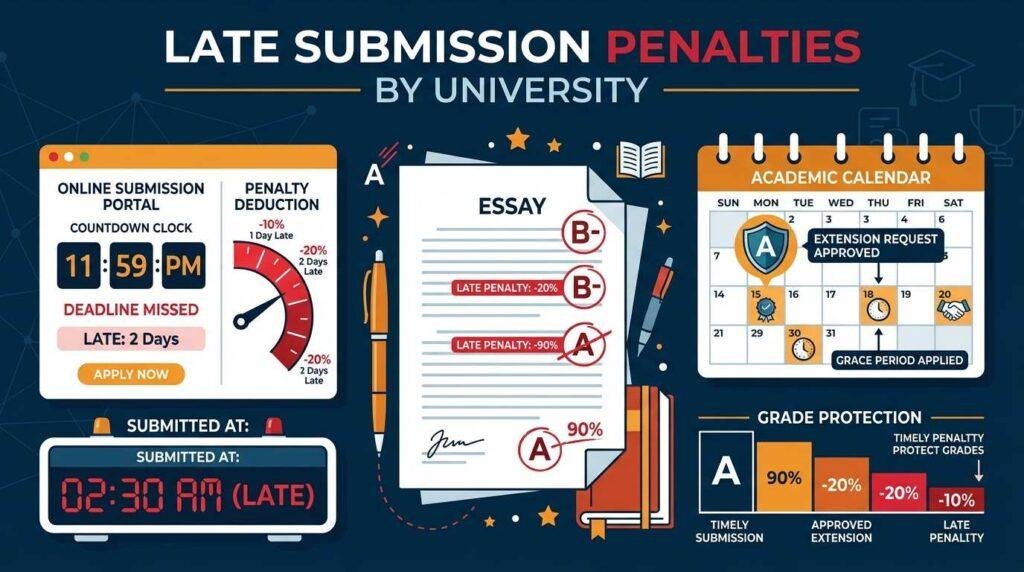
Late Submission Penalties by University: Proven 2026 Guide
Submitting an academic assignment past the deadline is a stressful reality for college undergraduates, making understanding Late Submission Penalties by University essential for academic survival. Whether caused by intense midterms overlap, unexpected technical malfunctions on learning management systems, illness, or poor time management, missing a submission deadline triggers institutional grade deductions. In these high-pressure moments, familiarizing yourself with the exact Late Submission Penalties by University helps you evaluate strategic tradeoffs, protect your cumulative GPA, and avoid unearned zeroes.
Try it yourself: Use our free Late Submission Penalty Calculator to run your own numbers in seconds. No sign-up needed.
However, departmental late policies are rarely uniform. Navigating Late Submission Penalties by University requires auditing course syllabi, understanding digital timestamp mechanisms, knowing whether deductions apply to maximum points versus earned marks, and utilizing formal extension appeals. This comprehensive 2026 guide breaks down institutional policies from top global universities, provides mathematical penalty formulas, offers decision triage trees, and presents an email template to help you minimize academic deductions.
Quick Answer
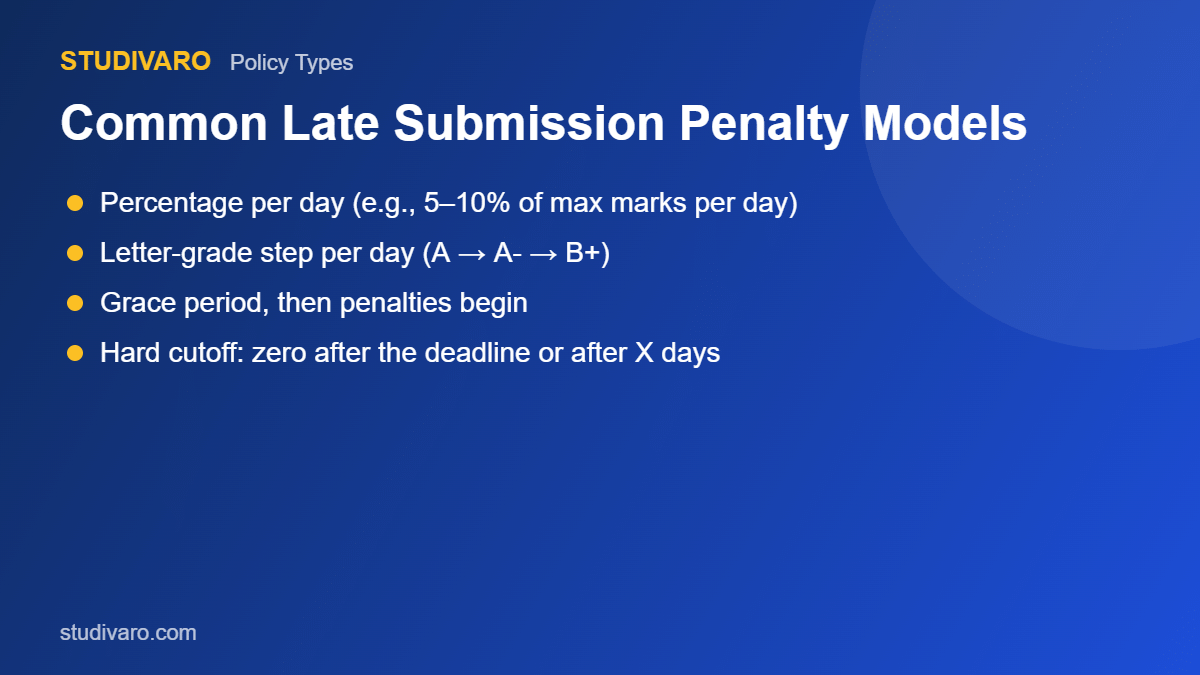
Under Late Submission Penalties by University, academic departments deduct percentage marks from an assignment for each day or hour it is submitted past the official deadline. In higher education, when evaluating Late Submission Penalties by University, the most common standard is a 5% to 10% reduction per 24-hour period late, with submissions typically receiving an automatic zero if submitted more than 5 to 7 days past the cutoff.
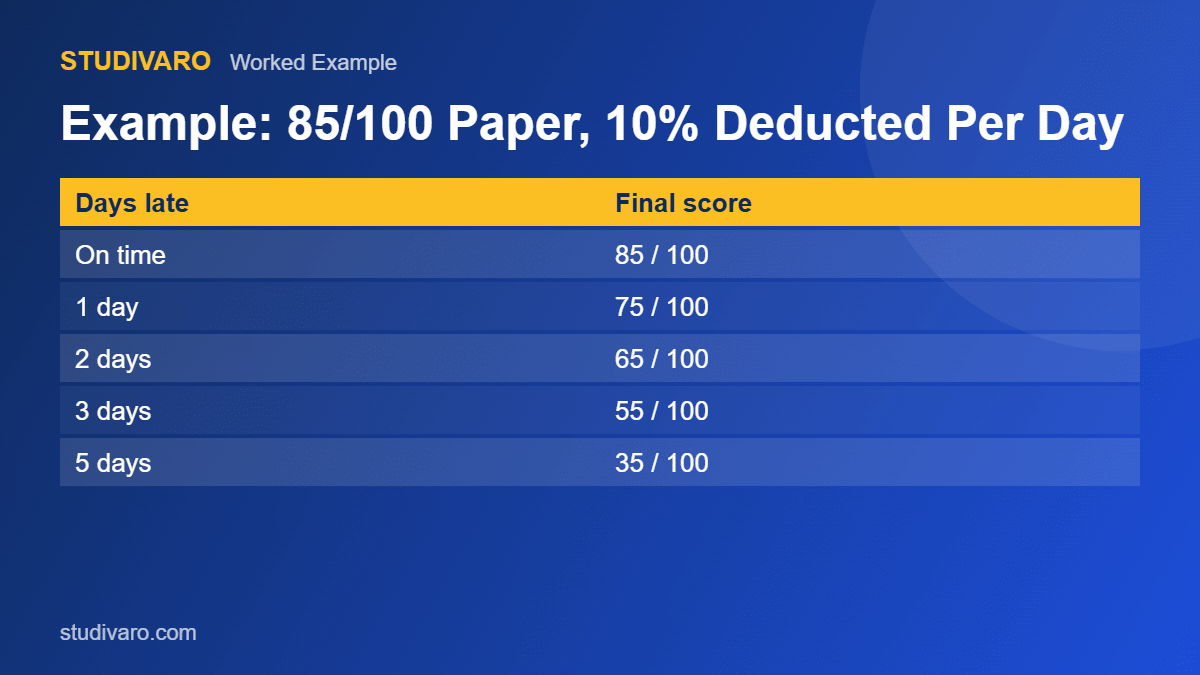
For example, on an essay graded out of 100 points where a student earns a raw score of 88%, submitting 36 hours late under a standard 10% daily deduction results in a 20% total penalty (2 days × 10%), reducing the final grade to 68% (a solid passing C+) rather than a devastating 0%.
`
The Core Late Submission Rule of Thumb:
- SUBMISSION PARADOX —> A penalized 60% or 70% protects your GPA 10x better than a 0%
- THE BREAK-EVEN RULE —> Only take a late penalty if extra study time gains more points
than the daily deduction cost (Quality Gain > Penalty Cost) - TIME STAMP TRUTH —> Digital portals (Canvas, Blackboard, Turnitin) log late submissions
down to the exact second (12:00:01 AM is late)
`
Use our interactive calculator above to enter your assignment points, raw earned grade, hours late, and departmental penalty rate to view your net score instantly.
Table of Contents
How Late Submission Penalties by University Function Across Higher Education
While specific percentages vary, Late Submission Penalties by University fall into three primary administrative frameworks:
- Daily Percentage Deductions: Under these Late Submission Penalties by University, a fixed deduction (typically 5%, 10%, or 20% per 24-hour window) is subtracted from the assignment grade. This is the most common model in American and Canadian universities.
- Capped Grade Ceilings (The Pass-Cap System): Common in the United Kingdom, Australia, and New Zealand, this system permits late submissions up to a specific window (often 7 to 14 days), but caps the maximum achievable mark at the institutional passing threshold (typically 40% or 50%), regardless of how brilliant the work is.
- Flat Letter Grade Deductions: Under this tier-based policy, each 24-hour delay reduces the earned letter grade by a fixed step (for example, an A- drops to a B+, and a B drops to a C+).
Furthermore, digital submission portals like Canvas, Blackboard, Brightspace, and Turnitin enforce rigid timestamp logging. If an assignment is due at 11:59:00 PM, submitting at 11:59:45 PM is recorded as on-time, while submitting at 12:00:05 AM triggers an automated “LATE” flag in the professor’s grading queue.
Late Submission Penalties by University Comparison Matrix
Understanding how institutional policies differ worldwide enables you to navigate academic regulations effectively, as demonstrated in this comprehensive Late Submission Penalties by University comparative breakdown:
| University / System | Standard Daily Penalty | Maximum Allowed Window | Weekend Policy | Mitigation Procedure |
|---|---|---|---|---|
| Harvard University (FAS) | 1/3 letter grade per 24h (e.g., A to A-) | 3–5 days (syllabus discretion) | Counted as calendar days | Contact Resident Dean before deadline |
| Cornell University | 5%–10% per 24h from max points | 3–7 days | Calendar days apply | Formal extension request via professor |
| Oxford & Cambridge (UK) | 5% per working day or capped pass | 5 working days | Working days only (Mon–Fri) | Submit Proctors’ Discretion application |
| University of Edinburgh (UK) | 5% deduction per calendar day | 7 calendar days (0 after day 7) | Counted as calendar days | Special Circumstances Committee |
| University of Toronto (Canada) | 2%–5% per business day | Capped at 5 days | Business days generally | Registrar medical verification certificate |
| University of Melbourne (Aus) | 10% deduction per day from max | 5 working days (0 after day 5) | Working days policy | Special Consideration portal petition |
| US State Flagships (Average) | 10% flat deduction per calendar day | 3–5 days | Calendar days apply | Student Accessibility / Medical note |
The Mathematical Penalty Formula: Calculating Your Net Grade
The mathematical mechanics governing Late Submission Penalties by University depend on whether deductions apply to maximum points or earned marks.
`
Gross vs. Net Late Penalty Equations
- Standard Gross Deduction (Most Common):
Final Score = Raw Earned Score – (Daily Penalty % * Days Late * Max Points) - Relative Net Deduction (Rare / Lenient):
Final Score = Raw Earned Score * [ 1 – (Daily Penalty % * Days Late) ]
Where:
- Raw Earned Score = Points awarded based on assignment rubric quality
- Daily Penalty % = Decimal penalty rate (e.g., 10% = 0.10)
- Days Late = Number of 24-hour periods past the official deadline (rounded up)
- Max Points = Total point value of the assignment (e.g., 100 points)
`
When modeling Late Submission Penalties by University, always verify if your professor uses the gross or net formula:
- Under Gross Deduction: On a 100-point paper with a raw score of 80% and a 10% daily penalty, 2 days late yields: $80 – (0.10 \times 2 \times 100) = 80 – 20 = 60%$.
- Under Relative Net Deduction: On the same paper, 2 days late yields: $80 \times [1 – (0.10 \times 2)] = 80 \times 0.80 = 64%$.
To determine how penalized coursework affects your semester average, apply our How to Calculate the Grade You Need on Your Final Exam tool to measure final exam leverage.
Worked Example 1: Two Days Late Under a 10% Daily Deduction Policy
To observe the practical impact of Late Submission Penalties by University, examine a student who completes a 100-point term paper 36 hours late in an American university course.
- Assignment Maximum Value: 100 points
- Student Raw Rubric Grade: 86% (86 points)
- Official Policy: 10% deduction per 24 hours late (rounded up)
- Time Elapsed Past Deadline: 36 hours (Counts as 2 full days late)
Step 1: Calculate Total Penalty Percentage
Because the submission exceeded 24 hours, the penalty covers 2 full periods:
- Total Penalty Percentage = 2 × 10% = 20% (0.20)
Step 2: Calculate Deduction Points and Net Score
- Penalty Points Deducted = 100 × 0.20 = 20.0 points
- Final Recorded Score = 86.0 – 20.0 = 66.0% (Passing Grade)
Step 3: Compare Results and Strategic Takeaway
This demonstrates how Late Submission Penalties by University reward submitting work late over receiving a permanent zero. Earning a 66% preserves course credit and protects cumulative standing, whereas accepting a 0% would mathematically drop an entire course average by nearly a full letter grade.
Worked Example 2: The Cap-at-Pass System (UK and Commonwealth Standard)
A widely utilized model within international Late Submission Penalties by University is the capped passing grade. Consider an undergraduate studying at a UK institution who submits an honours essay 48 hours late.
- Assignment Value: 100%
- Undergraduate Raw Score: 74% (First-Class Honours quality)
- Institutional Late Rule: Submissions within 5 days accepted, but capped at the 40% threshold.
Step 1: Evaluate Submission Window
The student submitted within 48 hours (Day 2 of the 5-day allowable window). The submission is accepted.
Step 2: Apply Grade Capping Mechanism
Regardless of earning a 74% on academic merits, the institutional cap is enforced:
- Final Recorded Grade = 40.0% (Third-Class / Bare Pass)
Step 3: Compare Results and Strategic Takeaway
Understanding these international Late Submission Penalties by University is critical for study-abroad candidates: in capped systems, polishing an essay to perfection past the deadline yields zero point benefit beyond the 40% baseline.
Real-World Institutional Rules: Late Submission Penalties by University Worldwide
Comparing actual Late Submission Penalties by University reveals distinct cultural and pedagogical approaches:
At Cornell University Academic Policies, professors maintain syllabus autonomy, but common STEM departmental policies mandate a 10% penalty for each calendar day late, cutting off completely after 72 hours. Online homework platforms (such as WebAssign or MasteringPhysics) often employ automatic decay curves that deduct 1% to 2% per hour past the due time.
In the United Kingdom, institutions like the University of Edinburgh and King’s College London follow standardized faculty handbooks established under national benchmarks documented by AACRAO. Edinburgh enforces a strict 5% deduction per calendar day up to 7 days, after which work receives zero marks.
Canadian research institutions such as the University of Toronto enforce business-day policies in specific faculties, meaning submitting an assignment on Monday morning that was due on Friday evening may count as only one business day late, depending on departmental guidelines.
For students balancing intensive coursework demands, applying The Carnegie 2:1 Study Hour Rule Explained helps ensure adequate weekly study hours to prevent missed deadlines. If a compromised assignment threatens your standing, review our guide on Pass Fail vs Letter Grade to understand when alternative grading protects your transcript.
Mitigating Circumstances and Extension Policies
Every institution implementing Late Submission Penalties by University provides administrative pathways for formal extensions. However, requests must be supported by valid mitigating circumstances:
Legitimate Grounds for Extensions:
- Severe acute physical illness or hospitalization (verified by medical certificate).
- Bereavement or serious family emergency.
- Documented technical collapse of university-managed servers (verified by IT status reports).
- Legally recognized religious observances or mandatory military service.
Invalid Grounds for Extensions:
- Personal computer or printer failure (students are expected to back up files to cloud storage).
- Heavy academic workload or multiple deadlines on the same calendar day.
- Misreading the syllabus deadline or time zone confusion.
- Social commitments, athletic leisure events, or employment scheduling conflicts.
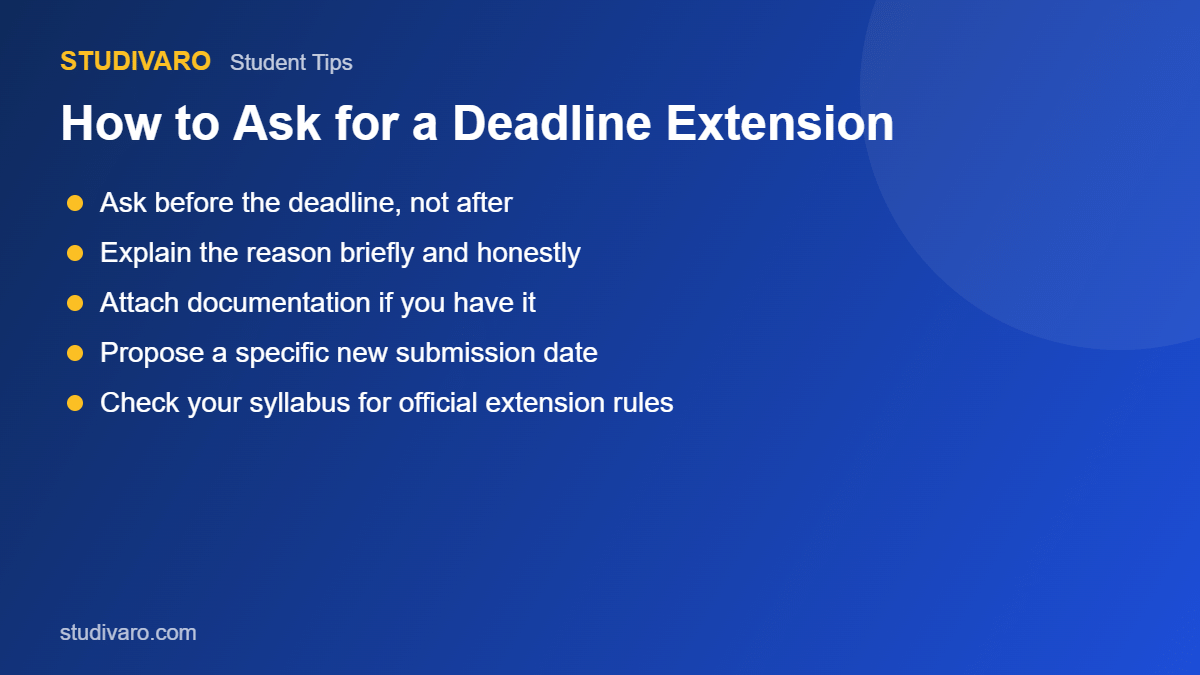
Professional Email Template to Request an Extension:
Common Late Submission Mistakes and Myths
Undergraduates frequently commit avoidable errors when dealing with Late Submission Penalties by University:
Mistake 1: Submitting Work via Email Instead of the Digital Portal
Sending an unrequested email attachment to your professor when the syllabus specifies Canvas or Blackboard leaves your official record blank. Professors may disregard email submissions entirely.
Mistake 2: Believing That Submitting Late Is Worse Than a Zero
Undergraduates who miss a deadline by a few hours often give up and submit nothing. Believing that submitting late is worse than a zero ignores how Late Submission Penalties by University function. A penalized 65% keeps your course grade viable, while a 0% severely damages your cumulative GPA, potentially triggering Academic Probation GPA Recovery procedures.
Mistake 3: Waiting Until After the Deadline to Request Help
Emailing your instructor 10 minutes after the deadline carries far less credibility than emailing 24 hours in advance. Proactive communication signals maturity and responsibility.
Mistake 4: Overlooking Weekend Penalties
Assuming Saturday and Sunday are “free” non-penalized days is a costly misconception. Unless the syllabus explicitly states “business days,” learning management systems count every elapsed calendar day.
Mistake 5: Not Verifying Digital Upload Confirmations
Uploading a corrupted file, empty document, or failing to click “Submit” leaves you without an official submission receipt. Always take a screenshot of your digital submission confirmation screen.
How to Use the Late Submission Penalty Calculator
Our interactive calculator helps you model net grades across four straightforward steps:
- Input your raw earned score, the due date, and the specific Late Submission Penalties by University percentage.
- Enter the exact number of hours or days past the deadline your assignment was submitted.
- Select whether your university applies deductions to maximum assignment points or earned points.
- Instantly view your net penalized percentage, point deduction total, and equivalent letter grade.
The Strategic Triage Matrix: Submit on Time vs. Polish and Submit Late
Use this decision framework to navigate Late Submission Penalties by University when facing an impending deadline:
`
Late Submission Triage Protocol
Current Work State Action Recommendation Mathematical Rationale
- Draft is 80%+ Done SUBMIT ON TIME A polished 82% earned on time beats
Needs minor editing (Do not take penalty) a 90% minus 10% daily late penalty (80%) - Draft is <50% Done POLISH & SUBMIT LATE Submitting a rushed 45% fails the paper;
Missing core sections (Take 1-day 10% penalty) spending 24h to produce an 85% yields a net 75% - Over 3 Days Late SUBMIT IMMEDIATELY Deductions compound daily; after 3 days,
Approaching cutoff (Take any partial credit) submitting prevents an irrecoverable zero
`
To master semester organization and prevent recurring late submissions, utilize our dedicated College Study Hours Planner. Furthermore, monitoring lecture participation using the College Attendance & Bunk Calculator and calculating assignment grade impacts with the Academic Late Submission Penalty Calculator ensures you retain control over your academic trajectory.
Frequently Asked Questions About Late Submission Penalties by University
Do university late submission penalties count weekends?
At most colleges, digital learning management systems count weekends as elapsed calendar days. When reviewing syllabus Late Submission Penalties by University, online learning management systems count weekends unless “business days” or “working days” are explicitly specified.
Is submitting 5 minutes late penalized the same as 23 hours late?
Technically, yes. Most universities enforce late penalties in 24-hour discrete blocks. Submitting 5 minutes late or 20 hours late both fall into the “Day 1” penalty bracket. However, some sympathetic professors offer an informal grace period of 10 to 15 minutes.
What is the maximum late submission penalty a college can charge?
Under most Late Submission Penalties by University, institutions cap late submissions at 5 to 7 days, after which work receives an automatic score of zero. In UK universities, submissions within the allowable late window are capped at a passing grade of 40%.
Can a professor refuse to accept a late submission completely?
Yes. Faculty possess academic freedom to enforce strict “no late work accepted” policies on their course syllabi. In these courses, registrars enforcing Late Submission Penalties by University require formal documentation of documented emergencies to override instructor rules.
Does a late penalty impact my cumulative GPA?
Indirectly, yes. While the penalty itself does not appear on your transcript, the lower course grade resulting from the penalty enters your cumulative GPA calculation. Use our College GPA Calculator to model the exact impact.
How do late penalties interact with student loan repayment?
While late assignments do not directly affect loan balances, receiving course zeroes can lead to failed credits and semester repetition, increasing overall debt. Project your borrowing obligations with our Student Loan Monthly Payment Calculator.
Related Student Tools
Explore Studivaro’s full suite of academic planning tools:
- Academic Late Submission Penalty Calculator: Simulate exact point deductions and net grades for overdue assignments.
- College GPA Calculator: Model semester and cumulative GPA across credit hours and letter grades.
- How to Calculate the Grade You Need on Your Final Exam: Calculate exact exam percentages required to hit target letter grades.
- The Carnegie 2:1 Study Hour Rule Explained: Calculate weekly study hour requirements based on enrolled course credits.
- Curved Grading & Bell Curves Explained: Learn how statistical grading curves shift course percentages.
- Pass Fail vs Letter Grade: Understand the transcript and GPA implications of alternative grading options.
- Academic Probation GPA Recovery: Step-by-step strategies for returning to good academic standing.
- Student Loan Monthly Payment Calculator: Estimate loan repayment schedules, interest accrual, and repayment terms.
Final Takeaway: Mastering Late Submission Penalties by University
Mastering Late Submission Penalties by University transforms deadline crises from panic into strategic calculation. When an unexpected emergency strikes, calculating penalty tradeoffs, communicating proactively with faculty, and submitting completed work rather than surrendering to a zero protects your course grade and cumulative GPA. Review your syllabus guidelines, calculate potential point deductions with our Academic Late Submission Penalty Calculator, and stay proactive throughout your university journey.
Academic Late Submission Penalty Calculator
Calculate your net assignment grade, points deducted, and equivalent letter grade based on hours late and syllabus policy.