

The Carnegie 2:1 Study Hour Rule Explained: Best 2026 Guide
Entering college is an exhilarating transition, but for millions of undergraduates, the sudden surge in academic expectations quickly triggers severe time-management shock. In high school, most learning occurs directly inside the classroom under direct teacher supervision. In higher education, the dynamic flips entirely: the vast majority of intellectual comprehension, problem-solving, and memorization must occur independently outside of lecture halls. Having the Carnegie 2:1 study hour rule explained is the single most valuable orientation lesson any collegiate scholar can master.
Try it yourself: Use our free Carnegie rule college study hours planner to calculate your weekly preparation workload in seconds. No sign-up needed.
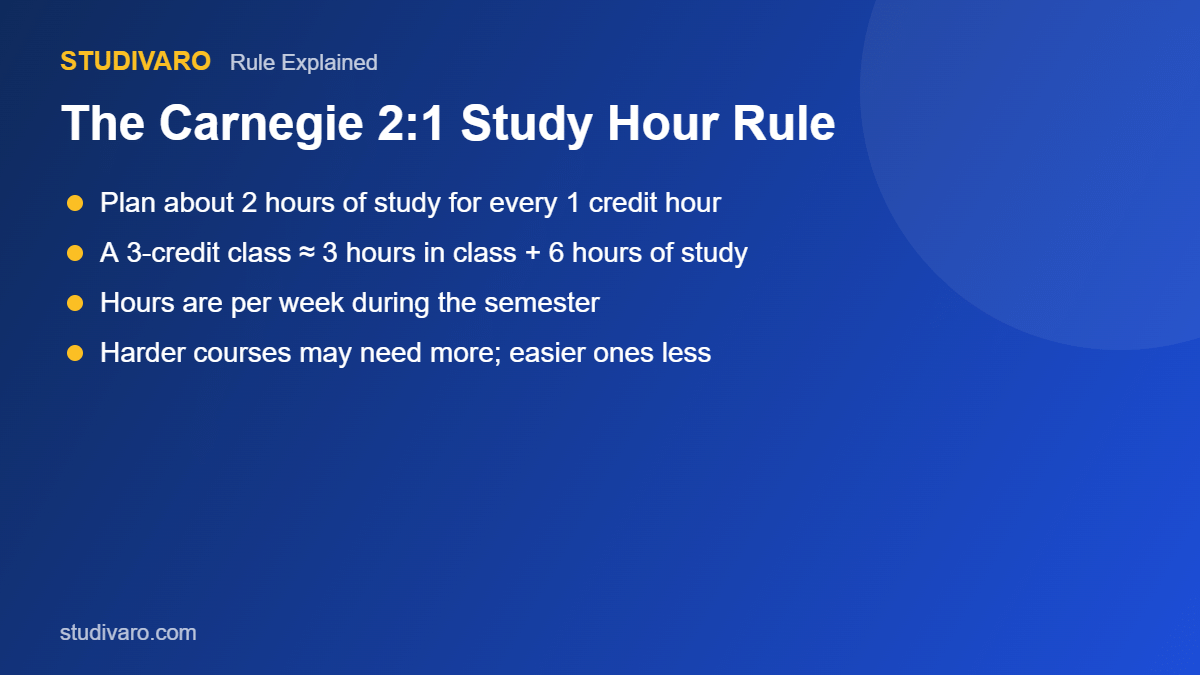
For over a century, colleges and universities across the United States and worldwide have structured degree programs around a specific academic formula. With the Carnegie 2:1 study hour rule explained, students discover that for every single credit hour spent in a lecture, institutional accreditation bodies expect them to dedicate a minimum of two hours to independent reading, homework, lab preparation, and revision.
When students fail to calculate their workload accurately, academic burnout, missed assignment deadlines, and plummeting GPAs inevitably follow. This comprehensive guide provides the Carnegie 2:1 study hour rule explained in exhaustive detail, complete with historical accreditation origins, credit-to-workload formulas, major-by-major reality adjustments, and practical 168-hour weekly time-blocking templates.
Table of Contents
The Carnegie 2:1 Study Hour Rule Calculator
Calculate your weekly college study workload, in-class lecture time, and 168-hour life balance using the Carnegie accreditation standard.
What Is the Carnegie Unit? The Carnegie 2:1 Study Hour Rule Explained
To appreciate why higher education institutions enforce this workload expectation, we must examine its origin. Having the Carnegie 2:1 study hour rule explained requires exploring the history of the "Carnegie Unit," established in 1906 by the Carnegie Foundation for the Advancement of Teaching.
Originally designed by philanthropist Andrew Carnegie and educational reformers to establish standardized criteria for faculty pensions and secondary school curricula, the metric soon became the legal standard for measuring collegiate academic credit:
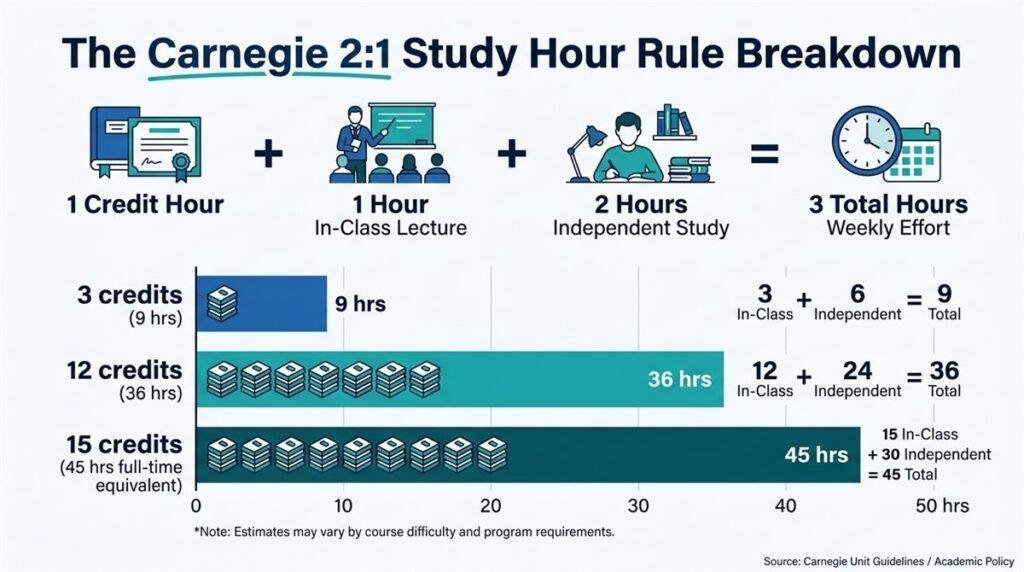
- Federal Credit Hour Definition: According to compliance regulations enforced by the U.S. Department of Education, a single semester credit hour represents not less than one hour of direct faculty instruction and a minimum of two hours of out-of-class student work each week across a standard 15-week semester.
- The 3:1 Total Commitment: Every registered credit hour represents three total hours of weekly intellectual labor. Having the Carnegie 2:1 study hour rule explained clarifies that a 3-credit lecture demands nine weekly hours of total effort.
Accreditation boards like SACSCOC, NECHE, and the Higher Learning Commission require universities to demonstrate compliance with this standard to maintain degree-granting legitimacy.
Credit Hour Workload Table: The Carnegie 2:1 Study Hour Rule Explained
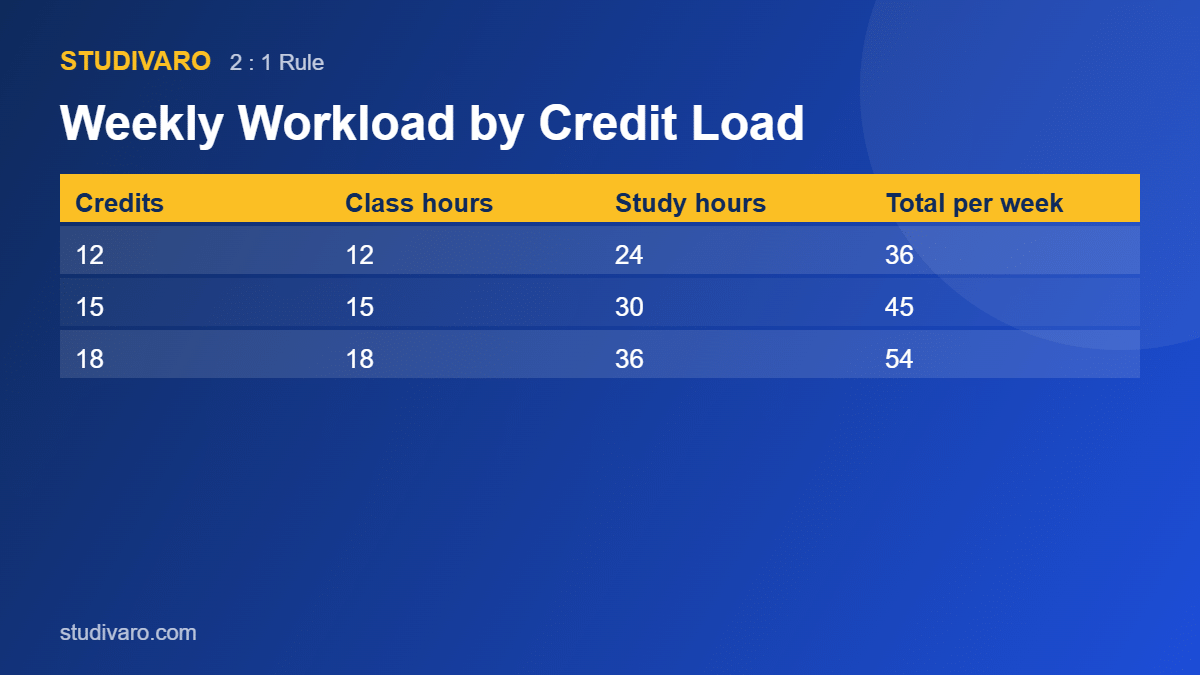
The table below illustrates how weekly academic commitments multiply as course load increases, demonstrating the Carnegie 2:1 study hour rule explained across standard undergraduate enrollments:
| Enrolled Semester Credits | In-Class Lecture Hours / Week | Required Independent Study Hours / Week | Total Weekly Academic Hours (Full Workload) | Equivalent Corporate Job Comparison |
|---|---|---|---|---|
| 3 Credits (1 Course - Part-Time) | 3 Hours | 6 Hours | 9 Hours / Week | Minor Part-Time Hobby |
| 6 Credits (2 Courses - Half-Time) | 6 Hours | 12 Hours | 18 Hours / Week | Regular Part-Time Job |
| 9 Credits (3 Courses - Three-Quarter) | 9 Hours | 18 Hours | 27 Hours / Week | Substantial Part-Time Job |
| 12 Credits (4 Courses - Minimum Full-Time) | 12 Hours | 24 Hours | 36 Hours / Week | Standard Full-Time Career |
| 15 Credits (5 Courses - Normal Full-Time) | 15 Hours | 30 Hours | 45 Hours / Week | Demanding Corporate Career |
| 18 Credits (6 Courses - Maximum Overload) | 18 Hours | 36 Hours | 54 Hours / Week | High-Intensity Professional Role |
Reviewing this table provides the Carnegie 2:1 study hour rule explained in concrete terms. Enrolling in 15 credits is not a casual part-time schedule; it is an intensive 45-hour workweek that exceeds standard full-time employment.
Major-Specific Workload Variations: The Carnegie 2:1 Study Hour Rule Explained
While accreditation guidelines prescribe a uniform 2:1 ratio, real-world collegiate demands vary drastically by academic major. Having the Carnegie 2:1 study hour rule explained across distinct disciplines helps students prevent catastrophic under-preparation:
1. STEM, Engineering, and Organic Chemistry (The 3:1 to 4:1 Reality)
In disciplines such as chemical engineering, advanced calculus, physics, and computer science, problem sets require hours of iterative derivation. A 4-credit organic chemistry lecture with an integrated laboratory component regularly demands 12 to 16 hours of independent review weekly. For STEM scholars, having the Carnegie 2:1 study hour rule explained means treating the 2:1 ratio as an absolute floor rather than an upper limit.
2. Architecture and Studio Fine Arts (The 4:1 Studio Paradox)
Studio-based courses frequently award only 3 credit hours despite requiring 6 hours of scheduled studio contact and an additional 12 to 15 hours of physical model construction and drafting weekly. Evaluating your academic commitments for creative majors reveals that studio courses often demand twice the investment of traditional lecture modules.
3. Humanities, Business, and Social Sciences (The Heavy Reading Reality)
In history, philosophy, English literature, and business management, class time is discussion-oriented. Students must digest hundreds of pages of dense historical manuscripts, legal case studies, and academic papers between lectures. Here, having the Carnegie 2:1 study hour rule explained emphasizes active analytical synthesis, essay drafting, and primary source evaluation.
The 168-Hour Weekly Time Budget: The Carnegie 2:1 Study Hour Rule Explained
Every student possesses exactly 168 hours in a seven-day week. Analyzing the Carnegie 2:1 study hour rule explained through a zero-based weekly time budget demonstrates whether your semester schedule is mathematically sustainable:
[Total Available Time: 168 Hours / Week] │ ├─► Rest & Biological Needs: 56 Hours (8 Hours Sleep / Night) ├─► Full-Time Academic Load: 45 Hours (15 Credits x 3 Hours) ├─► Part-Time Campus Job: 15 Hours (Student Employment) ├─► Personal Hygiene & Meals: 21 Hours (3 Hours / Day) ├─► Daily Commute & Transit: 7 Hours (1 Hour / Day) │ └─► Remaining Discretionary Time: 24 Hours (Free Time, Social, Fitness)
As this breakdown demonstrates, having the Carnegie 2:1 study hour rule explained proves that academic excellence does not require sacrificing sleep, physical fitness, or social relationships. Problems arise only when students fail to schedule their 30 independent study hours, allowing unstructured procrastination to consume their evenings.
High-Impact Study Strategies: The Carnegie 2:1 Study Hour Rule Explained
Spending thirty hours per week staring at highlighted textbooks is ineffective. To maximize your academic return on investment, having the Carnegie 2:1 study hour rule explained must be paired with evidence-based cognitive learning techniques:
1. Active Recall and Spaced Retrieval
Re-reading lecture slides creates an "illusion of competence" where material feels familiar but cannot be reproduced during examinations. As educational research by the Carnegie Foundation for the Advancement of Teaching emphasizes, active self-testing using flashcards, practice exam questions, and the Feynman technique dramatically improves long-term memory retention.
2. Distributed Practice (Spaced Repetition)
Never cram six hours of independent study for a single course into a single marathon Sunday evening session. The human brain consolidates conceptual neural pathways during REM sleep cycles. Dividing your study hours into three 2-hour focused sprints throughout the week yields superior exam performance with significantly less mental exhaustion.
3. The Pomodoro Interval Framework
Structure your out-of-class study blocks into 25-minute uninterrupted focus intervals followed by 5-minute cognitive breaks. Four consecutive intervals equal two hours of deep work, fulfilling the daily study quota prescribed by the Carnegie 2:1 study hour rule explained.
Working Students and Part-Time Realities: The Carnegie 2:1 Study Hour Rule Explained
Over 40% of full-time undergraduate students work at least 20 hours per week at off-campus jobs. For working scholars, having the Carnegie 2:1 study hour rule explained is critical for avoiding catastrophic course withdrawals.
If you work 25 hours per week at a job and register for 15 credits (requiring 45 hours of academic effort), your combined weekly commitment reaches 70 hours. Working 70 hours weekly over fourteen weeks is statistically correlated with elevated failure rates. When balancing employment and college, applying standard workload formulas reveals that taking 12 credits or 9 credits is often the far wiser, GPA-preserving decision.
Academic Performance and Long-Term Student Debt Connections
Allocating sufficient study hours protects your cumulative GPA, prevents failed courses that must be repeated at high tuition costs, and ensures on-time graduation. To optimize your overall college financial and academic strategy, explore these specialized Studivaro guides:
- Missed College Lecture Cost Calculator: Understand the precise monetary tuition investment wasted whenever a scheduled class is missed.
- College Attendance Policies & Safe Bunk Margins: Calculate mandatory minimum class attendance thresholds and safe absence buffers.
- ECTS to US Semester Credits Conversion Guide: Compare European ECTS student workload contact hours with American Carnegie credit standards.
- Thesis Writing Schedule Guide: Master multi-month research and writing milestones for graduate dissertations and honors theses.
- Dorm vs Off-Campus Living Student Cost Comparison: Evaluate how campus living arrangements impact commute times and daily study routines.
Integrating these specialized tools with the Carnegie 2:1 study hour rule explained guarantees comprehensive academic time mastery.

Sample Weekly Schedule Using the Carnegie 2:1 Rule
Here is what the Carnegie 2:1 study hour rule looks like for a typical 15-credit semester. It adds up to about 45 hours per week, roughly the same as a full-time job, which is exactly the point of the rule.
| Day | Class time | Study blocks (2:1 rule) |
|---|---|---|
| Monday | 3 hours | 6 hours |
| Tuesday | 3 hours | 6 hours |
| Wednesday | 3 hours | 6 hours |
| Thursday | 3 hours | 6 hours |
| Friday | 3 hours | 4 hours |
| Saturday | — | 2 hours |
| Sunday | — | Rest / weekly review |
| Total | 15 hours | 30 hours |
When to Adjust the Carnegie 2:1 Study Hour Rule
The rule is a planning guideline, not a law. Use it as a starting point and adjust based on real results:
- Increase study time for courses with heavy problem sets, lab reports, or cumulative exams, such as organic chemistry, engineering, or advanced math.
- Reduce it slightly for courses where you already have strong background knowledge, but only if your grades confirm it.
- Front-load early in the term so you are not forced into 12-hour cram sessions before midterms.
- Count active study only. Rereading notes while scrolling your phone is not the same as practice questions or teaching the material to someone else.
- Plan around work hours. If you work 20 hours a week, a full 15-credit load plus the Carnegie rule may not be realistic; consider 12 credits instead.
Frequently Asked Questions (FAQs)
What is the Carnegie 2:1 study hour rule?
The Carnegie 2:1 rule is an institutional accreditation standard stating that for every one credit hour a student spends in the classroom, they should dedicate approximately two hours to independent outside-of-class study, homework, and reading each week.
Does the 2:1 study rule apply to online asynchronous college courses?
Yes. In fully online asynchronous courses where there is no physical lecture, the total time expectation remains three hours per credit hour. For a 3-credit online course, you should expect to spend roughly nine hours total per week reviewing video modules, completing discussion boards, and writing assignments.
Can a student pass college courses without studying two hours per credit?
In introductory general education classes, some students may succeed with fewer study hours. However, in upper-division courses, STEM disciplines, and professional degree tracks, studying less than the 2:1 guideline frequently leads to exam failure, academic probation, and lost scholarships.
How does the Carnegie rule affect summer semester courses?
Because summer terms are compressed from standard 15-week semesters down to 6 to 8 weeks, the weekly time commitment doubles. A 3-credit course completed over 7 weeks requires 6 hours in class and 12 hours of independent study weekly, totaling 18 hours per week for a single class.
Is the Carnegie study hour rule enforced by professors?
Professors design syllabus reading lists, weekly homework sets, and semester research papers calibrated to the 2:1 standard. While instructors do not monitor how you spend your time at home, exam difficulty directly reflects whether you completed the required out-of-class preparation.
The Carnegie 2:1 Study Hour Rule: Key Takeaways
A quick recap before you build your semester plan, choose your credit load, or talk to your academic advisor about next term:
- The Carnegie 2:1 study hour rule suggests about two hours of study outside class for every credit hour each week.
- A 15-credit semester therefore means roughly 30 study hours plus 15 class hours, about 45 hours per week in total.
- Treat the rule as a baseline and adjust it by course difficulty and your actual grades.
- Schedule study blocks in your calendar the same way you schedule classes.
Understanding the Carnegie 2:1 study hour rule helps you pick a realistic course load and avoid burning out halfway through the semester, while still leaving room for work, sleep, and friends.
Try this: for the first three weeks of your next semester, log your actual study hours for each course next to your quiz and assignment scores. Compare the numbers with the Carnegie 2:1 target. If you are hitting the target and your grades are strong, keep going. If your grades lag, increase study time for that course or change how you study before the first major exam arrives.
Final Strategy: Mastering Your Academic Schedule
Understanding the Carnegie 2:1 study hour rule explained transforms collegiate life from an unpredictable, stress-filled struggle into an organized, professional routine. By treating your studies as a structured 40-to-45-hour full-time commitment, scheduling dedicated daily focus blocks, and protecting your rest, you will master difficult academic material while enjoying a rewarding, balanced university experience.
The Carnegie Rule Quick Formula: Weekly Study Hours by Credit Load
The fundamental equation of the Carnegie Rule establishes that for every 1 credit hour enrolled, students must plan 2 hours of independent study outside the classroom:
Weekly Outside Study Hours = Total Enrolled Credit Hours × 2
- 12 Credits (Minimum Full-Time): 12 in-class hrs + 24 study hrs = 36 total weekly hours.
- 15 Credits (Standard College Schedule): 15 in-class hrs + 30 study hrs = 45 total weekly hours.
- 18 Credits (Heavy Overload): 18 in-class hrs + 36 study hrs = 54 total weekly hours.
Plan your semester study schedule and balance exam prep using our interactive College Study Hours Planner.