
Updated: October 2026 • Verified under Title IV & AACRAO Collegiate Attendance Guidelines
Academic Oversight: Reviewed and verified by the Studivaro Academic Review Board in accordance with higher education enrollment compliance policies, Federal Student Aid (U.S. Department of Education Title IV) attendance verification requirements, and academic registrar standards established by AACRAO.
How many classes can you miss in college before failing? On average, collegiate regulations allow you to miss between 2 and 6 class sessions per course before receiving an automatic failing grade (FA or FN). The specific threshold depends on your course meeting schedule: in a 3-day-per-week schedule (MWF), you can typically miss a maximum of 4 to 6 classes; in a 2-day-per-week schedule (T/Th), the limit is 3 to 4 classes; and in a once-per-week 3-hour seminar or laboratory, missing more than 1 or 2 sessions will result in mandatory course withdrawal or failure. Exceeding your professor’s syllabus threshold triggers an administrative drop, forfeiture of course credit, and potential clawbacks of federal financial aid grants.
📊 Check Your Remaining Absence Allowance Instantly:
Calculate how many lectures you have left before crossing below 75% or 80% attendance safety thresholds:
It is 7:30 AM on a rainy Thursday morning. Your alarm goes off, your bed is warm, and you have stayed up until 3:00 AM studying for a mid-term exam in another course. As you calculate whether you can sleep for another two hours, a sudden panic strikes your mind: how many classes can you miss in college before you automatically fail the course?
Unlike high school, where truant officers or automated robocalls notify your parents the moment you skip homeroom, collegiate attendance policies operate with deceptive autonomy. While professors rarely lecture you about skipping, universities maintain rigid institutional policies that can quietly terminate your course enrollment. In fact, knowing how many classes can you miss in college is not just a matter of avoiding a bad grade—it protects your cumulative GPA, your institutional scholarships, your visa compliance, and thousands of dollars in tuition investment.
1. The Golden Schedule Rule: Meeting Frequency vs. Absence Limits
When students ask how many classes can you miss in college, the single most critical factor is the weekly meeting rhythm of the course. In higher education, the universal benchmark used by most college academic senates is the “Two-Week Absence Rule”: a student may not miss more than the equivalent of two weeks of academic instruction without being subject to an administrative drop or automatic failing grade.
To calculate your specific limit, identify your course meeting schedule in the comprehensive matrix below:
| Meeting Pattern | Total Semester Sessions | Safe Absences (No Penalty) | Grade Penalty Threshold | Automatic Failure / Drop |
|---|---|---|---|---|
| 3 Days / Week (MWF – 50 mins) | 42 – 45 classes | 1 – 3 absences | 4 – 5 absences | 6+ absences (14%+) |
| 2 Days / Week (T/Th – 75 mins) | 28 – 30 classes | 1 – 2 absences | 3 absences | 4+ absences (14%+) |
| 1 Day / Week (3-hour block) | 14 – 15 classes | 0 – 1 absence | 2 absences | 3+ absences (20%+) |
| Science Laboratory / Clinical | 12 – 14 labs | 0 absences | 1 absence (make-up req) | 2+ unexcused misses |
| Accelerated / Summer (8-week term) | 16 – 20 classes | 0 – 1 absence | 2 absences | 3+ absences (15%+) |
As illustrated in the data above, the margin for error is razor-thin. For a course meeting twice weekly (Tuesday/Thursday), missing just four lectures means you have skipped 14% of the entire semester’s curriculum. At prominent institutions across North America, missing more than 15% to 20% of contact hours mandates an automatic failing grade regardless of how well you perform on exams.
2. University Grading Penalties: The “FA” and “FN” Grades
Many undergraduates falsely assume that if they skip class but ace the midterm and final exam, they will still pass with an “A” or “B”. However, academic registrars enforce specific institutional transcript codes specifically designed to penalize unexcused absenteeism:
- The “FA” Grade (Failure Due to Absence): Recorded on your official academic transcript when you fail a course exclusively due to exceeding the maximum permitted unexcused absences. This grade calculates directly into your cumulative GPA as a 0.00 quality point penalty (learn how this drags your record down with our College GPA Calculator).
- The “FN” Grade (Failure for Non-Attendance): Assigned when a student stops attending classes altogether without executing a formal course drop through the registrar portal before the published add/drop deadline.
- Percentage Step-Down Penalties: Rather than outright failure, many humanities, language, and seminar professors enforce a step-down grading scale. For example:
- Absences 1 – 3: No academic penalty (allowable personal days).
- Absence 4: Final course grade deducted by 3 full percentage points (e.g., an 82% B becomes a 79% C+).
- Absence 5: Additional 3% deduction (grade drops to 76% C).
- Absence 6: Automatic F in the course.
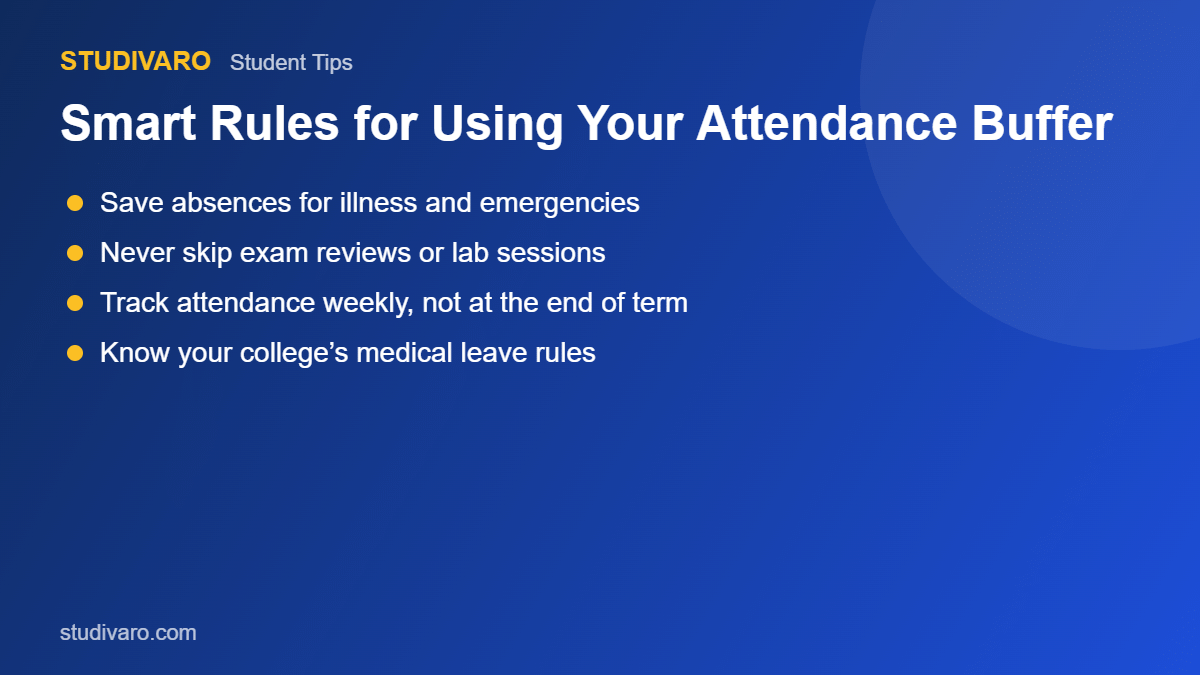
To maintain a proactive safety cushion, read our comprehensive breakdown on college attendance policy below 75 percent to understand how faculty appeal boards evaluate extenuating circumstances.
3. Severe Consequences: Federal Aid, F-1 Visas, and Accreditation
When evaluating how many classes can you miss in college, the ramifications frequently extend far beyond your professor’s gradebook. University attendance tracking is closely tied to national regulatory frameworks and international immigration laws:
A. Federal Financial Aid Clawbacks (Title IV LDA Reporting)
Under federal regulations governed by the U.S. Department of Education, colleges that disburse Title IV student financial aid (Pell Grants, Federal Direct Subsidized and Unsubsidized Loans, FSEOG) must verify that enrolled students actively participate in their courses. If an instructor records that you have ceased attending without an official excuse, the registrar is legally compelled to report your “Last Date of Attendance” (LDA).
If your LDA falls before the 60% completion mark of the semester, your university must perform a Return of Title IV Funds (R2T4) calculation. This means the federal government will claw back unearned grant and loan disbursements, leaving you with an unexpected tuition balance that you must pay immediately out of pocket.
B. International Student Visa Revocation (F-1 / J-1 Status)
For international students enrolled under an F-1 or J-1 student visa, maintaining full-time enrollment (minimum 12 credit hours for undergraduates) is mandatory under the Student and Exchange Visitor Information System (SEVIS). If excessive absences cause a professor to administratively drop you from a 3-credit course, your active credits drop below 12. Your Designated School Official (DSO) will be required to terminate your SEVIS record, putting you out of legal status and subject to deportation.
C. Massive Financial Tuition Waste
Skipping classes also carries a tangible financial price tag. When you divide annual college tuition and fees by the actual number of lecture hours scheduled throughout an academic year, the average cost per lecture session ranges from $45 at in-state public universities to upwards of $220 per lecture at private elite institutions:
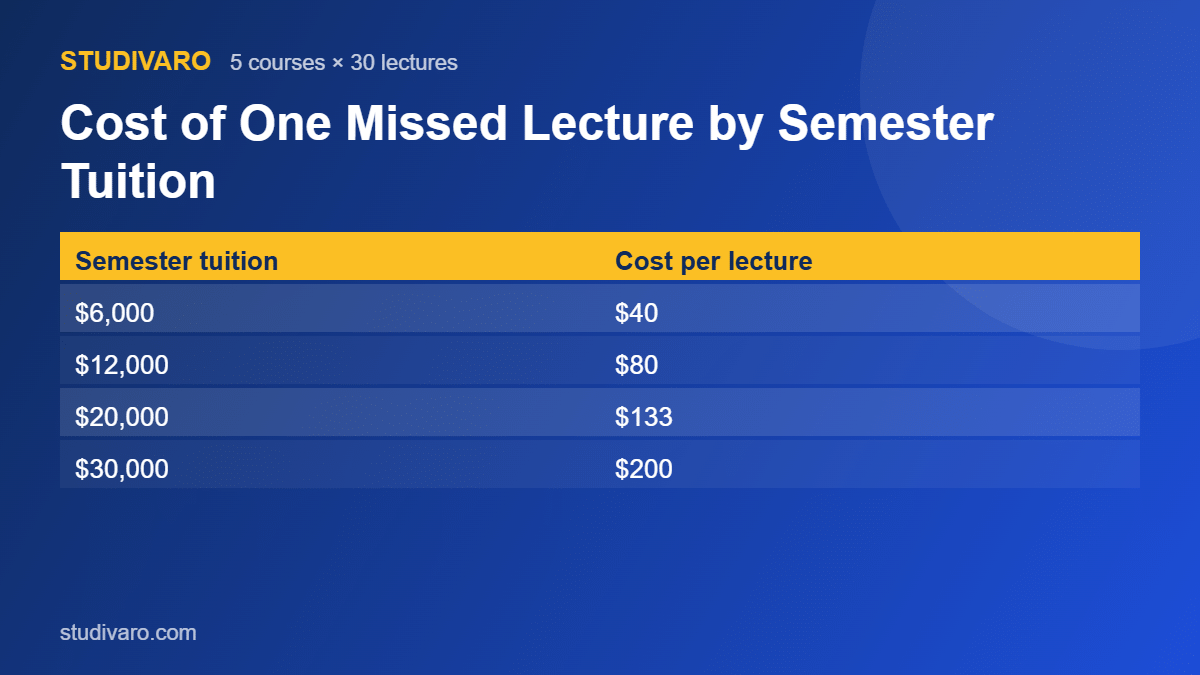
You can calculate your exact financial loss for every skipped lecture session using our dedicated Semester Tuition Per Lecture ROI Calculator.
4. Excused vs. Unexcused Absences: How to Protect Your Standing
When investigating how many classes can you miss in college, knowing the legal distinction between an unexcused bunk and an institutional excused absence is your primary shield. Under university senate bylaws and AACRAO standards, the following categories legally mandate reasonable academic accommodations:
| Absence Category | Legally Protected? | Required Verification Document | Professor Obligation |
|---|---|---|---|
| Documented Acute Illness / Surgery | Yes | Licensed Physician / Health Center note specifying date | Must permit make-up exams or alternative assignments without penalty. |
| Religious Holidays & Observance | Yes (State / Fed Law) | Advance written notification submitted during first 2 weeks | Mandatory accommodation for all missed exams and coursework. |
| Intercollegiate Athletics / Debate | Yes (Institutional) | Official Athletic Department travel roster memo | Instructors must provide proctored travel exams or remote submission. |
| Bereavement / Immediate Family Loss | Yes | Obituary link, memorial card, or Dean of Students memo | Excused for 3 to 7 consecutive academic business days. |
| Title IX Pregnancy / Childbirth | Yes (Federal Law) | Title IX Coordinator verification letter | Legally protected medical leave; no attendance penalties permitted. |
| Oversleeping / Traffic / Vacation | No (Unexcused) | None accepted | Counted directly toward allowable absence limit; 0 on in-class work. |
Professional Absence Email Protocol: What to Send Your Professor
If you know in advance that you must miss a lecture due to illness or an unavoidable emergency, sending a professional email before class begins can preserve your instructor’s goodwill and prevent punitive deductions. Never ask: “Did I miss anything important?” (which implies class is normally unimportant). Instead, utilize this proven communication template:
Subject: Absence Notice – [Course Code] – [Your Full Name] – [Class Date]

Dear Professor [Professor's Last Name],

I am writing to notify you that I will be unable to attend today's lecture in [Course Code, e.g., BIOL 204] due to [brief professional reason, e.g., an acute respiratory illness / a scheduled medical procedure].

I have already arranged with my classmate, [Classmate Name], to obtain comprehensive lecture notes, and I will thoroughly review Chapter [X] in our course textbook before our next meeting.

I have completed the assigned readings for today and will submit our weekly problem set via the student portal before the 11:59 PM deadline. If there are any supplemental materials or announcements discussed in class, I will ensure I review them promptly.

Thank you very much for your understanding.

Sincerely,
[Your Full Name]
Student ID: [Your ID Number]
Course Section: [e.g., Section 01, MWF 9:00 AM]
If you are also dealing with overdue papers or homework, review our guide on late submission penalties to calculate how turning in work late compares against an outright missed deadline.
5. The “Safe Bunk” Mathematical Formula
To establish with absolute certainty how many classes can you miss in college without jeopardizing your academic standing, apply the standardized collegiate Safe Bunk Formula:
Safe Misses Remaining = ⌊ Total Semester Classes × (1 − Minimum Required Attendance Percentage) ⌋ − Classes Already Missed
Let us calculate a practical example for a standard 3-credit course:
- Total Semester Classes: 42 lectures across a 15-week semester (Monday, Wednesday, Friday).
- University Minimum Attendance Policy: 80% mandatory attendance threshold (represented as 0.80).
- Classes Missed So Far: 3 lectures.
Applying the formula:
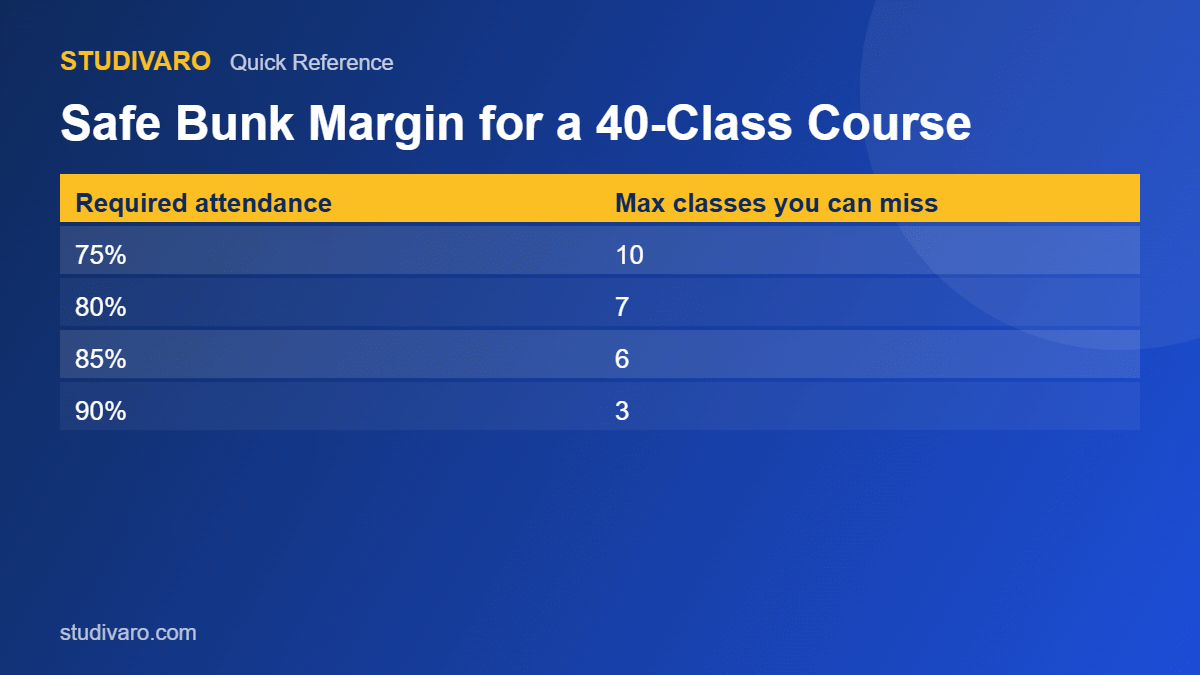
Remaining Safe Misses = 8 − 3 = 5 Classes Remaining
In this scenario, you have exactly 5 safe skips remaining before your attendance percentage falls below 80%. If your institution enforces a stricter 85% attendance rule, your total allowed absences drops to 6 classes, leaving you with only 3 safe skips. Instead of performing manual arithmetic every week, use our verified Attendance Safe Bunk Calculator to model your exact course limits automatically.
Frequently Asked Questions
Do professors take attendance in large 300-person lecture halls?
Yes, increasingly so. Modern university lecture halls utilize digital tracking platforms such as iClicker, Top Hat, Canvas geolocation beacons, and QR code scanners displayed on projector screens for 60 seconds. While professors may not manually call out roll, automated software logs your daily presence and syncs with the university gradebook.
What happens if you miss an exam due to an unexcused absence?
In virtually all higher education syllabi, missing a scheduled exam without prior written approval or documented medical emergency results in an automatic zero (0%). Because midterm and final exams constitute between 20% and 40% of your course grade, a single zero makes passing the class statistically improbable.
Can you get kicked out of college for missing too many classes?
Yes. Accumulating excessive unexcused absences triggers administrative course drops and academic probation. If your cumulative semester GPA falls below 2.00 as a result of multiple FA grades, you will face academic suspension or permanent academic dismissal from the institution.
Does having a doctor’s note erase a college absence?
A doctor’s note converts an unexcused absence into an excused absence, which protects you from disciplinary failure and grants you the right to make up missed exams or assignments. However, if your medical condition forces you to miss more than 30% of the entire semester, universities will typically counsel you to take an official Medical Incomplete (I) or Medical Withdrawal (MW) rather than awarding course credit.
What is the difference between an administrative drop and a course withdrawal?
A course withdrawal (W) is initiated voluntarily by the student before the withdrawal deadline, removing the class from GPA calculation. An administrative drop is initiated involuntarily by the instructor or registrar due to non-attendance, frequently resulting in an FA grade (0.00 GPA quality points) and financial aid penalties.
How many classes can you miss in college before federal financial aid is revoked?
Federal student aid (Title IV) does not mandate a specific number of classes, but requires universities to establish that students are actively attending. If you miss two consecutive weeks of unexcused classes or stop attending before the 60% completion point of the semester, your university must report non-attendance, leading to recalculation and partial forfeiture of your financial aid funds.
Calculate Your Remaining Safe Absences With Zero Risk
Enter your university’s attendance threshold (75% or 85%) and total semester lectures to calculate the exact number of classes you can miss without failing.
Interactive Attendance Tool • Instant Calculation
Calculate Your Exact Safe Absences (Safe Bunk Margin)
Input your course meeting pattern and current absences to see your remaining buffer before failing the course under university regulations.