
The UC Berkeley GPA Calculator allows undergraduate and graduate Golden Bears to compute their exact semester GPA, projected cumulative GPA, and academic standing under the official University of California, Berkeley Academic Senate grading regulations. Use this interactive tool to simulate letter grades, test course repetitions, check College of Letters & Science (L&S) and Engineering honors cutoffs, and prevent academic probation.
Cal UC Berkeley GPA Calculator (Official 2026 Tool)
Configured for UC Berkeley 4.000 Scale (A+ Capped at 4.000 per Senate Regulation 201)
Table of Contents: UC Berkeley GPA & Academic Senate Regulations
- 1. Official UC Berkeley Grading Scale & Quality Point Matrix
- 2. How to Calculate Your UC Berkeley GPA: Manual Step-by-Step Formula
- 3. Berkeley Distinction at Graduation vs Dean’s Honors List (The Truth About Latin Honors)
- 4. UC Berkeley Course Repeat & Grade Forgiveness Policies (Regulation A201)
- 5. Academic Standing, Probation, and Subject to Dismissal Rules
- 6. Pass / No Pass (P/NP) Grading Rules and the One-Third Unit Cap
- 7. Frequently Asked Questions: UC Berkeley GPA & Academic Rules
1. Official UC Berkeley Grading Scale & Quality Point Matrix
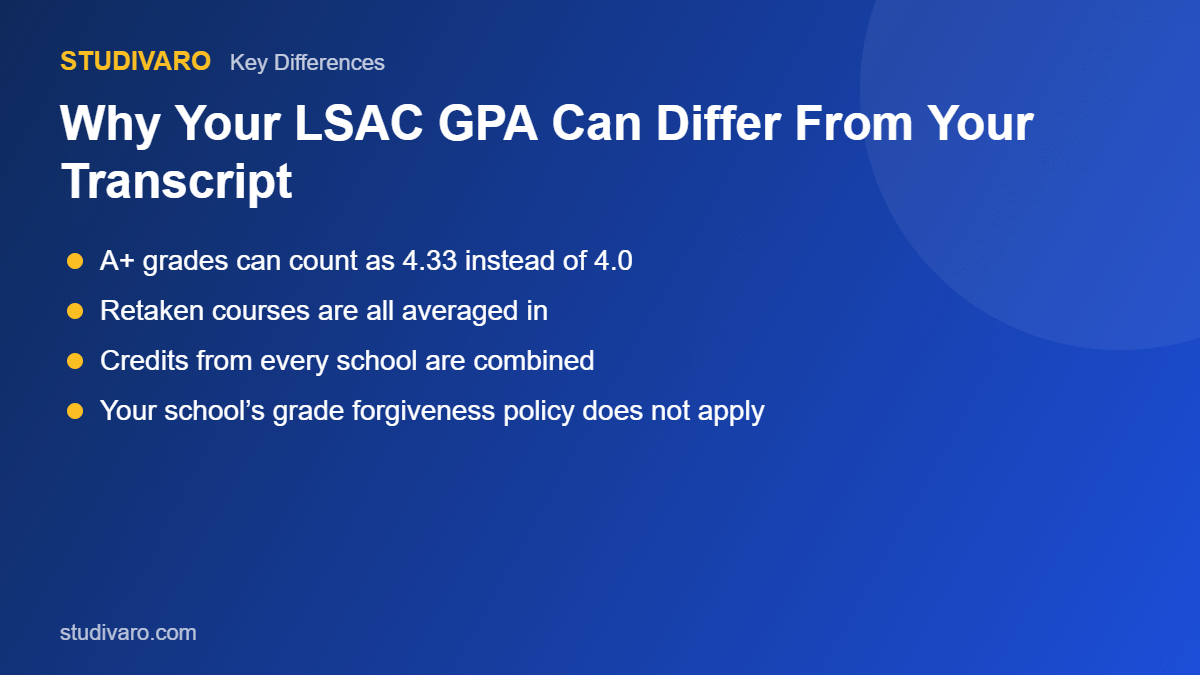
Under University of California, Berkeley Academic Senate Regulation A201, undergraduate academic performance is officially evaluated on a 4.000-point scale. Unlike many high schools or non-UC universities where an A+ yields 4.300 or 4.333 quality points, UC Berkeley caps an A+ at exactly 4.000 grade points. While an A+ is permanently recorded on your official Berkeley transcript to recognize extraordinary intellectual achievement, it does not elevate your numerical GPA above 4.000.
Every letter grade carries a specific numerical weight multiplied by the unit value of the course to determine total grade points earned across your curriculum:
| Letter Grade | Grade Points (Per Unit) | Official Berkeley Performance Definition | Unit Credit Awarded? |
|---|---|---|---|
| A+ | 4.000 | Extraordinary Achievement (Transcript Distinction) | Yes |
| A | 4.000 | Excellent | Yes |
| A- | 3.700 | Superior | Yes |
| B+ | 3.300 | Very Good | Yes |
| B | 3.000 | Good | Yes |
| B- | 2.700 | Fair / Competent | Yes |
| C+ | 2.300 | Satisfactory | Yes |
| C | 2.000 | Average Passing | Yes |
| C- | 1.700 | Minimum Threshold for ‘Pass’ (P) Equivalent | Yes |
| D+ | 1.300 | Barely Passing (Repeat Eligible) | Yes (Degree Only) |
| D | 1.000 | Poor Passing (Repeat Eligible) | Yes (Degree Only) |
| D- | 0.700 | Lowest Passing Grade (Repeat Eligible) | Yes (Degree Only) |
| F | 0.000 | Failing (Zero Units Earned) | No |
| P | None | Passed (Equivalent to C- or better; excluded from GPA) | Yes |
| NP | None | Not Passed (D+ or lower; excluded from GPA) | No |
To verify how your numerical GPA compares to the universal standard across American collegiate institutions, explore our comprehensive breakdown on the 4.0 vs 4.3 GPA Scale.
2. How to Calculate Your UC Berkeley GPA: Manual Step-by-Step Formula
The mathematical calculation of your UC Berkeley GPA is governed by standard credit-hour weighting. Course grades are not simply averaged together; instead, high-unit laboratory courses and core lectures (such as 4-unit technical sequences) exert double the mathematical influence of 2-unit seminars.
The official mathematical formula defined by the UC Office of the Registrar is:
Step-by-Step Berkeley Semester Calculation Walkthrough:
- Assign Grade Points: Look up the quality point value for each completed course using the Berkeley Senate Table above (e.g., A = 4.000, A- = 3.700, B+ = 3.300).
- Compute Course Grade Points: Multiply the grade point value by the course unit value (e.g., a 4-unit class with an A- earns
4.0 × 3.700 = 14.800grade points). - Sum Your Grade Points: Add together the grade points from all letter-graded courses in the term.
- Sum Your Graded Units: Add together the unit values of all courses taken for a letter grade (exclude any P/NP, S/U, or Incomplete units).
- Divide Points by Units: Divide your total grade points by total graded units, carrying the result to three decimal places before rounding.
Representative Cal Freshman / Sophomore Semester Example:
- COMPSCI 61A (4 units): Grade A (4.000 pts) →
4 × 4.000 = 16.000grade points - MATH 1A (4 units): Grade A- (3.700 pts) →
4 × 3.700 = 14.800grade points - DATA C8 (4 units): Grade B+ (3.300 pts) →
4 × 3.300 = 13.200grade points - ENGLISH R1A (4 units): Grade A (4.000 pts) →
4 × 4.000 = 16.000grade points
Semester Berkeley GPA =
60.000 / 16.0 = 3.750
To master the exact credit-weighting mechanisms behind major prerequisites, consult our guide on How to Calculate Semester GPA with Credit Hours, or calculate target scores on your upcoming midterm and finals using our Final Exam Grade Calculator.
3. Berkeley Distinction at Graduation vs Dean’s Honors List (The Truth About Latin Honors)
A frequent source of confusion among undergraduate students is the misconception that UC Berkeley awards traditional Latin honors (such as cum laude, magna cum laude, or summa cum laude). UC Berkeley does not print Latin honors on diplomas or official transcripts.
Instead, the Berkeley Division of the Academic Senate administers honors under two distinct official frameworks: General Scholarship at Graduation (Distinction) and Semester Dean’s Honors List.
1. Distinction in General Scholarship at Graduation:
To qualify for graduation honors, an undergraduate must complete a minimum of 50 units at the University of California, with at least 43 units completed for a letter grade on the Berkeley campus. Honors tiers are determined strictly by class percentile rankings within each college at the conclusion of the academic year:
- Highest Distinction (Summa Cum Laude Equivalent): Awarded to the top 3% of the graduating class. Historical cutoff typically ranges between 3.975 and 4.000.
- High Distinction (Magna Cum Laude Equivalent): Awarded to the next 7% of the graduating class (top 10% cumulative). Historical cutoff typically ranges between 3.930 and 3.960.
- General Distinction (Cum Laude Equivalent): Awarded to the next 10% of the graduating class (top 20% cumulative). Historical cutoff typically lands between 3.850 and 3.900.
2. Semester Dean’s Honors List:
The Dean’s Honors List is awarded on a term-by-term basis to undergraduates who complete at least 12 letter-graded units during the semester and finish in the top 10% of students within their college (e.g., College of Letters & Science, College of Engineering, College of Chemistry). Students with any unresolved Incomplete (I) or No Pass (NP) marks for the semester are ineligible.
Compare Berkeley’s percentile criteria with national university benchmarks in our detailed registry of Dean’s List GPA Requirements and Cum Laude GPA Requirements.
4. UC Berkeley Course Repeat & Grade Forgiveness Policies (Regulation A201)
Under UC Berkeley Division Academic Senate Regulation A201 and UC Systemwide Senate Regulation 782, course repetition is strictly regulated to protect academic standards while offering grade forgiveness for students recovering from early academic setbacks:
The 12-Unit First Repeat Grade Replacement Rule
An undergraduate student may repeat only courses in which they received a grade of D+, D, D-, F, NP, or U. You are legally barred from repeating any course in which you received a grade of C- or higher.
- For the First 12 Repeated Units: When repeating substandard grades up to a cumulative maximum of 12 units, only the newly earned grade and quality points are used in computing your cumulative Berkeley GPA. The original substandard grade remains visible on your official transcript, but its numerical grade points are suppressed from your GPA calculation.
- Repetitions Beyond 12 Units: Once you exceed 12 units of repeated coursework, both the original grade and the subsequent repeat grade are permanently factored into your cumulative GPA. Both sets of attempted units count in the GPA denominator.
- Degree Unit Credit: Course credit toward the 120-unit degree requirement is granted only once. Repeating and passing a course does not produce double unit credit.
To calculate how repeating a D or F will directly alter your cumulative standing, review our detailed guide on Grade Forgiveness & Retakes: GPA Impact Explained and understand the institutional consequences of What Happens If You Fail a Class in College.
5. Academic Standing, Probation, and Subject to Dismissal Rules
UC Berkeley enforces strict quarterly and cumulative thresholds to identify students in academic distress. Under Academic Senate Regulation A201:
✅ Good Academic Standing
Requires both a Semester GPA ≥ 2.000 and an overall Cumulative UC GPA ≥ 2.000 across all attempted coursework.
⚠️ Academic Probation
Triggered if either your Term GPA falls below 2.000 or your Cumulative UC GPA drops below 2.000. Students must enter an academic recovery contract.
🚨 Subject to Dismissal
Occurs if a student’s Term GPA falls below 1.500 in any semester, or if a student on probation fails to achieve a 2.000 term GPA or 2.000 cumulative GPA in the subsequent semester.
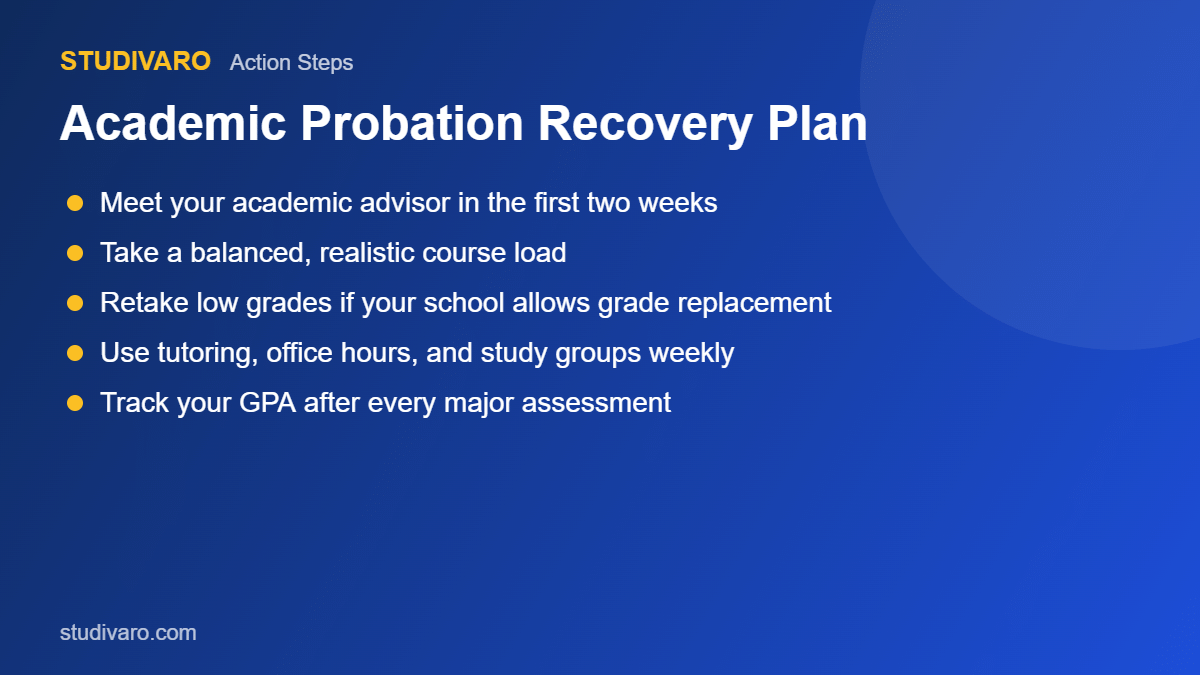
If your current cumulative standing is below the 2.000 or 3.000 threshold, follow our step-by-step institutional recovery protocol in Academic Probation GPA Recovery and build a credit recovery schedule using our guide on How to Raise Your GPA from 2.5 to 3.5.
6. Pass / No Pass (P/NP) Grading Rules and the One-Third Unit Cap
UC Berkeley allows students to take select courses on a Pass / No Pass (P/NP) basis to encourage intellectual exploration outside their major without risking GPA depreciation. However, strict Senate regulations apply:
- The Passing Standard: To receive a grade of
P(Passed), a student must demonstrate academic performance equivalent to a C- or better (2.000 quality points). A grade of D+ or lower results in anNP(Not Passed). - The One-Third Unit Cap (L&S Rule): In the College of Letters & Science, no more than one-third (33.3%) of your total passed units earned at UC Berkeley may be completed on a P/NP basis. Courses offered exclusively on a P/NP basis (such as Berkeley Connect, Decals, or 98/198 seminars) are excluded from the numerator but factored into your overall totals.
- Major Requirement Restrictions: Almost all academic departments (including Computer Science, Economics, Haas Business, and Engineering) strictly require all major prerequisite and upper-division core courses to be completed for a letter grade. Taking a major requirement P/NP will invalidate it toward your degree.
Academic Late Submission Penalty Calculator
Submitting an assignment or project past the bCourses deadline? Calculate exact percentage deductions, late slip consumption, and syllabus-based penalties instantly.
Calculate Late Deduction →7. Frequently Asked Questions: UC Berkeley GPA & Academic Rules
Does an A+ raise your GPA above 4.0 at UC Berkeley?
No. Under UC Berkeley Division Academic Senate Regulation 201, an A+ carries exactly 4.000 grade points, which is mathematically identical to an A. While an A+ is recorded on your official transcript to recognize extraordinary work, the maximum possible numerical GPA at UC Berkeley is 4.000.
What happens if I get a D or F in a class at Cal?
A grade of D-, D, or D+ awards degree unit credit but does not fulfill prerequisite standards requiring a C- or better. An F awards zero unit credit and 0.000 grade points. Under Berkeley Regulation A201, you may repeat up to 12 units of D or F grades, where the newly earned grade will replace the original grade in your cumulative GPA calculation.
How does Pass/No Pass (P/NP) affect my Berkeley GPA?
Neither a Pass (P) nor a No Pass (NP) grade is included in your Berkeley GPA calculation. A grade of P requires performance equivalent to a C- or better and grants degree units. An NP grade provides zero units. In L&S, no more than one-third of your total passed UC units may be taken on a P/NP basis.
Does UC Berkeley use Latin honors like Summa or Magna Cum Laude?
No. UC Berkeley does not print Latin honors on diplomas or transcripts. Instead, Berkeley awards Distinction in General Scholarship at Graduation based on class percentiles within each college: Highest Distinction (top 3%), High Distinction (next 7%), and General Distinction (next 10%).
What GPA do I need to make the Dean’s Honors List at Cal?
To make the Dean’s Honors List, an undergraduate must complete a minimum of 12 letter-graded units in a semester and rank in the top 10% of their college. In competitive colleges like Letters & Science and Engineering, the semester cutoff typically requires a GPA between 3.900 and 4.000.
What is the minimum GPA to avoid academic probation at UC Berkeley?
You must maintain both a semester GPA of 2.000 or higher and an overall cumulative UC GPA of 2.000 or higher. If either drops below 2.000, you are placed on Academic Probation. If your term GPA falls below 1.500 in any single semester, you become subject to immediate academic dismissal.