
The Purdue GPA Calculator allows undergraduate and graduate Boilermakers to compute their exact semester index, projected cumulative GPA, and academic standing under the official Purdue University Office of the Registrar regulations. Use this interactive tool to model letter grades, test course retake grade replacements, evaluate College of Engineering and Science distinction benchmarks, and track Dean’s List vs. Semester Honors qualification.
P Purdue GPA Calculator (Official 2026 Tool)
Configured for Purdue West Lafayette 4.00 Index (A+ Capped at 4.00 Quality Points)
Table of Contents: Purdue GPA & Academic Regulations
- 1. Official Purdue Grading Scale & Quality Point Matrix
- 2. How to Calculate Your Purdue GPA: The Index Formula & Manual Walkthrough
- 3. Dean’s List vs. Semester Honors: The Critical Differences Most Students Miss
- 4. Graduation with Distinction vs Highest Distinction (The Truth About Latin Honors)
- 5. Purdue Course Retake & Grade Replacement Policy (University Regulations Part 2)
- 6. Academic Notice (Probation) & Separation Rules
- 7. Frequently Asked Questions: Purdue GPA & Academic Rules
1. Official Purdue Grading Scale & Quality Point Matrix
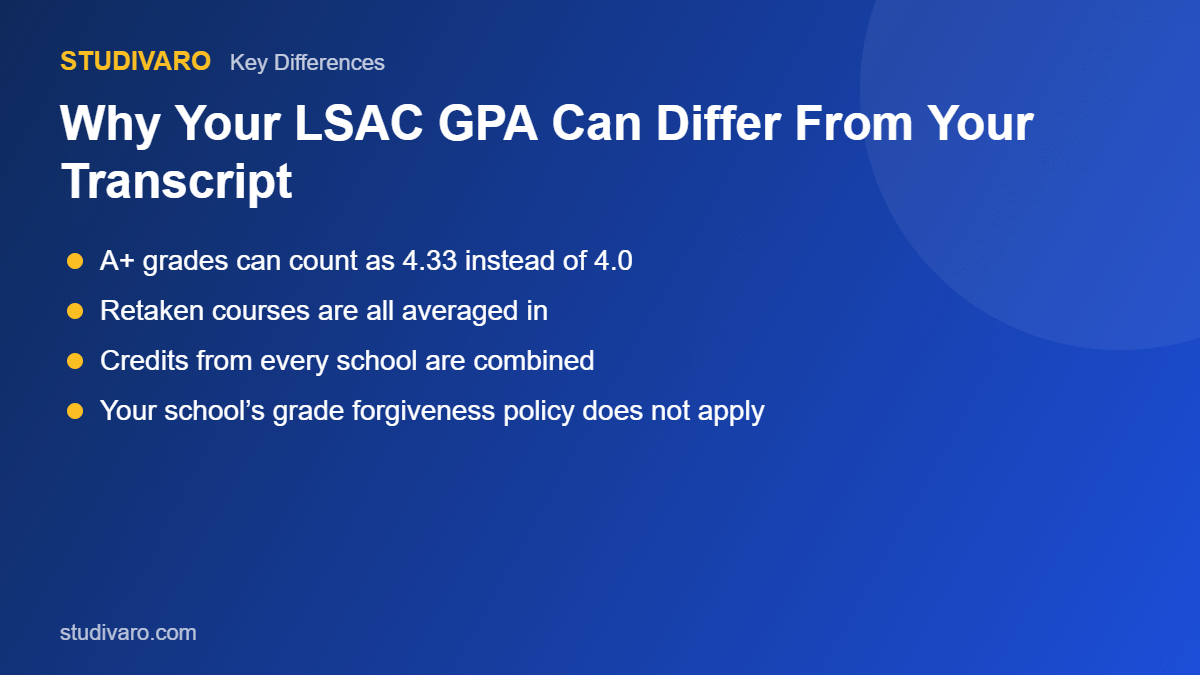
Under Purdue University Office of the Registrar academic regulations, student scholarship is officially recorded on a 4.00 cumulative index scale. While Purdue utilizes plus and minus grading across all undergraduate colleges (including First-Year Engineering, Science, Krannert/Daniels School of Business, and Liberal Arts), an A+ carries exactly 4.00 quality points. While an A+ acknowledges exceptional subject mastery on your official academic transcript, it does not mathematically elevate your GPA above 4.00.
The official quality point conversion table administered by the Purdue University Registrar is structured as follows:
| Letter Grade | Quality Points (Per Credit Hour) | Institutional Performance Standard | Degree Credit Awarded? |
|---|---|---|---|
| A+ | 4.000 | Highest Academic Achievement (Transcript Honors) | Yes |
| A | 4.000 | Excellent | Yes |
| A- | 3.700 | Superior | Yes |
| B+ | 3.300 | Very Good | Yes |
| B | 3.000 | Good | Yes |
| B- | 2.700 | Fair / Competent | Yes |
| C+ | 2.300 | Satisfactory | Yes |
| C | 2.000 | Passing (Minimum Good Standing Benchmark) | Yes |
| C- | 1.700 | Minimum Grade for Many Engineering Prereqs | Yes |
| D+ | 1.300 | Passing, Below Standard (Retake Recommended) | Yes |
| D | 1.000 | Poor Passing (Retake Recommended) | Yes |
| D- | 0.700 | Lowest Passing Grade | Yes |
| F | 0.000 | Failure (Counts in GPA Hours; 0 Credits) | No |
| P | None | Passing (C- or better; excluded from index) | Yes |
| N | None | Not Passing (Excluded from index) | No |
To evaluate how Purdue’s quality point distributions correlate across other Big Ten and national institutions, compare our universal breakdown on the 4.0 vs 4.3 GPA Scale.
2. How to Calculate Your Purdue GPA: The Index Formula & Manual Walkthrough
Purdue University officially refers to your Grade Point Average as your Academic Index. The Semester Index and Cumulative Index are determined using credit-hour weighting, ensuring that foundational 4-credit calculus and chemistry courses carry double the mathematical impact of a 2-credit seminar.
The official formula utilized by myPurdue and the Office of the Registrar is:
Step-by-Step Boilermaker Calculation Protocol:
- Identify Credit Hours: Record the credit hours for each registered course (e.g., MA 16500 is 4 credits).
- Assign Quality Point Values: Convert your letter grade into quality points using the official table above (e.g., A = 4.000, B+ = 3.300).
- Calculate Course Quality Points: Multiply the credit hours by the quality points earned (e.g.,
4 credits × 3.700 (A-) = 14.800 quality points). - Sum Your Total Quality Points: Add together the quality points earned from all graded courses in the semester.
- Sum Your GPA Hours: Add together the credit hours of all letter-graded courses (exclude Pass/No Pass, Incomplete, or Withdrawn courses).
- Divide Points by Hours: Divide your total quality points by total GPA hours to compute your official semester index.
Representative First-Year Engineering (FYE) Semester Example:
- ENGR 13100 (2 credits): Grade A (4.000 pts) →
2 × 4.000 = 8.000quality points - MA 16500 (4 credits): Grade A- (3.700 pts) →
4 × 3.700 = 14.800quality points - PHYS 17200 (4 credits): Grade B+ (3.300 pts) →
4 × 3.300 = 13.200quality points - CHM 11500 (4 credits): Grade A (4.000 pts) →
4 × 4.000 = 16.000quality points
Purdue Semester Index =
52.000 / 14.0 = 3.714 (Rounds to 3.71)
To master credit weighting across upper-division courses, consult our guide on How to Calculate Semester GPA with Credit Hours, or calculate the exact final exam score needed to preserve your grade using our Final Exam Grade Calculator.
3. Dean’s List vs. Semester Honors: The Critical Differences Most Students Miss
Many undergraduate students at Purdue mistakenly assume that “Dean’s List” and “Semester Honors” are interchangeable terms. Under Purdue University academic regulations, they represent two distinct institutional recognitions governed by completely separate criteria:
| Academic Metric | Purdue Dean’s List | Purdue Semester Honors |
|---|---|---|
| Core Focus | Sustained High Cumulative Index | Outstanding Single-Term Performance |
| Minimum Cumulative GPA | 3.500 or higher | 2.000 or higher (Good Standing) |
| Minimum Semester GPA | 3.000 or higher | 3.500 or higher |
| Required Cumulative Credits | At least 12 GPA hours completed | None (requires only 2.000 standing) |
| Required Semester Credits | At least 6 GPA hours in the term | At least 6 GPA hours in the term |
Students who earn a semester GPA of 3.500 or higher while maintaining an overall cumulative GPA of 3.500 or higher with 12+ total credits earn both honors simultaneously on their official myPurdue transcript.
Compare Purdue’s dual-recognition framework with national university standards in our comprehensive index of Dean’s List GPA Requirements and Cum Laude GPA Requirements.
4. Graduation with Distinction vs Highest Distinction (The Truth About Latin Honors)
A widespread misconception among Purdue undergraduates is searching for “Purdue Summa Cum Laude” cutoffs. Purdue University West Lafayette does not award traditional Latin honors (Cum Laude, Magna Cum Laude, Summa Cum Laude) on undergraduate diplomas.
Instead, Purdue recognizes graduating seniors using Graduation with Distinction and Graduation with Highest Distinction based on college percentile rankings evaluated every spring:
- Graduation with Distinction: Conferred upon candidates who rank in the top 10% of their graduating class within their specific college or school. Requirements mandate a minimum cumulative index of 3.300 and at least 65 credit hours completed at Purdue University. Depending on the college (e.g., Engineering vs Science vs Health & Human Sciences), recent cutoff GPAs typically fall between 3.740 and 3.910.
- Graduation with Highest Distinction: Conferred upon the top 3/10ths of the top 10% (the top 3% overall) of graduating seniors in each college. This represents the Purdue equivalent of Summa Cum Laude. Recent historical cutoffs generally demand a near-perfect cumulative index around 3.970 to 4.000.
Note: If you attend Purdue University Global (the online campus), standard Latin honors with static GPA brackets (Summa 4.00, Magna 3.80–3.99, Cum Laude 3.70–3.79) are utilized instead of West Lafayette percentiles.
5. Purdue Course Retake & Grade Replacement Policy (University Regulations Part 2)
Under Purdue Academic Regulations Part 2, Section D, Purdue offers one of the most generous course retake and grade forgiveness frameworks among Big Ten universities:
The “Most Recent Grade Replaces” Principle
When you repeat a course at Purdue University, the most recent grade earned completely replaces the previous grade in your Cumulative GPA (index) calculation.
- Transcript Notation: The original grade permanently remains visible on your official academic transcript with an
E(Excluded from index) notation. The newly earned grade receives anI(Included in index) notation. - Full Quality Point Replacement: If you originally earned an F (0.000 pts) in a 4-credit course and repeat it with an A (4.000 pts), the entire 0.000 penalty is removed from your cumulative index and replaced with 16.000 quality points.
- Warning on Lower Grades: Because the rule dictates that the most recent grade applies (not the highest grade), if you repeat a C and earn a D, the D is the grade factored into your cumulative index.
- Degree Credit Limitation: Degree credit hours are awarded only once. Retaking a passed course does not add cumulative degree hours toward graduation.
To compute the exact cumulative GPA increase from replacing a low grade, explore our in-depth analysis on Grade Forgiveness & Retakes: GPA Impact Explained and examine institutional rules in What Happens If You Fail a Class in College.
6. Academic Notice (Probation) & Separation Rules
Purdue University enforces strict index thresholds to identify students who are not making satisfactory academic progress toward graduation:
✅ Good Academic Standing
Requires maintaining both a Semester Index ≥ 2.000 and an overall Cumulative Index ≥ 2.000 across all Purdue coursework.
⚠️ Academic Notice (Probation)
Triggered if either your Semester Index drops below 2.000 or your Cumulative Index falls below 2.000 at the end of any regular academic session.
🚨 Academic Separation (Dropped)
Occurs if a student on Academic Notice fails to earn a Semester Index of at least 2.000 while their Cumulative Index remains below 2.000.
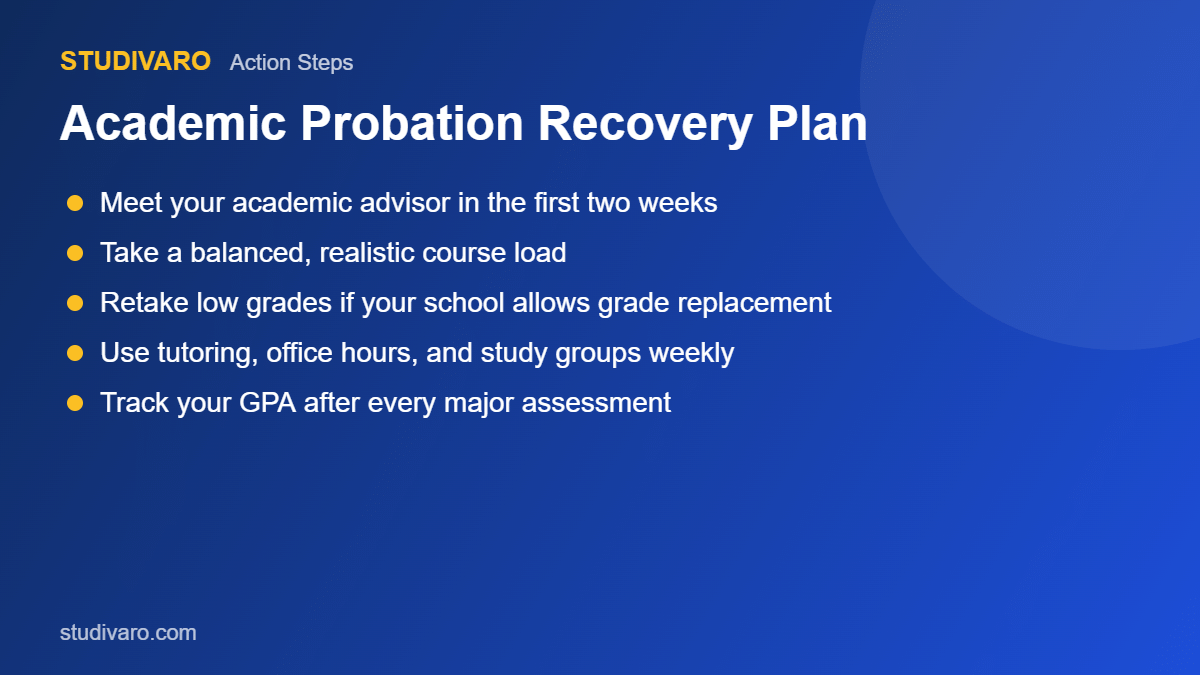
If you have been placed on Academic Notice, build an immediate index recovery roadmap with our guide on Academic Probation GPA Recovery and learn how to plan a multi-semester credit comeback in How to Raise Your GPA from 2.5 to 3.5.
Academic Late Submission Penalty Calculator
Submitting an engineering problem set or lab report past the Brightspace deadline? Model exact hourly and daily grade penalties according to your course syllabus.
Calculate Late Deduction →7. Frequently Asked Questions: Purdue GPA & Academic Rules
Does an A+ carry 4.33 quality points at Purdue University?
No. Under Purdue University Office of the Registrar regulations, an A+ carries exactly 4.000 quality points, which is mathematically equivalent to an A. While an A+ is permanently noted on your official transcript to recognize extraordinary academic performance, the maximum possible cumulative index at Purdue is 4.000.
What is the difference between Dean’s List and Semester Honors at Purdue?
The Dean’s List requires a Cumulative Index of 3.500+ and a Semester Index of 3.000+ with at least 12 cumulative GPA hours and 6 semester hours. Semester Honors requires a Semester Index of 3.500+ and at least a 2.000 Cumulative Index (good standing) with at least 6 semester GPA hours.
How does repeating a course affect my Purdue GPA?
Purdue enforces a grade replacement policy: the most recent grade earned replaces previous grades in your Cumulative GPA calculation. The previous attempt remains on your transcript with an “E” (excluded) mark, while the new grade receives an “I” (included) mark.
Does Purdue award Latin honors like Summa Cum Laude at graduation?
No. Purdue University West Lafayette does not print Latin honors on diplomas. Instead, seniors graduate with Distinction (top 10% of their college with a 3.30+ GPA and 65+ Purdue credits) or Highest Distinction (the top 3% overall of the college).
What GPA triggers Academic Notice at Purdue University?
Academic Notice (probation) is triggered whenever your Semester Index or Cumulative Index drops below 2.000 at the end of a regular term. If on Academic Notice and your subsequent semester GPA remains below 2.000 while cumulative is below 2.000, you are dropped for academic deficiency.
How do Pass/Not Pass (P/N) grades factor into my Purdue GPA?
Grades of P (Pass) and N (Not Pass) carry no quality points and are completely excluded from your GPA calculation. A grade of P requires performance equivalent to a C- or better and grants degree credit hours, whereas an N awards zero credit hours.