
Academic Oversight: Reviewed and verified by the Studivaro Academic Review Board in accordance with statutory collegiate attendance regulations (UGC, AICTE, and North American Dean of Students guidelines) governing medical leave attendance condonation and examination eligibility.
What is Medical Leave Attendance Condonation? It is a formal administrative waiver granted by university academic committees that permits students whose class attendance has dropped between 65.0% and 74.9% due to certified medical illness to sit for semester examinations. Attendance below the statutory 65% floor cannot be condoned by department chairs and requires emergency Dean of Students or Medical Leave of Absence (MLOA) procedures.
Securing a formal medical leave attendance condonation is often the only legal mechanism that shields university students from administrative debarment, mandatory course repetition, and semester failure when acute illness disrupts lecture schedules. While collegiate accreditation bodies enforce mandatory 75% or 80% attendance baselines, statutory academic charters maintain specific condonation relief windows—typically permitting students with documented medical emergencies to sit for examinations if their attendance remains at or above a strict 65% threshold.
📱 Calculate Your Exact Condonation & Safe Bunk Margins:
Find out exactly how many medical absence hours you need excused to restore your attendance back above the mandatory 75% examination threshold:
Open Attendance Safe Bunk Calculator →However, over 40% of student medical petitions are summarily rejected each semester due to procedural filing errors, missing institutional endorsements, or invalid documentation formats. This comprehensive master guide outlines the exact university bylaws governing medical condonation, provides an audit checklist for medical certificates, walks through step-by-step recalculation formulas, and delivers three copy-paste ready application templates to protect your academic standing.
1. Understanding Medical Leave Attendance Condonation: The 65% Floor Rule
Under university academic ordinances across North American, European, and Commonwealth university frameworks, attendance regulations are structured around two distinct operational thresholds: the Standard Exam Qualification Threshold (75% to 80%) and the Statutory Condonation Floor (65%).
When a student’s attendance falls between 65% and 74.9% strictly due to certified medical incapacitation, the Head of Department (HOD) and the Dean of Academic Affairs hold discretionary authority to grant condonation. Condonation does not mean your absences are erased; rather, it constitutes an official institutional pardon that waives debarment penalties and validates your examination admit card.
| Attendance Range | Official Academic Status | Action Required | Eligible Authority |
|---|---|---|---|
| 75.0% – 100% | Full Academic Clearance | Automatic exam hall ticket release | Course Instructor |
| 65.0% – 74.9% | Condonation Eligible Zone | Formal medical appeal + fee payment | Head of Department / Academic Dean |
| 55.0% – 64.9% | Critical Debarment Zone | Vice-Chancellor / Dean Senate Appeal | Executive Academic Board Only |
| Below 55.0% | Absolute Debarment (Ineligible) | Mandatory course retake / Term repeat | No Relief Available |
If your attendance is currently hovering near the borderline, consult our complete analysis on college attendance below 75 percent penalties to evaluate whether your department imposes condonation processing fines alongside medical documentation.
2. Anatomy of an Approved Medical Certificate: The Verification Checklist
Collegiate registrars process hundreds of fraudulent medical claims annually. As a consequence, university health inspection boards conduct rigorous verification audits before certifying medical leave attendance condonation. To ensure your medical leave application is approved on first submission, verify that your physician’s documentation contains the following seven indispensable elements:
- Official Clinic or Hospital Letterhead: The document must be printed on formal institutional letterhead including the clinic’s physical address, telephone landline, and verified email address.
- Physician Registration Details: The attending medical officer’s full name, professional medical council registration number (e.g., GMC, State Medical Board, MCI), and legal signature must be clearly visible.
- Clinical Diagnosis & Symptoms: The certificate must specify the clinical pathology (e.g., Acute Gastroenteritis, Viral Bronchitis, Post-Surgical Recovery) rather than vague entries such as “was feeling sick.”
- Explicit Bed Rest & Recuperation Window: The physician must state exact chronological calendar dates, such as: “Recommended complete clinical bed rest from October 12, 2026, to October 22, 2026.”
- Official Physical Stamp / Seal: An embossed clinic seal or indelible ink doctor stamp positioned directly over the doctor’s signature.
- Supporting Pharmacy Bills & Diagnostic Reports: Receipts for prescribed medications, lab test reports (e.g., blood panels, radiological imaging), or hospital discharge summaries corroborating the duration of absence.
- University Health Center Endorsement: If your institution requires campus verification, submit the private clinic slip to the campus chief medical officer within 48 hours for countersigning.
3. Step-by-Step Mathematical Calculation of Medical Condonation
Universities calculate condonation relief using one of two standard mathematical models. Understanding which method your registrar applies determines whether you can legally write your final exams.
Model A: Excused Hours Net Recalculation
Under the Net Recalculation model, certified medical absence hours are subtracted directly from total conducted lecture hours, recalculating your attendance against the adjusted course denominator:
Adjusted Attendance % = [Attended Lectures / (Total Conducted Lectures – Excused Medical Lectures)] × 100
Worked Example: Suppose your Organic Chemistry course conducts 60 lectures throughout the term. You attended 42 classes and missed 18. Your current attendance stands at 70.0% (42 / 60 × 100), placing you in the debarment zone. If the department approves 10 lectures of medical condonation, your revised formula becomes:
Adjusted Attendance = [42 / (60 – 10)] × 100 = (42 / 50) × 100 = 84.0% (Cleared for Exams)
Model B: Fixed Condonation Percentage Credit
Under the Fixed Credit model, universities grant an administrative percentage credit (up to a maximum ceiling of 10%) directly to your aggregate total, provided your physical presence exceeds the 65.0% floor:
Final Credited Attendance % = Recorded Physical Attendance % + Approved Medical Allowance (Max 10%)
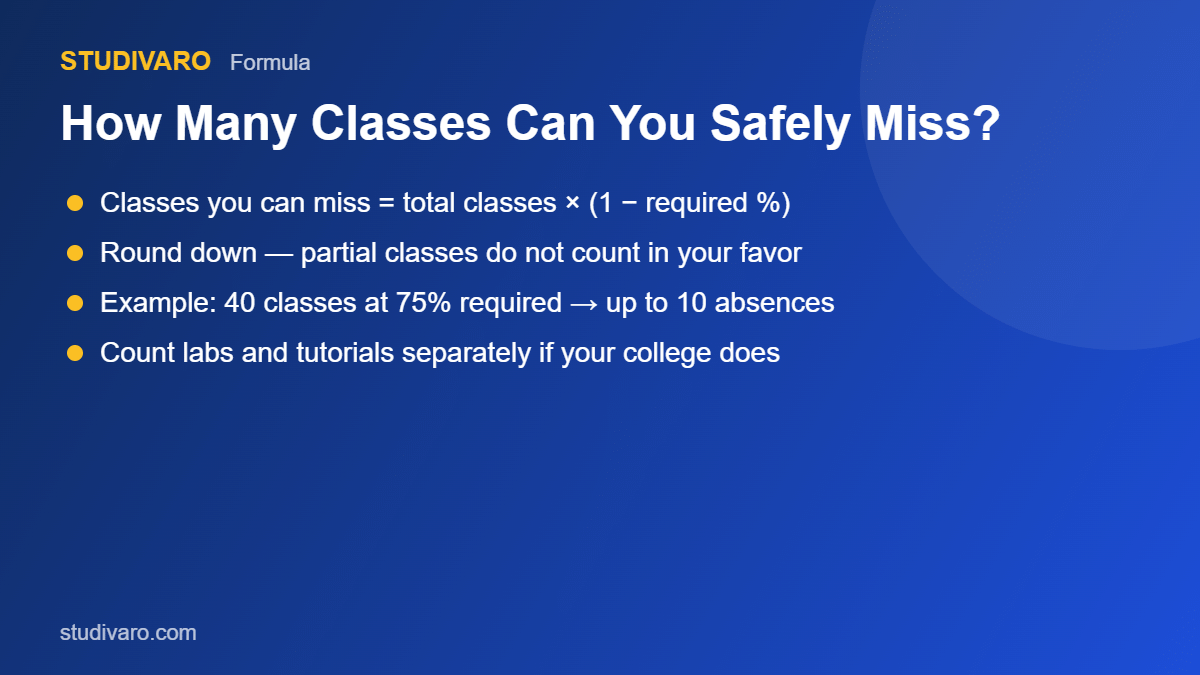
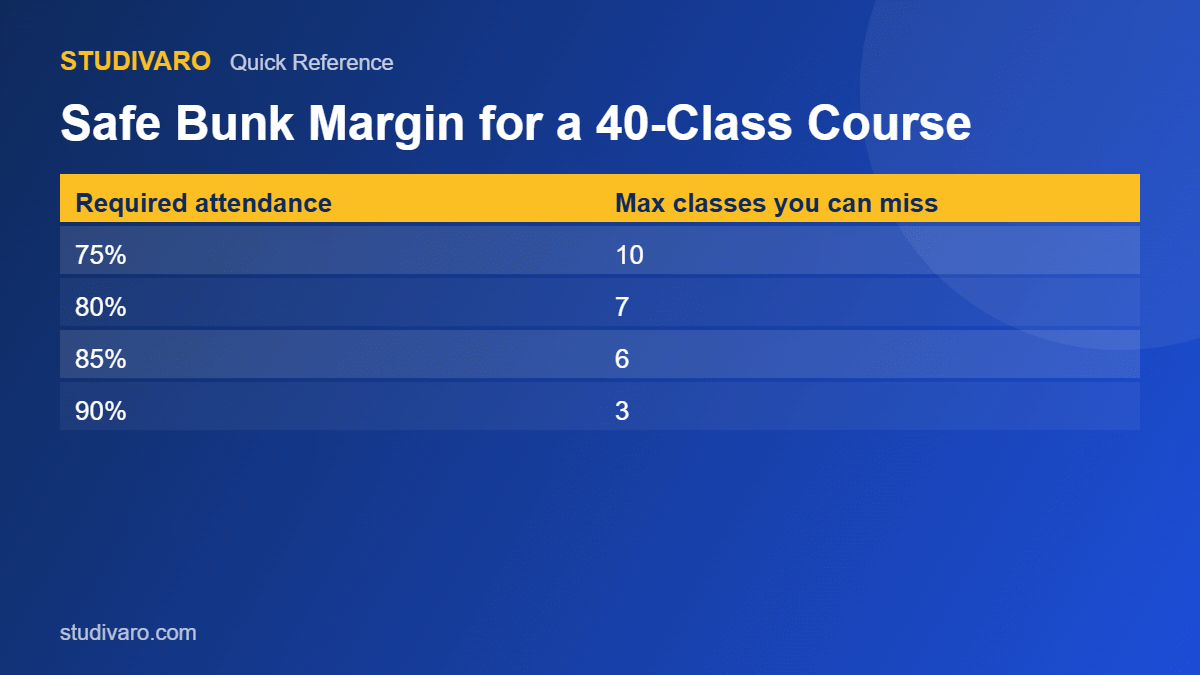
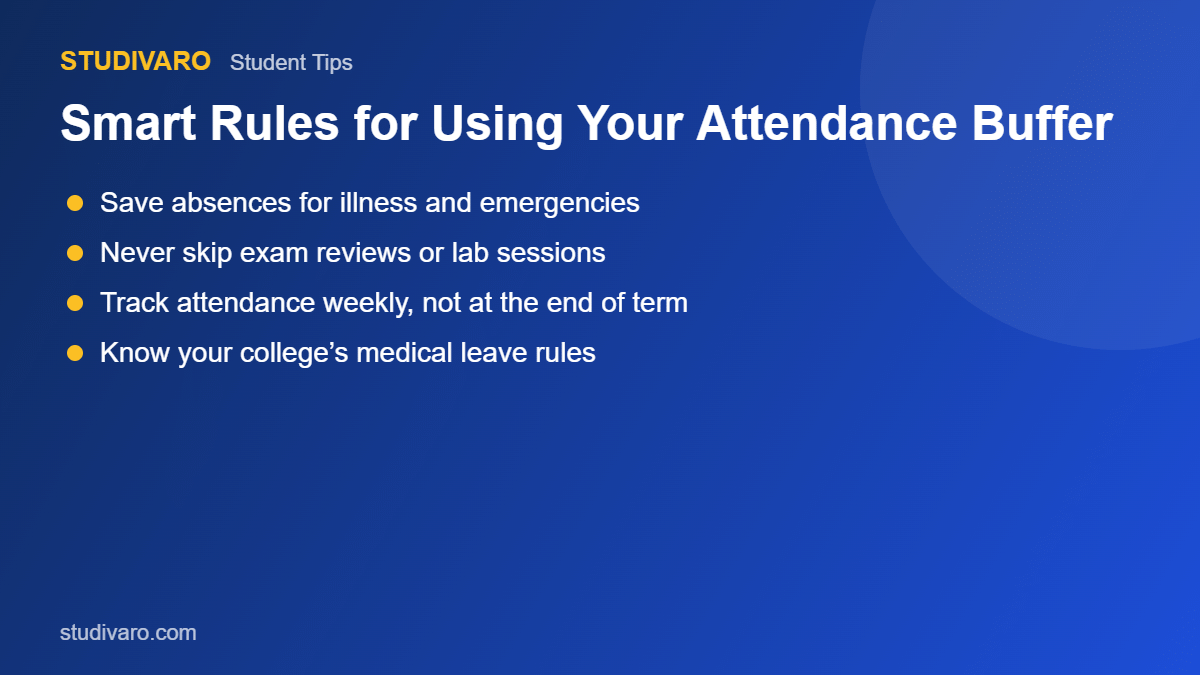
To avoid calculation discrepancies before submitting your paperwork, cross-verify your class schedule using our specialized attendance safe bunk calculator, which accounts for scheduled holidays and lecture weighting.
4. Three Copy-Paste Ready Medical Leave & Condonation Templates
When communicating with faculty advisors and academic deans, professionalism, clarity, and chronological transparency are critical. Use the following structured templates tailored to specific medical situations.
Template 1: Advance Notification of Scheduled Surgery or Clinical Procedure
Dear Professor [Professor’s Last Name],
I am writing to formally notify you that I will be absent from [Course Name & Code] from [Start Date] through [End Date] due to a scheduled medical procedure and physician-mandated clinical recovery.
My attending physician, Dr. [Doctor’s Name], has advised a strict [Number of Days]-day recuperation period. I have attached the official medical admission letter and surgical advisory from [Hospital/Clinic Name] for your administrative records.
During my absence, I will complete the required textbook readings and coordinate with [Classmate’s Name] to review lecture notes. I have already submitted [Assignment Name] via the course portal ahead of deadline. Upon my discharge, I will present the physical documentation to the University Health Center for formal institutional condonation endorsement.
Thank you for your understanding and guidance.
Sincerely,
[Your Full Name]
Student ID: [Your ID Number]
Degree Program: [Your Major / Year]
Contact: [Your Phone Number]
Template 2: Post-Illness Attendance Condonation Application to Course Instructor
Dear Professor [Professor’s Last Name],
I am writing to formally request medical attendance condonation for [Number of Missed Lectures] lectures missed in [Course Name & Code] between [Start Date of Illness] and [End Date of Illness].
During this timeframe, I was incapacitated by [Medical Condition, e.g., acute viral bronchitis and high fever] under the active care of Dr. [Doctor’s Name] at [Clinic Name]. In accordance with university attendance regulations, I am attaching my verified Medical Certificate, diagnostic lab reports, and the University Health Center verification countersignature.
My current attendance stands at [Current %], and excusing these documented medical dates will restore my standing to [Projected %], ensuring full compliance with the 75% examination eligibility requirement.
I am prepared to submit any makeup coursework or take missed quizzes at your earliest convenience.
Respectfully submitted,
[Your Full Name]
Student ID: [Your ID Number]
Program & Section: [Your Major / Section]
Template 3: Formal Condonation Petition to the Dean of Academic Affairs
To: Office of the Dean of Academic Affairs
University of [University Name]
Respected Dean [Dean’s Last Name],
I am submitting this formal petition to request academic condonation for medical leave under Section [Cite Relevant University Statute, e.g., Bylaw 14.2 on Medical Condonation] for the [Fall/Spring 2026] academic semester.
Due to an unexpected medical emergency requiring hospitalization and extended convalescence from [Date] to [Date], my cumulative attendance across [Number of Enrolled Courses] registered courses dropped into the condonation-eligible bracket (currently [Your Overall %], surpassing the statutory 65% floor).
Enclosed with this petition dossier are:
1. Official Hospital Discharge Summary & Treatment Records
2. Licensed Medical Practitioner Certificate with Registration Seal
3. University Chief Medical Officer (CMO) Verification Endorsement
4. Course-by-Course Attendance Breakdown certified by Department Advisors
5. Paid Condonation Application Fee Receipt [#Receipt Number]
I maintain a cumulative GPA of [Your GPA], and have consistently completed all scheduled term papers and assignments. I respectfully urge the Academic Committee to grant attendance condonation and authorize the issuance of my final examination hall ticket.
Thank you for your time, consideration, and support.
Yours faithfully,
[Your Full Name]
Student ID: [Your ID Number]
Department: [Your Academic Department]
If your health-related absence also caused you to miss major coursework deadlines, review our specialized guide on how to email a professor for an assignment extension to preserve your continuous assessment grades.
5. Critical Mistakes That Cause Condonation Denials
Academic grievance boards dismiss hundreds of petitions each semester due to procedural oversights. Avoid these four fatal mistakes:
- Breaching the 72-Hour Submission Window: Nearly all universities mandate that medical slips must be lodged within 3 business days of returning to classes. Waiting until final debarment rosters are published at semester’s end will result in an immediate administrative denial.
- Submitting Incomplete Medical Dossiers: Submitting a one-page doctor slip without diagnostic test receipts, pharmacy invoices, or clinic contact credentials triggers fraud scrutiny.
- Falling Below the Absolute 65% Floor: If severe chronic illness pulls your aggregate attendance below 65%, standard departmental condonation is legally blocked. In such instances, apply immediately for an official Medical Leave of Absence (MLOA) or retroactive course withdrawal rather than condonation.
- Neglecting Coursework Makeup Agreements: Condonation excuses attendance hours but does not excuse missed academic knowledge. Always arrange makeup lab sessions or paper submissions with your instructor immediately upon your return.
Frequently Asked Questions (FAQ)
What is the minimum attendance percentage required to apply for medical condonation?
Most collegiate academic regulations establish a strict 65% absolute attendance floor for medical condonation eligibility. If your physical attendance falls below 65% (even with legitimate medical documentation), statutory university bylaws generally prevent departmental heads from granting condonation, requiring a full semester repeat or specialized Dean of Student Affairs intervention.
Can a private clinic doctor provide a valid medical certificate for condonation?
Yes, provided the attending physician possesses an active, verifiable state or national medical registration license number. However, many tier-1 universities mandate that private clinic certificates exceeding 3 to 5 consecutive days of class absence must be countersigned or endorsed by the official University Chief Medical Officer (CMO) or University Health Center.
What is the standard deadline for submitting a medical condonation application?
University academic policy standardly requires students to submit medical condonation dossiers within 3 to 7 working days of returning to campus classes. Applications submitted weeks later during end-semester examination debarment notices are almost universally rejected as retroactive afterthoughts.
Does receiving medical attendance condonation remove the absence from my transcript?
No. Medical condonation does not erase your recorded class absences or alter the historical lecture roll. Instead, it grants an administrative waiver that exempts you from minimum attendance debarment sanctions, allowing you to legally sit for midterm and end-semester final examinations.
Can mental health crises or severe depressive episodes qualify for medical condonation?
Yes. Recognized academic institutions treat documented mental health emergencies—including severe clinical depression, generalized anxiety crises, and psychiatric treatment—as legitimate grounds for medical leave condonation, provided documentation is signed by a licensed clinical psychologist, psychiatrist, or campus mental health counselor.
How do I calculate if medical condonation will put me back above 75%?
You can calculate your adjusted attendance by subtracting the approved medical absence hours from your total conducted lecture hours: (Attended Hours / (Total Conducted Hours – Excused Medical Hours)) * 100. Alternatively, use the free Studivaro Attendance Safe Bunk Calculator for automatic percentage forecasting.