
If you miss a final exam in college, the immediate academic outcome depends entirely on whether your absence is legally classified as excused or unexcused under your institution’s academic senate regulations. For an unexcused absence—such as oversleeping, misreading the examination timetable, or booking conflicting holiday travel—professors are procedurally required to record a score of zero (0% / F) on the exam. Because collegiate final examinations routinely account for 25% to 50% of your total course grade, receiving an unpenalized zero almost invariably drops a passing B or C down to an outright course failure (F) or an unrecoverable D grade.
Conversely, if an unexpected, documented crisis prevents you from sitting for the assessment—such as acute medical hospitalization, severe family bereavement, or active civic summons—university bylaws provide protective administrative remedies. Under institutional provisions, faculty can grant an official incomplete grade in college (grade notation ‘I’) or a deferred examination (grade notation ‘X’), giving you a legally binding window of 4 to 12 weeks into the subsequent academic term to sit for a proctored make-up exam without GPA penalty.
Executive Summary: Missed Final Exam Critical Benchmarks
- The 24-Hour Notification Window: Over 90% of university bylaws require students to email their professor and department chair prior to or within 24 hours of the missed exam start time to preserve make-up eligibility.
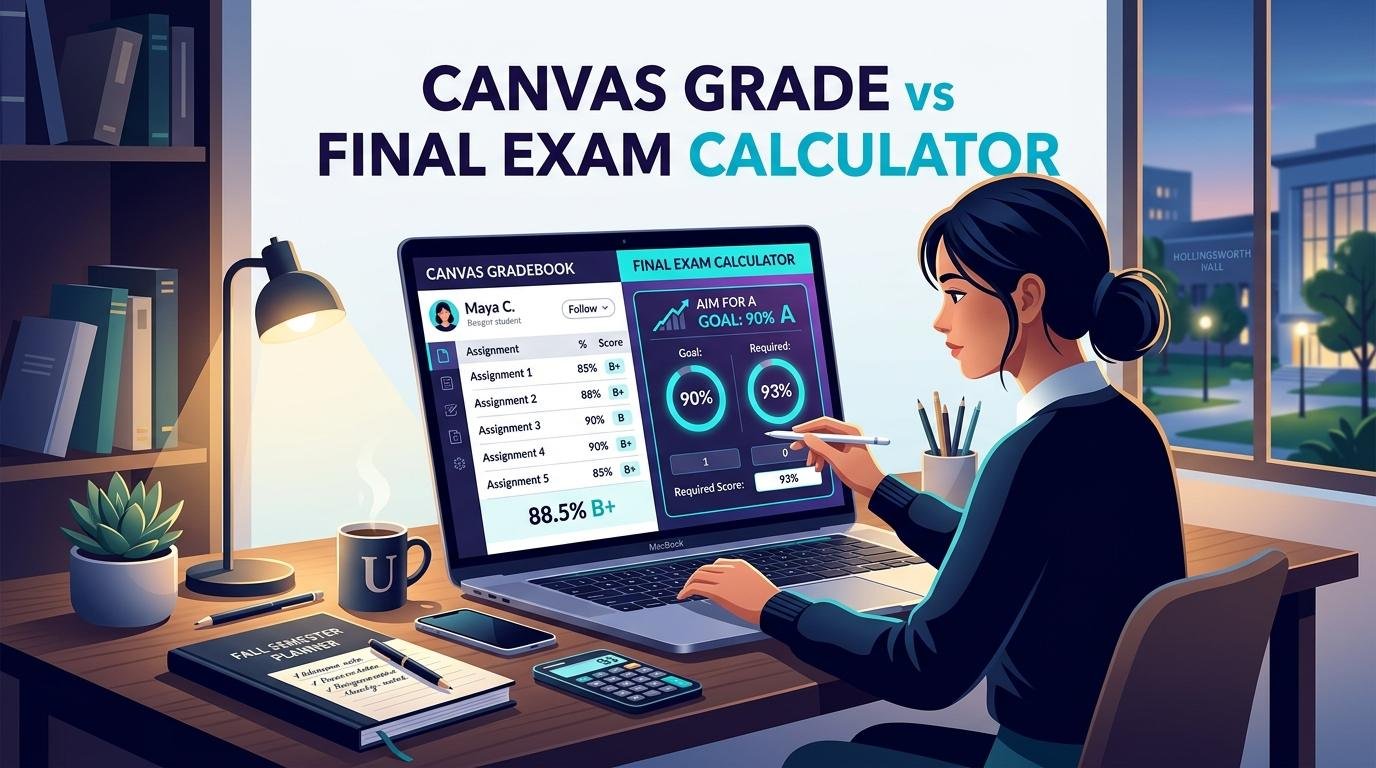
- Unexcused Absence Zero Impact: On a standard 35% weighted final exam, entering a 0 drops an 85% (B) course standing to 55.25% (F). You can model your exact survival threshold using our free Final Exam Grade Calculator.
- Mandatory Third-Party Evidence: Self-written notes, informal doctor notes without physician licensing (NPI) credentials, and generic pharmacy receipts are categorically rejected across public universities.
- Incomplete (‘I’) vs Deferred (‘X’) Resolution: If approved for an excused deferred exam, you do not retake the entire semester; you merely take the make-up final during the department’s sanctioned rescheduling session.
- SAP & Financial Aid Peril: A semester course failure caused by an unexcused zero directly penalizes your federal Satisfactory Academic Progress (SAP) credit completion pace (minimum 67% required) and cumulative 2.0 GPA standing.
Table of Contents (Click to Expand)
- 1. Mathematical Grade Impact: How a Missed Final Destroys Your Course Standing
- 2. Excused vs. Unexcused Absences: The Legal Collegiate Distinction
- 3. Official University Missed Final Exam Policies (10-Institution Matrix)
- 4. Emergency Action Protocol: 5 Steps to Execute Within 24 Hours
- 5. Copy-Paste Emergency Email Templates to Professors and Deans
- 6. Incomplete Grade (‘I’) vs. Deferred Examination (‘X’) Notations
- 7. Federal SAP Standing and Academic Probation Implications
- 8. Frequently Asked Questions (FAQ)
Mathematical Grade Impact: How a Missed Final Destroys Your Course Standing
In collegiate syllabi, final examinations carry higher percentage weightings than any individual midterm, problem set, or laboratory report. When an unexcused absence forces an instructor to input a zero, the mathematical destruction is immediate and severe. The final course grade is calculated via weighted composite aggregation:
Course Grade = (Term Work Average × Term Weight) + (Final Exam Score × Final Exam Weight)
Consider a student enrolled in a 4-credit calculus course who maintains an 88.0% (B+) average on midterms, quizzes, and homework across 15 weeks of instruction. The table below details what happens to that B+ grade when the student misses the final exam without an approved excuse across typical syllabus weighting tiers:
As demonstrated, if a final is weighted at 40% or more, even a student with a perfect 100% on all previous assignments will plummet to an overall 60.0% (D-), which fails the minimum grade requirement for major progression across all accredited universities. If you want to review how individual zeroes compound across your syllabus, explore our complete breakdown on how much does a zero affect your grade.
Model Your Exact Final Exam Grade & Course Survival Standing
Calculate how a specific exam score, curve, or make-up examination shifts your cumulative letter grade and cumulative GPA standing in real time.
Excused vs. Unexcused Absences: The Legal Collegiate Distinction
University academic policies maintain an unyielding boundary between legitimate, verifiable emergencies and ordinary negligence. Under faculty senate codes, individual instructors do not have arbitrary authority to grant make-ups for unexcused circumstances, as doing so violates institutional accreditation equity standards.
What Qualifies as an Excused Missed Final Exam
To be categorized as an excused absence, the event must be sudden, unavoidable, and corroborated by independent third-party evidence. Valid statutory grounds include:
- Acute Medical Emergencies: Sudden hospitalization, severe physical trauma, contagious acute illness, or emergency surgical interventions documented contemporaneously by a licensed medical physician (MD or DO).
- Severe Family Bereavement: Death of an immediate family member (parent, legal guardian, sibling, spouse, child, or grandparent) corroborated by an obituary, death certificate, or funeral service memorial program.
- Subpoenaed Legal Obligations: Mandatory court appearances, grand jury duty, or governmental subpoenas that cannot be rescheduled or deferred.
- Official University Sanctioned Representation: Active NCAA varsity athletic competition, documented national collegiate debate championships, or academic conferences where the student officially represents the institution.
- Bona Fide Religious Holy Days: Religious observances protected under state and federal law, provided formal written notice was submitted within the first two weeks of the academic semester.
- Active Military Deployment: Mandatory military activation or mandatory reservist training orders under Title 10/32 of the U.S. Code.
What Is Strictly Categorized as an Unexcused Absence
Academic deans and department chairs routinely reject the following explanations, recording a permanent zero without appeal rights:
- Oversleeping or Alarm Malfunctions: Sleeping past an 8:00 AM exam time or dead smartphone battery incidents are categorized as personal administrative negligence.
- Misreading the Examination Timetable: Assuming a final exam takes place during ordinary class lecture hours or confusing exam dates on the registrar portal.
- Conflicting Personal or Vacation Travel: Booking non-refundable airline tickets, holiday flights, or family vacations prior to the official conclusion of finals week.
- Traffic Delays and Parking Difficulties: Highway congestion, transit delays, or campus parking searches (unless accompanied by a formal state police collision accident report).
- Unverified Technology Glitches: Personal laptop battery failure, unverified home Wi-Fi outages during unproctored online finals without verifiable canvas/LMS server outage logs.
Official University Missed Final Exam Policies (10-Institution Matrix)
Every accredited research institution codifies its missed final examination policy within its official Faculty Senate Bylaws or Undergraduate Catalog. The comprehensive matrix below synthesizes statutory policies across 10 flagship universities:
| University | Official Policy Citation | Notification Requirement | Excused Resolution Mechanism | Unexcused Consequence |
|---|---|---|---|---|
| UCLA | Academic Senate Reg A-306 | Prior to exam start or 24h | Deferred Examination (‘I’ notation) | Grade of F on examination |
| UMich | LSA Faculty Code § 8.01 | Immediate written notice | ‘X’ (Absent from Exam) or ‘I’ grade | Converts to ‘E’ (Fail) after 4 weeks |
| UT Austin | General Information § C | Within 48 hours of exam | Temporary ‘X’ notation; 1 semester to clear | Permanent ‘F’ recorded |
| Penn State | Faculty Senate Policy 44-25 | Before exam or within 24h | Deferred Final Examination | Zero score; course failure |
| ASU | ACD 304-01 Final Exam Policy | Immediate; dean notification | Incomplete grade contract | 0 points; grade calculated with zero |
| NYU | CAS Academic Bulletin § 14 | Prior to exam start | Dean’s Incomplete Petition | Zero recorded; no make-up permitted |
| Texas A&M | Student Rule 7 (Attendance) | Within 3 school business days | Authorized make-up or ‘I’ grade | Unexcused zero; final grade calculated |
| UF | Regulation 4.001 (Final Exams) | Within 24 hours of absence | Deferred exam within subsequent term | Zero points; grade assigned |
| UW | Scholastic Regulations Ch. 110 | Immediately prior to exam | Incomplete grade approval via Dean | Numeric grade 0.0 on examination |
| Ohio State | Faculty Rule 3335-8-20 | Within 24 hours with evidence | Alternate exam or ‘I’ mark | Calculated as zero in course aggregate |
Notice the universal requirement across all 10 institutions: the burden of proof rests entirely on the student. If you do not formally contact your instructor within the stipulated 24-to-48-hour window, professors lose their administrative leeway to offer an alternative, and final grade rosters are locked into the registrar database. For deeper insights into official grading scale nuances, review our guides for UCLA, UMich, and UT Austin.
Emergency Action Protocol: 5 Steps to Execute Within 24 Hours
If you realize you have missed or are about to miss your final exam, take immediate, systematic action. Do not wait for grades to post to student self-service. Execute these five steps sequentially:
Step 1: Contact Instructor and Department Chair Immediately
Send a professional email from your official university .edu email address. State your full legal name, student ID number, course title, section number, and a concise explanation of the emergency. If your emergency occurs within 2 hours of the exam, copy the Academic Department Chair on the communication to establish a verifiable time stamp.
Step 2: Obtain Contemporaneous Independent Documentation
Secure signed, dated third-party verification immediately. If medical, obtain a hospital discharge summary or physician note verifying you were physically incapacitated on the exact day and time of the examination. The documentation must include the clinic’s letterhead, contact number, and the physician’s medical license number.
Step 3: Request an Incomplete (‘I’) or Deferred Exam (‘X’) Contract
Explicitly request formal paperwork rather than an informal verbal promise. Complete an Incomplete Grade Contract specifying the exact make-up exam date, proctoring arrangements, and the default grade that will post if the exam is not completed. Familiarize yourself with can a professor change your grade after submitting so you understand how faculty submit grade change authorizations.
Step 4: Engage Academic Advising and the Dean of Students Office
If your professor refuses to grant an excused absence despite verifiable documentation, schedule an urgent appointment with an Academic Advisor and the Dean of Students. University ombudsman offices can intervene when a medical crisis meets institutional guidelines but an instructor acts contrary to senate bylaws.
Step 5: Assess Retroactive Medical Withdrawal Options
If catastrophic circumstances (such as extended hospitalization or family trauma) incapacitated you across finals week, inquire about a Retroactive Medical Withdrawal. An approved medical withdrawal removes all course registrations for the semester, replacing failing letter grades with neutral ‘W’ notations that protect your cumulative GPA.
Copy-Paste Emergency Email Templates to Professors and Deans
When communicating with professors during finals week, maintain a respectful, formal, and objective tone. Never sound entitled or demand a make-up as an automatic right. Use these verified scripts:
Template 1: Acute Medical Emergency on Exam Morning
Dear Professor [Professor’s Last Name],
I am writing to urgently notify you that due to a sudden, acute medical emergency requiring hospitalization, I was physically unable to attend our scheduled final examination this morning for [Course Code] ([Course Title]).
I am currently receiving care at [Hospital/Clinic Name]. I have obtained comprehensive medical documentation from my attending physician verifying my emergency admission and physical incapacitation during the scheduled exam window. I have attached the physician’s signed verification letter to this email.
I understand the critical importance of academic integrity and examination standards. I respectfully request the opportunity to discuss an excused Deferred Examination or an Incomplete Grade (‘I’) contract at your earliest convenience once I am medically cleared. I am fully prepared to take an alternative proctored examination whenever the department permits.
Thank you for your understanding and guidance during this emergency.
Respectfully,
[Your Full Legal Name]
Student ID: [Your ID Number]
Major: [Your Degree Program]
Phone: [Your Phone Number]
Template 2: Severe Family Bereavement
Dear Professor [Professor’s Last Name],
I am writing to formally report an unexpected family tragedy. My [family member relationship, e.g., grandmother/father] passed away unexpectedly, requiring my immediate travel out of state to handle family affairs and funeral services.
Consequently, I will be unable to sit for our scheduled final examination on [Date of Final Exam] at [Time]. I have attached official documentation, including the obituary and travel confirmation, for departmental verification. I have also reached out to the Dean of Students Office to log this institutional bereavement notice.
Prior to this tragedy, I maintained a [Your Current Grade, e.g., 86% B] standing in your course. I respectfully request an Incomplete Grade (‘I’) notation so that I may complete the examination upon my return at the start of the next term.
Thank you for your support during this difficult time.
Sincerely,
[Your Full Legal Name]
Student ID: [Your ID Number]
Incomplete Grade (‘I’) vs. Deferred Examination (‘X’) Notations
Students frequently confuse an Incomplete (‘I’) grade with a Deferred Examination (‘X’) mark. While both prevent immediate GPA damage, they function under distinct registrar mechanisms:
- Incomplete Grade (‘I’): Assigned when a student has completed the vast majority of coursework in good standing (typically at least 70% to 80% with a passing grade of C or better) but an approved emergency prevents completion of the final exam or final term paper. The ‘I’ carries neutral GPA weight (0.0 quality points calculated into cumulative standing) for a statutory period (typically 12 months). If uncompleted, it permanently converts to an ‘F’.
- Deferred Examination (‘X’ or ‘ABS’): Used specifically by institutions like the University of Michigan, University of Texas, and Harvard to designate absence from the final examination alone. It requires the student to take the examination at the department’s designated make-up testing session—often held during the first four weeks of the following semester. If the exam is not taken by the deadline, the ‘X’ converts to an ‘E’ or ‘F’.
For strategic methods on addressing marginal grade boundaries before grades become finalized, consult our guide on how to ask professor to round up grade.
Federal SAP Standing and Academic Probation Implications
The downstream consequences of an unexcused zero on a final exam extend far beyond a single course transcript. Under Title IV federal regulations, students receiving financial aid (Pell Grants, Direct Subsidized and Unsubsidized Loans) must maintain Satisfactory Academic Progress (SAP):
- Cumulative GPA Threshold (Qualitative Component): Undergraduate students must maintain a minimum cumulative GPA of 2.00 on a 4.0 scale. A course failure resulting from a missed final exam can drag a borderline cumulative GPA below 2.0, triggering immediate Academic Warning or Academic Probation.
- Credit Completion Pace (Quantitative Component): Federal regulations mandate that students successfully earn at least 67% of all attempted credit hours. A grade of ‘F’ or an unresolved ‘I’ counts as attempted hours but yields 0 earned hours, directly suppressing your completion ratio.
- Maximum Timeframe (150% Rule): Failing a course requires retaking it, consuming additional credit hours toward your degree completion cap (typically 180 attempted credits for a 120-credit bachelor’s degree).
If an unexcused zero causes an overall course grade below institutional minimums, explore our detailed analysis of college attendance policy below 75 percent and university grade forgiveness mechanisms.
Frequently Asked Questions (FAQ)
Can a professor refuse to give a make-up final exam?
Yes. If your absence is unexcused under university senate regulations (such as oversleeping or conflicting personal travel), instructors are procedurally required to deny make-up requests to preserve grading equity. However, if you provide verified, official documentation of an excused emergency within institutional deadlines, instructors must provide a reasonable administrative remedy under university policy.
Will missing a final exam show up on my official college transcript?
An examination score itself never appears on an official transcript. However, the final composite letter grade resulting from that exam (e.g., an ‘F’ or ‘D’) or an temporary administrative notation (such as an Incomplete ‘I’ or Deferred ‘X’) will be permanently recorded on your official academic transcript.
How long do I have to take a make-up or deferred final exam?
Deadlines vary by university. Flagship institutions like UMich give students four weeks into the following term to resolve an ‘X’ notation, while other institutions allow until the end of the subsequent regular semester (typically 12 to 16 weeks). If the make-up exam is not completed by the registrar’s deadline, the incomplete notation automatically converts to a failing grade (F).
Can I appeal a zero on a final exam if my medical documentation was denied?
Yes. Every accredited college maintains an Academic Grievance or Grade Appeal Committee. You can file a formal grade appeal with the department chair and academic dean within statutory deadlines (usually within 30 days of the start of the next semester) proving that your documentation met university policy criteria.
What happens if I miss a final exam due to severe weather?
If the university officially cancels campus operations or declares an emergency weather closure, all scheduled final examinations are automatically rescheduled by the central registrar. If the university remains open but severe local weather prevents safe travel, students must contact the instructor immediately to request an excused absence under departmental severe weather provisions.