

Academic Oversight: Reviewed and verified by the Studivaro Academic Review Board in accordance with statutory collegiate regulations (AACRAO standards, U.S. Higher Education Act Title IV guidelines, and university academic senate ordinances) governing student attendance tracking, lecture contact hour quotas, and examination eligibility.
What is the college attendance policy below 75 percent? Most colleges and universities enforce a mandatory 75% minimum lecture attendance rule. If your attendance falls below 75%, institutional regulations trigger debarment from semester final exams, resulting in an administrative failing grade (FA or NF). However, students maintaining attendance between 65.0% and 74.9% can qualify for attendance condonation by submitting verified medical records or dean-approved hardship appeals within 3 to 7 working days. If attendance drops below 65%, condonation is rarely granted and students must request an emergency late withdrawal (“W”) or repeat the course.
📱 Check Your Attendance Status & Debarment Risk Instantly:
Calculate how many classes you can safely skip or how many consecutive lectures you must attend to cross the safe 75% threshold under institutional rules:
Every academic semester, thousands of undergraduate and postgraduate students confront a stressful crisis: receiving an automated registrar notification indicating that their class attendance has plunged to 71%, 68%, or lower. Whether caused by chronic illness, mental health emergencies, family crises, transit disruptions, or rigorous part-time work schedules, falling below mandatory thresholds creates severe anxiety regarding exam qualification. Understanding the exact regulations of your university’s college attendance policy below 75 percent is the single most critical factor in preventing exam debarment, maintaining scholarship eligibility, and protecting your cumulative GPA.
Academic attendance mandates are not arbitrary classroom rules set by individual professors. Instead, they represent strict accreditation standards enforced by national educational authorities like the University Grants Commission (UGC), regional higher education councils, and federal compliance agencies monitoring Title IV Federal Student Aid and international student visas. Navigating the procedural framework behind the college attendance policy below 75 percent empowers students to deploy calculated mathematical recoveries, file legitimate medical condonation petitions, and safeguard their academic transcripts before hall tickets are revoked.
1. Why Higher Education Mandates the College Attendance Policy Below 75 Percent
The 75% attendance benchmark has been universally adopted across higher education institutions worldwide. Under guidelines established by the American Association of Collegiate Registrars and Admissions Officers (AACRAO) and statutory universities globally, the college attendance policy below 75 percent is sustained by three regulatory pillars:
- Curricular Contact Hour Integrity: University degree accreditation stipulates that one academic semester credit hour equals approximately 15 hours of direct classroom instruction. If a student misses more than 25% of scheduled lectures, they fail to satisfy the minimum instructional contact time mandated by accreditation bodies.
- Financial Aid and F-1 Visa Reporting: For students receiving federal Pell Grants, Direct Loans, or studying on F-1 student visas, institutions must certify continuous active class attendance. Non-attendance violations under the college attendance policy below 75 percent can trigger mandatory administrative withdrawal and visa cancellation.
- Continuous Formative Evaluation: Interactive discussions, laboratory demonstrations, pop quizzes, and group case studies cannot be adequately substituted by passive textbook reading.
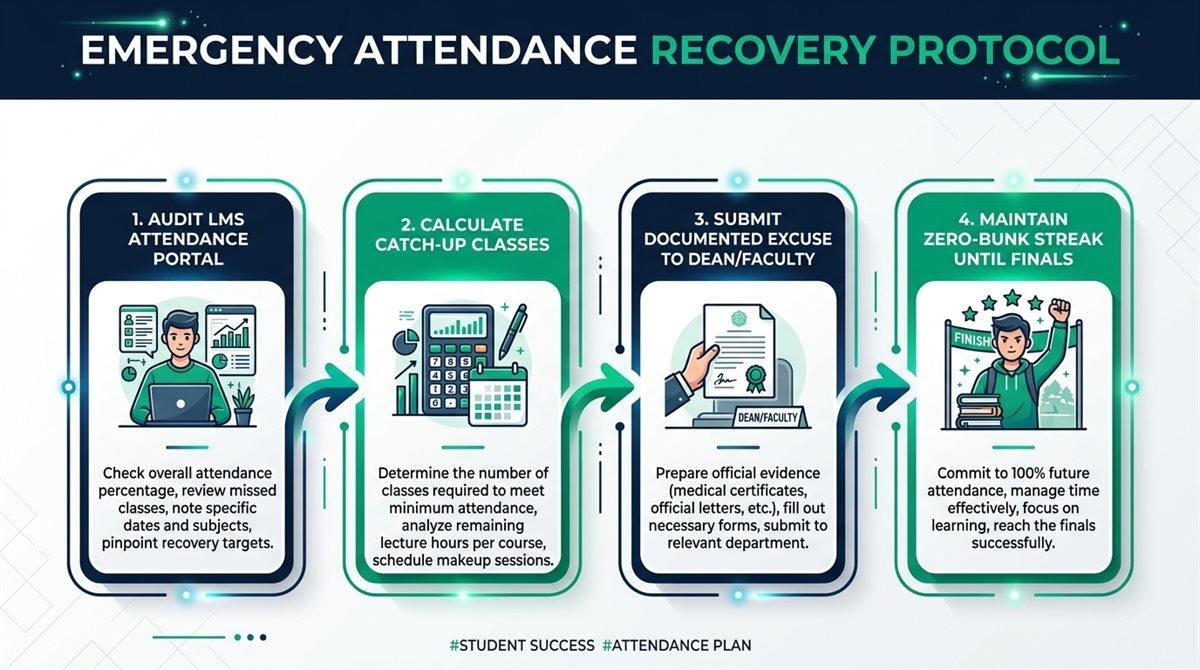
2. The 4 Stages of Disciplinary Escalation When Attendance Drops Below 75%
Universities rarely impose immediate debarment without preceding procedural warnings. When your attendance declines under the college attendance policy below 75 percent, administrative monitoring advances through four distinct escalation phases:
| Attendance Percentage | Official Administrative Status | Institutional Escalation Action | Immediate Student Action Plan |
|---|---|---|---|
| 75.0% – 100% | Safe Zone Clearance | Unrestricted exam hall ticket issued; normal course progression. | Maintain current pace; use safe bunks prudently for exam revision. |
| 70.0% – 74.9% | First Advisory Warning | Automated portal alert sent to student, academic advisor, and department chair. | Halt all unexcused absences immediately; attend consecutive lectures to recover above 75%. |
| 65.0% – 69.9% | Condonation Eligible Zone | Debarment notice generated pending formal submission of medical or emergency proof. | Submit a certified medical condonation petition with physician documentation and dean approval. |
| Below 65.0% | Debarment / Critical Default | Hall ticket blocked; student assigned an administrative failing grade (FA or NF). | Petition for emergency late medical withdrawal (“W”) to avoid GPA devastation, or prepare for course retake. |
3. The Mathematics of Attendance: Safe Bunk vs Catch-Up Formula
Never rely on subjective estimates or rough guesses when managing your attendance. Campus management software and enterprise ERP systems calculate attendance strictly on integer fractions:
Current Attendance % = (Total Classes Attended / Total Classes Held) × 100
Under the operational rules of any standard college attendance policy below 75 percent, two mathematical scenarios determine your day-to-day decisions:
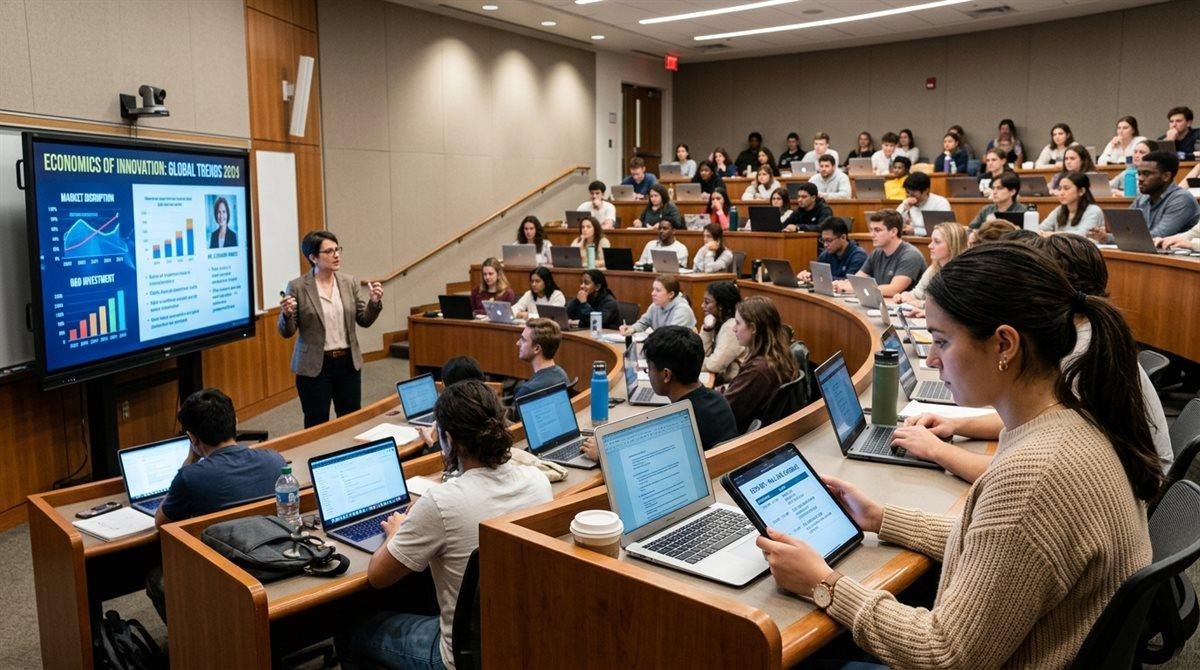
Scenario A: How Many Classes Can You Safely Miss (Safe Bunks)?
If your attendance is comfortably above 75% and you need time off to study for midterms, complete capstone projects, or attend job interviews, use the exact safe bunk formula:
Safe Bunks = Floor[ (Total Attended − (0.75 × Total Held)) / 0.75 ]
Real-World Example: Suppose 40 lectures have taken place so far and you have attended 36 sessions (giving you 90% attendance):
Safe Bunks = [36 − (0.75 × 40)] / 0.75 = (36 − 30) / 0.75 = 6 / 0.75 = 8 classes can be skipped without breaching the 75% attendance threshold.
Scenario B: How Many Consecutive Classes Must You Attend to Recover?
If your attendance has already violated the college attendance policy below 75 percent, every additional missed lecture increases your deficit exponentially. To determine the precise number of upcoming consecutive lectures ($x$) you must attend without missing even one:
Consecutive Classes Needed (x) = Ceiling[ (0.75 × Total Held − Total Attended) / 0.25 ]
Real-World Example: Suppose 50 lectures have been held to date, but you attended only 32 (resulting in a dangerous 64% attendance rate):
Classes Needed = [(0.75 × 50) − 32] / 0.25 = (37.5 − 32) / 0.25 = 5.5 / 0.25 = 22 consecutive classes.
To verify your numbers automatically without manual errors, input your schedule into the interactive Studivaro Attendance Safe Bunk Calculator, which simulates your remaining semester timetable instantly.
4. What is Attendance Condonation and How Does It Work Below 75%?
Attendance Condonation is the formal administrative relief granted by a department head or college dean that excuses an attendance shortage of up to 10%, effectively lowering the examination eligibility threshold from 75% to 65% for qualifying students. Understanding this mechanism is vital when navigating a college attendance policy below 75 percent.
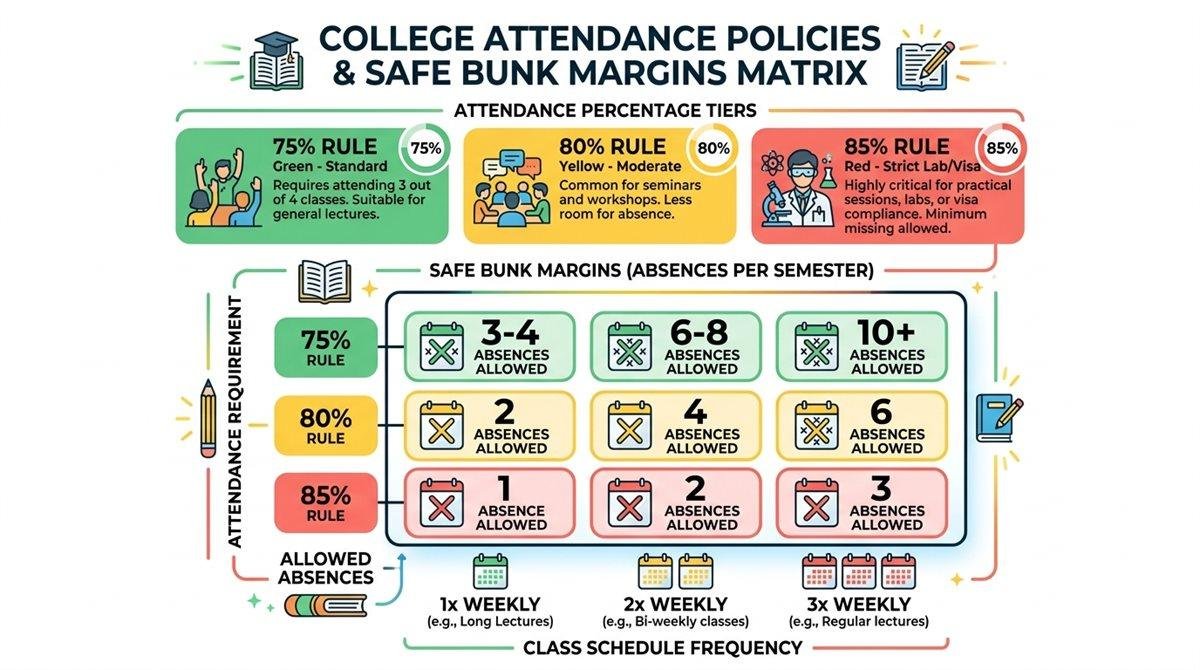
Statutory Grounds for Attendance Condonation
University academic councils evaluate condonation requests against strict documentary standards. The only grounds universally accepted include:
- Medical Hospitalization or Serious Illness: Must be substantiated by official hospital discharge summaries, clinical diagnosis reports, laboratory tests, and a registered physician’s medical fitness certificate. Minor conditions like common colds are routinely rejected. For full requirements, consult our detailed guide on medical leave attendance condonation.
- University-Sanctioned Representation: Active participation in collegiate sports meets, national academic conferences, debate competitions, or accredited campus recruitment drives endorsed by university authorities.
- Family Bereavement: Loss of an immediate family member (parent, sibling, guardian), verified by official notification.
- Statutory Court Summons or Accidents: Formal police documentation for vehicular accidents or legal court appearances.
Important Financial Note on Condonation Fees: Most statutory universities require students to pay an administrative condonation fee (typically between $25 and $100 per course) when submitting extenuating medical claims to offset administrative review and academic board processing costs.
5. Three Ready-to-Send Email Templates to Rescue Your Attendance
When addressing attendance deficits governed by the college attendance policy below 75 percent, communicating promptly and professionally with faculty and administrators is paramount. Use the three tested email templates below:
Template 1: Formal Medical Leave Notification to Professor & Department Chair
Subject: Medical Absence Documentation & Attendance Review – [Your Name] – [Student ID] – [Course Name/Code]

Dear Professor [Professor's Last Name] (and Respected Head of Department),

I am writing to formally submit medical documentation regarding my recent absence from [Course Name, e.g., MATH 201] between [Start Date] and [End Date].

During this period, I was under medical treatment for [Brief Illness Description, e.g., severe influenza / emergency appendectomy] and was advised by my physician to remain on strict bed rest. I have attached the official medical fitness certificate, clinical discharge summary, and prescriptions from Dr. [Doctor's Name], [Hospital/Clinic Name].

Due to these unavoidable health circumstances, my attendance has dropped to [Your Current %]. I respectfully request that these absences be registered as approved medical leave so that my examination eligibility remains protected under institutional condonation bylaws.

I have already caught up on missed lecture notes through classmates and completed all assigned readings for Chapters [X through Y]. Please let me know if there are supplementary assignments or problem sets I can submit.

Thank you very much for your time, consideration, and understanding.

Sincerely,
[Your Full Name]
Student ID: [Your ID Number]
Degree Program & Semester: [e.g., BS Computer Science, Semester 4]
Contact Phone: [Phone Number]
Template 2: Official Attendance Condonation Petition to Academic Dean
Subject: Application for Attendance Condonation – [Your Name] – [Student ID] – Semester [X]

Respected Dean of Academic Affairs,

I am formally submitting this petition for attendance condonation for the current academic term ([Fall/Spring 2026]). My cumulative attendance currently stands at [e.g., 68.5%], falling slightly short of the mandatory 75% standard due to unavoidable medical circumstances.

The attendance deficit occurred between [Date] and [Date] due to [brief reason: severe medical hospitalization / family emergency]. All supporting statutory certificates, clinical summaries, and departmental endorsements are attached to this petition.

I have consistently maintained strong academic standing across all internal evaluations, maintaining a current course average of [e.g., 84% / B+]. Being debarred from final examinations would significantly delay my degree completion and affect my academic trajectory.

I respectfully request your esteemed office to grant condonation for this attendance shortage and authorize my examination admit card. I am prepared to remit the required administrative condonation fee immediately.

Respectfully yours,
[Your Full Name]
Roll / Registration ID: [Your ID]
Department & Program: [Your Department]
Attachments: [Medical_Certificate.pdf, Hospital_Discharge.pdf, Department_Endorsement.pdf]
Template 3: Requesting Make-Up Academic Work from Professor
Subject: Attendance Concern & Make-Up Opportunity Inquiry – [Your Name] – [Course Code]

Dear Professor [Professor's Last Name],

I hope you are having a productive semester. I am writing after noticing during our recent student portal update that my attendance in [Course Name] currently sits at [e.g., 72%].

I deeply value this course and accept full personal accountability for the lectures missed earlier this term due to [brief reason, e.g., unavoidable transport disruptions / work schedule conflicts]. I want to ensure my exam qualification is not compromised.

Could I schedule a brief 5-minute conversation during your office hours this week? I would be extremely grateful for the opportunity to complete an extra research summary, additional problem set, or laboratory write-up to demonstrate my mastery of the missed curriculum.

I have committed to attending every single remaining session this term without exception.

Warm regards,
[Your Full Name]
Student ID: [Your ID Number]
Course Section: [e.g., Section 03, MWF 10:00 AM]
6. What If Condonation Is Rejected? Emergency Damage Control
If your attendance falls below the statutory 65% condonation floor or if your appeal is rejected by the academic board under the college attendance policy below 75 percent, sitting for the semester final exam becomes legally impossible. To protect your degree progress and prevent transcript damage, execute these emergency damage-control procedures immediately:
- File for an Emergency Medical or Late Withdrawal (“W”): An administrative attendance failure (assigned as an “FA” or “F”) factors into your GPA as a 0.0, severely damaging your academic standing. Read our comprehensive analysis on what happens if you fail a class in college. In contrast, an approved “W” withdrawal grade appears on your transcript without penalizing your cumulative GPA.
- Leverage Grade Forgiveness and Retake Policies: If you receive an FA grade, check your university’s retake regulations. Many colleges allow grade replacement where your subsequent retake grade replaces the failing mark in your cumulative GPA calculation. See our complete guide on grade forgiveness and retakes GPA impact.
- Consult the Student Academic Ombudsman: If your attendance records were misstated due to technical errors in biometric readers, RFID card misreads, or substitute instructor reporting errors, lodge a formal attendance discrepancy grievance with the student ombudsman office.
- Compare Cumulative vs Major GPA Ramifications: Understand whether an attendance debarment impacts only your general education GPA or impairs your graduation qualification in your major. Review our breakdown of cumulative GPA vs major GPA differences and rules.
- Plan an Accelerated Summer Course Retake: Register for an intensive 6-week summer or winter intersession to replace the course credit and keep your graduation timeline on schedule.
Frequently Asked Questions (FAQs)
Can a college professor fail you solely for missing classes?
Yes. If the official course syllabus specifies that attendance counts toward the course grade (e.g., 10% to 15% participation weight) or if institutional regulations enforce a college attendance policy below 75 percent for exam qualification, a professor has full academic authority to assign an administrative failing grade (FA) regardless of your exam performance.
What is the difference between an unexcused absence and an excused absence?
An excused absence is officially recognized and validated by the university registrar following submission of verified documentation (such as hospital admission records, court subpoenas, or university-sponsored athletic events). An unexcused absence is any missed class without approved documentation, including personal trips, transit delays, or oversleeping.
Does an attendance debarment (FA grade) affect federal financial aid (FAFSA)?
Yes. Failing a course due to non-attendance directly harms your Satisfactory Academic Progress (SAP) Pace completion rate (which requires passing at least 67% of all attempted credit hours) and lowers your cumulative GPA, which can place you on financial aid probation or suspension under Title IV rules.
How much is a typical university condonation fee?
Condonation fees vary widely by institution. In Commonwealth and Indian universities (such as VTU, Anna University, or Mumbai University), condonation fees typically range between $20 to $80 per paper. In North American and UK colleges, administrative petition review fees range from $50 to $150.
Can medical certificates be submitted after the semester ends?
Almost never. Most universities enforce a strict 3-to-7-day submission window—medical documentation must be deposited with the department office within a few working days of returning to campus. Retrospective medical certificates submitted during final exam week are routinely rejected as fraudulent.
How do I calculate how many classes I need to attend to reach 75%?
Use the formula: Classes Needed = Ceiling[(0.75 × Total Held − Total Attended) / 0.25]. Alternatively, enter your current lecture figures into the Studivaro Attendance Safe Bunk Calculator for immediate, exact results.